Western Regions in the context of "East Turkestan"

Play Trivia Questions online!

or

Skip to study material about Western Regions in the context of "East Turkestan"

Ad spacer

⭐ Core Definition: Western Regions

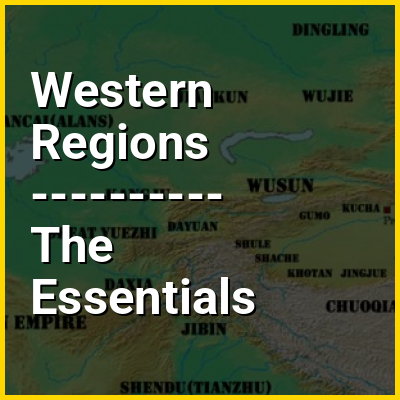
The Western Regions or Xiyu (Hsi-yü; Chinese: 西域) was a historical name specified in Ancient Chinese chronicles between the 3rd century BC to the 8th century AD that referred to the regions west of the Yumen Pass, most often the Tarim Basin in present-day southern Xinjiang (also known as Altishahr) and Central Asia (specifically the easternmost portion around the Ferghana Valley), though it was sometimes used more generally to refer to other regions to the west of China as well, such as Parthia (which technically belonged to West Asia) and Tianzhu (as in the novel Journey to the West, which refers to the Indian subcontinent in South Asia).

Because of their strategic location astride the Silk Road, the Western Regions have been historically significant to China since at least the 3rd century BC.

↓ Menu

>>>PUT SHARE BUTTONS HERE<<<

👉 Western Regions in the context of East Turkestan

East Turkestan or East Turkistan (Uyghur: شەرقىي تۈركىستان, ULY: Sherqiy Türkistan, UKY: Шәрқий Туркистан) is a loosely defined geographical region in the northwestern part of the People's Republic of China, on the cross roads of East and Central Asia. The term was coined in the 19th century by Russian Turkologists, including Nikita Bichurin, who intended the name to replace the common Western term for the region, "Chinese Turkestan", which referred to the Tarim Basin in Southern Xinjiang. Beginning in the 17th century, Altishahr, which means "Six Cities" in Uyghur, became the Uyghur name for the Tarim Basin. Uyghurs also called the Tarim Basin "Yettishar," which means "Seven Cities," and even "Sekkizshahr", which means "Eight Cities" in Uyghur. Chinese dynasties from the Han dynasty to the Tang dynasty had called an overlapping area the "Western Regions".

Starting in the 20th century, the Turkic Muslim Uyghur separatists and their supporters used East Turkestan as an appellation for the whole of Xinjiang (the Tarim Basin and Dzungaria) or for a future independent state in present-day Xinjiang Uyghur Autonomous Region. They reject the name Xinjiang (meaning "New Frontier" in Chinese) because of the Chinese perspective reflected in the name, and prefer East Turkestan to emphasize the connection to other, western Turkic groups.

↓ Explore More Topics
In this Dossier

Western Regions in the context of Jin dynasty (1115–1234)

The Jin dynasty (/ɪn/, Chinese: 金朝; pinyin: Jīn cháo), officially the Great Jin (大金; Dà Jīn), was a Jurchen-led imperial dynasty of China and empire ruled by the Wanyan clan that existed between 1115 and 1234. It is also often called the Jurchen dynasty or the Jurchen Jin after the ruling Jurchen people. At its peak, the empire extended from Outer Manchuria in the north to the Qinling–Huaihe Line in the south.

The Jin dynasty emerged from Wanyan Aguda's rebellion against the Liao dynasty (916–1125), which held sway over northern China until being driven by the nascent Jin to the Western Regions, where they would become known in Chinese historiography as the Western Liao. After conquering the Liao territory, the Jin launched a century-long campaign against the Song dynasty (960–1279) based in southern China, whose rulers were ethnically Han Chinese. Over the course of the Jin's rule, their emperors adapted to Han customs and even fortified the Great Wall against the ascendant Mongol Empire. The Jin also oversaw a number of internal cultural advances, such as the revival of Confucianism.

↑ Return to Menu

Western Regions in the context of Emperor Wu of Han

Emperor Wu of Han (156 – 29 March 87 BC), personal name Liu Che and courtesy name Tong, was the seventh emperor of the Han dynasty from 141 to 87 BC. His reign lasted 54 years – a record not broken until the reign of the Kangxi Emperor more than 1,800 years later – and remains the record for ethnic Han emperors. His reign resulted in a vast expansion of geopolitical influence for the Chinese civilization, and the development of a strong centralized state via governmental policies, economical reorganization and promotion of a hybrid LegalistConfucian doctrine. In the field of historical social and cultural studies, Emperor Wu is known for his religious innovations and patronage of the poetic and musical arts, including the development of the Imperial Music Bureau into a prestigious entity. It was also during his reign that cultural contact with western Eurasia was greatly increased, directly and indirectly.

During his reign, Emperor Wu led the Han dynasty through its greatest territorial expansion. At its height, the Empire's borders spanned from the Fergana Valley in the west, to northern Korea in the east, and to northern Vietnam in the south. Emperor Wu successfully repelled the nomadic Xiongnu from systematically raiding northern China, and dispatched his envoy Zhang Qian into the Western Regions in 139 BC to seek an alliance with the Greater Yuezhi and Kangju, which resulted in further diplomatic missions to Central Asia. Although historical records do not describe him as being aware of Buddhism, emphasizing rather his interest in shamanism, the cultural exchanges that occurred as a consequence of these embassies suggest that he received Buddhist statues from Central Asia, as depicted in the murals found in the Mogao Caves.
↑ Return to Menu

Western Regions in the context of Protectorate of the Western Regions

The Protectorate of the Western Regions (simplified Chinese: 西域都护府; traditional Chinese: 西域都護府; pinyin: Xīyù Dūhù Fǔ; Wade–Giles: Hsi-yü Tu-hu Fu) was an imperial administration (a protectorate) situated in the Western Regions administered by Han dynasty China and its successors on and off from 59 or 60 BCE until the end of the Sixteen Kingdoms period in 439 AD. The "Western Regions" refers to areas west of Yumen Pass, especially the Tarim Basin in southern Xinjiang. These areas would later be termed Altishahr (southern Xinjiang, excluding Dzungaria) by Turkic-speaking peoples. The term "western regions" was also used by the Chinese more generally to refer to Central Asia.

The protectorate was the first direct rule by a Chinese government of the area. It consisted of various vassal states and Han garrisons placed under the authority of a protector-general of the Western Regions, who was appointed by the Han court.

↑ Return to Menu

Western Regions in the context of Northern Silk Road

The Northern Silk Road is a historic inland trade route in Northwest China and Central Asia (historically known as the Western Regions), originating in the ancient Chinese capital of Chang'an (modern day Xi'an), westwards through the Hexi Corridor (in what is the modern Gansu province) into the Tarim Basin, going around north of the Taklamakan Desert along the two sides of the Tianshan Mountains, and then past the Pamir Mountains to reach the ancient kingdoms of Bactria, Sogdia, Kushan, Parthia and eventually the eastern provinces of the Roman Empire. It is the northernmost branch of the several Silk Roads providing trade, cultural exchanges and military mobilizations between China and the outside world.

The route was first developed by the Han dynasty in the latter part of the 1st century BC to secure diplomatic alliance against the Xiongnu confederacy, with whom China had been having escalating conflicts, and was progressively transformed into a major trade route during the subsequent dynasties to project Chinese influence towards the west.

↑ Return to Menu

Western Regions in the context of Yumen Pass

Yumen Pass (simplified Chinese: 玉门; traditional Chinese: 玉門; pinyin: Yùmén Guān; Uyghur: قاش قوۋۇق, Qash Qowuq), or Jade Gate or Pass of the Jade Gate, is the name of a pass of the Great Wall located west of Dunhuang in today's Gansu Province of China. During the Han dynasty (202 BC – AD 220), this was a pass through which the Silk Road passed, and was the one road connecting Central Asia with East Asia (China), the former called the Western Regions. Just to the south was the Yangguan pass, which was also an important point on the Silk Road. These passes, along with other sites along the Silk Road, were inscribed in 2014 on the UNESCO World Heritage List as the Silk Roads: the Routes Network of Chang'an-Tianshan Corridor World Heritage Site. The pass is at an elevation of 1400 meters.

↑ Return to Menu

Western Regions in the context of Bodhidharma

Bodhidharma was a semi-legendary Buddhist monk who lived during the 5th or 6th century CE. He is traditionally credited as the transmitter of Chan Buddhism to China, and is regarded as its first Chinese patriarch. He is also popularly regarded as the founder of Shaolin kung fu, an idea popularized in the 20th century, but based on the 17th century Yijin Jing and the Daoist association of daoyin gymnastics with Bodhidharma.

Little contemporary biographical information on Bodhidharma exists, and subsequent accounts are layered with legend and unreliable details. According to the principal Chinese sources, Bodhidharma came from the Western Regions, which typically refers to Central Asia but can also include the Indian subcontinent. He is described as either a "Persian Central Asian" or a "South Indian [...] the third son of a great Indian king." Aside from the Chinese accounts, several popular traditions also exist regarding Bodhidharma's origins. Throughout Buddhist art, Bodhidharma is depicted as an ill-tempered, large-nosed, profusely bearded, wide-eyed non-Chinese person.

↑ Return to Menu