Wave vector in the context of Reciprocal lattice


Wave vector in the context of Reciprocal lattice

Wave vector Study page number 1 of 1

Play TriviaQuestions Online!

or

Skip to study material about Wave vector in the context of "Reciprocal lattice"


HINT:

👉 Wave vector in the context of Reciprocal lattice

Reciprocal lattice is a concept associated with solids with translational symmetry which plays a major role in many areas such as X-ray and electron diffraction as well as the energies of electrons in a solid. It emerges from the Fourier transform of the lattice associated with the arrangement of the atoms. The direct lattice or real lattice is a periodic function in physical space, such as a crystal system (usually a Bravais lattice). The reciprocal lattice exists in the mathematical space of spatial frequencies or wavenumbers k, known as reciprocal space or k space; it is the dual of physical space considered as a vector space. In other words, the reciprocal lattice is the sublattice which is dual to the direct lattice.

The reciprocal lattice is the set of all vectors , that are wavevectors k of plane waves in the Fourier series of a spatial function whose periodicity is the same as that of a direct lattice . Each plane wave in this Fourier series has the same phase or phases that are differed by multiples of , at each direct lattice point (so essentially same phase at all the direct lattice points).

↓ Explore More Topics
In this Dossier

Wave vector in the context of Wavenumber

In the physical sciences, the wavenumber (or wave number), also known as repetency, is the spatial frequency of a wave. Ordinary wavenumber is defined as the number of wave cycles divided by length; it is a physical quantity with dimension of reciprocal length, expressed in SI units of cycles per metre or reciprocal metre (m). Angular wavenumber, defined as the wave phase divided by time, is a quantity with dimension of angle per length and SI units of radians per metre. They are analogous to temporal frequency, respectively the ordinary frequency, defined as the number of wave cycles divided by time (in cycles per second or reciprocal seconds), and the angular frequency, defined as the phase angle divided by time (in radians per second).

In multidimensional systems, the wavenumber is the magnitude of the wave vector. The space of wave vectors is called reciprocal space. Wave numbers and wave vectors play an essential role in optics and the physics of wave scattering, such as X-ray diffraction, neutron diffraction, electron diffraction, and elementary particle physics. For quantum mechanical waves, the wavenumber multiplied by the reduced Planck constant is the canonical momentum.

View the full Wikipedia page for Wavenumber
↑ Return to Menu

Wave vector in the context of Laue equations

In crystallography and solid state physics, the Laue equations relate incoming waves to outgoing waves in the process of elastic scattering, where the photon energy or light temporal frequency does not change upon scattering by a crystal lattice. They are named after physicist Max von Laue (1879–1960).

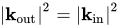
The Laue equations can be written as as the condition of elastic wave scattering by a crystal lattice, where is the scattering vector, , are incoming and outgoing wave vectors (to the crystal and from the crystal, by scattering), and is a crystal reciprocal lattice vector. Due to elastic scattering , three vectors. , , and , form a rhombus if the equation is satisfied. If the scattering satisfies this equation, all the crystal lattice points scatter the incoming wave toward the scattering direction (the direction along ). If the equation is not satisfied, then for any scattering direction, only some lattice points scatter the incoming wave. (This physical interpretation of the equation is based on the assumption that scattering at a lattice point is made in a way that the scattering wave and the incoming wave have the same phase at the point.) It also can be seen as the conservation of momentum as since is the wave vector for a plane wave associated with parallel crystal lattice planes. (Wavefronts of the plane wave are coincident with these lattice planes.)

View the full Wikipedia page for Laue equations
↑ Return to Menu