Reciprocal lattice in the context of Wave vector


Reciprocal lattice in the context of Wave vector

Reciprocal lattice Study page number 1 of 1

Play TriviaQuestions Online!

or

Skip to study material about Reciprocal lattice in the context of "Wave vector"


⭐ Core Definition: Reciprocal lattice

Reciprocal lattice is a concept associated with solids with translational symmetry which plays a major role in many areas such as X-ray and electron diffraction as well as the energies of electrons in a solid. It emerges from the Fourier transform of the lattice associated with the arrangement of the atoms. The direct lattice or real lattice is a periodic function in physical space, such as a crystal system (usually a Bravais lattice). The reciprocal lattice exists in the mathematical space of spatial frequencies or wavenumbers k, known as reciprocal space or k space; it is the dual of physical space considered as a vector space. In other words, the reciprocal lattice is the sublattice which is dual to the direct lattice.

The reciprocal lattice is the set of all vectors , that are wavevectors k of plane waves in the Fourier series of a spatial function whose periodicity is the same as that of a direct lattice . Each plane wave in this Fourier series has the same phase or phases that are differed by multiples of , at each direct lattice point (so essentially same phase at all the direct lattice points).

↓ Menu
HINT:

In this Dossier

Reciprocal lattice in the context of Miller index

Miller indices form a notation system in crystallography for lattice planes in crystal (Bravais) lattices.

In particular, a family of lattice planes of a given (direct) Bravais lattice is determined by three integers h, k, and , the Miller indices. They are written (hkℓ), and denote the family of (parallel) lattice planes (of the given Bravais lattice) orthogonal to , where are the basis or primitive translation vectors of the reciprocal lattice for the given Bravais lattice. (Note that the plane is not always orthogonal to the linear combination of direct or original lattice vectors because the direct lattice vectors need not be mutually orthogonal.) This is based on the fact that a reciprocal lattice vector (the vector indicating a reciprocal lattice point from the reciprocal lattice origin) is the wavevector of a plane wave in the Fourier series of a spatial function (e.g., electronic density function) which periodicity follows the original Bravais lattice, so wavefronts of the plane wave are coincident with parallel lattice planes of the original lattice. Since a measured scattering vector in X-ray crystallography, with as the outgoing (scattered from a crystal lattice) X-ray wavevector and as the incoming (toward the crystal lattice) X-ray wavevector, is equal to a reciprocal lattice vector as stated by the Laue equations, the measured scattered X-ray peak at each measured scattering vector is marked by Miller indices.

View the full Wikipedia page for Miller index
↑ Return to Menu

Reciprocal lattice in the context of Hexagonal lattice

The hexagonal lattice (sometimes called triangular lattice) is one of the five two-dimensional Bravais lattice types. The symmetry category of the lattice is wallpaper group p6m. The primitive translation vectors of the hexagonal lattice form an angle of 120° and are of equal lengths,

The reciprocal lattice of the hexagonal lattice is a hexagonal lattice in reciprocal space with orientation changed by 90° and primitive lattice vectors of length

View the full Wikipedia page for Hexagonal lattice
↑ Return to Menu

Reciprocal lattice in the context of Kikuchi lines (physics)

Kikuchi lines are patterns of electrons formed by scattering. They pair up to form bands in electron diffraction from single crystal specimens, there to serve as "roads in orientation-space" for microscopists uncertain of what they are looking at. In transmission electron microscopes, they are easily seen in diffraction from regions of the specimen thick enough for multiple scattering. Unlike diffraction spots, which blink on and off as one tilts the crystal, Kikuchi bands mark orientation space with well-defined intersections (called zones or poles) as well as paths connecting one intersection to the next.

Experimental and theoretical maps of Kikuchi band geometry, as well as their direct-space analogs e.g. bend contours, electron channeling patterns, and fringe visibility maps are increasingly useful tools in electron microscopy of crystalline and nanocrystalline materials. Because each Kikuchi line is associated with Bragg diffraction from one side of a single set of lattice planes, these lines can be labeled with the same Miller or reciprocal-lattice indices that are used to identify individual diffraction spots. Kikuchi band intersections, or zones, on the other hand are indexed with direct-lattice indices i.e. indices which represent integer multiples of the lattice basis vectors a, b and c.

View the full Wikipedia page for Kikuchi lines (physics)
↑ Return to Menu

Reciprocal lattice in the context of Laue equations

In crystallography and solid state physics, the Laue equations relate incoming waves to outgoing waves in the process of elastic scattering, where the photon energy or light temporal frequency does not change upon scattering by a crystal lattice. They are named after physicist Max von Laue (1879–1960).

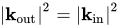
The Laue equations can be written as as the condition of elastic wave scattering by a crystal lattice, where is the scattering vector, , are incoming and outgoing wave vectors (to the crystal and from the crystal, by scattering), and is a crystal reciprocal lattice vector. Due to elastic scattering , three vectors. , , and , form a rhombus if the equation is satisfied. If the scattering satisfies this equation, all the crystal lattice points scatter the incoming wave toward the scattering direction (the direction along ). If the equation is not satisfied, then for any scattering direction, only some lattice points scatter the incoming wave. (This physical interpretation of the equation is based on the assumption that scattering at a lattice point is made in a way that the scattering wave and the incoming wave have the same phase at the point.) It also can be seen as the conservation of momentum as since is the wave vector for a plane wave associated with parallel crystal lattice planes. (Wavefronts of the plane wave are coincident with these lattice planes.)

View the full Wikipedia page for Laue equations
↑ Return to Menu