
- ⭐ Core Definition: Velocity
- Velocity in the context of Galileo Galilei
- Velocity in the context of Motion
- Velocity in the context of Statics
- Velocity in the context of Force
- Velocity in the context of Accelerating expansion of the universe
- Velocity in the context of Magnetic field
- Velocity in the context of Mass
- Velocity in the context of Time dilation
- Velocity in the context of Relativistic speed
- Velocity in the context of Gravity of Earth
- Velocity in the context of Seismic wave
- Velocity in the context of Helium nuclei
- Velocity in the context of Derivative
- Velocity in the context of Lorentz transformation
- Velocity in the context of Inertia
- Velocity in the context of Three-body problem
Velocity in the context of Galileo Galilei
Galileo di Vincenzo Bonaiuti de' Galilei (15 February 1564 – 8 January 1642), commonly referred to as Galileo Galilei (/ˌɡælɪˈleɪoʊ ˌɡælɪˈleɪ/ GAL-il-AY-oh GAL-il-AY, US also /ˌɡælɪˈliːoʊ -/ GAL-il-EE-oh -, Italian: [ɡaliˈlɛːo ɡaliˈlɛi]) or mononymously as Galileo, was an Italian astronomer, physicist, and engineer, sometimes described as a polymath. He was born in the city of Pisa, then part of the Duchy of Florence. Galileo has been called the father of observational astronomy, modern-era classical physics, the scientific method, and modern science.
Galileo studied speed and velocity, gravity and free fall, the principle of relativity, inertia, projectile motion, and also worked in applied science and technology, describing the properties of the pendulum and "hydrostatic balances". He was one of the earliest Renaissance developers of the thermoscope and the inventor of various military compasses. With an improved telescope he built, he observed the stars of the Milky Way, the phases of Venus, the four largest satellites of Jupiter, Saturn's rings, lunar craters, and sunspots. He also built an early microscope.
View the full Wikipedia page for Galileo GalileiVelocity in the context of Motion
In physics, motion is when an object changes its position with respect to a reference point in a given time. Motion is mathematically described in terms of displacement, distance, velocity, acceleration, speed, and frame of reference to an observer, measuring the change in position of the body relative to that frame with a change in time. The branch of physics describing the motion of objects without reference to their cause is called kinematics, while the branch studying forces and their effect on motion is called dynamics.
If an object is not in motion relative to a given frame of reference, it is said to be at rest, motionless, immobile, stationary, or to have a constant or time-invariant position with reference to its surroundings. Modern physics holds that, as there is no absolute frame of reference, Isaac Newton's concept of absolute motion cannot be determined. Everything in the universe can be considered to be in motion.
View the full Wikipedia page for MotionVelocity in the context of Statics
Statics is the branch of classical mechanics that is concerned with the analysis of force and torque acting on a physical system that does not experience an acceleration, but rather is in equilibrium with its environment.
If is the total of the forces acting on the system, is the mass of the system and is the acceleration of the system, Newton's second law states that (the bold font indicates a vector quantity, i.e. one with both magnitude and direction). If , then . As for a system in static equilibrium, the acceleration equals zero, the system is either at rest, or its center of mass moves at constant velocity.
View the full Wikipedia page for Statics


Velocity in the context of Force
In physics, a force is an action (usually a push or a pull) that can cause an object to change its velocity or its shape, or to resist other forces, or to cause changes of pressure in a fluid. In mechanics, force makes ideas like 'pushing' or 'pulling' mathematically precise. Because the magnitude and direction of a force are both important, force is a vector quantity (force vector). The SI unit of force is the newton (N), and force is often represented by the symbol F.
Force plays an important role in classical mechanics. The concept of force is central to all three of Newton's laws of motion. Types of forces often encountered in classical mechanics include elastic, frictional, contact or "normal" forces, and gravitational. The rotational version of force is torque, which produces changes in the rotational speed of an object. In an extended body, each part applies forces on the adjacent parts; the distribution of such forces through the body is the internal mechanical stress. In the case of multiple forces, if the net force on an extended body is zero the body is in equilibrium.
View the full Wikipedia page for ForceVelocity in the context of Accelerating expansion of the universe
Observations show that the expansion of the universe is accelerating, such that the velocity at which a distant galaxy recedes from the observer is continuously increasing with time. The accelerated expansion of the universe was discovered in 1998 by two independent projects, the Supernova Cosmology Project and the High-Z Supernova Search Team, which used distant type Ia supernovae to measure the acceleration. The idea was that as type Ia supernovae have almost the same intrinsic brightness (a standard candle), and since objects that are further away appear dimmer, the observed brightness of these supernovae can be used to measure the distance to them. The distance can then be compared to the supernovae's cosmological redshift, which measures how much the universe has expanded since the supernova occurred; the Hubble law established that the further away an object is, the faster it is receding. The unexpected result was that objects in the universe are moving away from one another at an accelerating rate. Cosmologists at the time expected that recession velocity would always be decelerating, due to the gravitational attraction of the matter in the universe. Three members of these two groups have subsequently been awarded Nobel Prizes for their discovery. Confirmatory evidence has been found in baryon acoustic oscillations, and in analyses of the clustering of galaxies.
The accelerated expansion of the universe is thought to have begun since the universe entered its dark-energy-dominated era roughly 5 billion years ago.Within the framework of general relativity, an accelerated expansion can be accounted for by a positive value of the cosmological constant Λ, equivalent to the presence of a positive vacuum energy, dubbed "dark energy". While there are alternative possible explanations, the description assuming dark energy (positive Λ) is used in the standard model of cosmology, which also includes cold dark matter (CDM) and is known as the Lambda-CDM model.
View the full Wikipedia page for Accelerating expansion of the universeVelocity in the context of Magnetic field
A magnetic field (sometimes called B-field) is a physical field that describes the magnetic influence on moving electric charges, electric currents, and magnetic materials. A moving charge in a magnetic field experiences a force perpendicular to its own velocity and to the magnetic field. A permanent magnet's magnetic field pulls on ferromagnetic materials such as iron, and attracts or repels other magnets. In addition, a nonuniform magnetic field exerts minuscule forces on "nonmagnetic" materials by three other magnetic effects: paramagnetism, diamagnetism, and antiferromagnetism, although these forces are usually so small they can only be detected by laboratory equipment. Magnetic fields surround magnetized materials, electric currents, and electric fields varying in time. Since both strength and direction of a magnetic field may vary with location, it is described mathematically by a function assigning a vector to each point of space, called a vector field (more precisely, a pseudovector field).
View the full Wikipedia page for Magnetic fieldVelocity in the context of Mass
Mass is an intrinsic property of a body. It was traditionally believed to be related to the quantity of matter in a body, until the discovery of the atom and particle physics. It was found that different atoms and different elementary particles, theoretically with the same amount of matter, have nonetheless different masses. Mass in modern physics has multiple definitions which are conceptually distinct, but physically equivalent. Mass can be experimentally defined as a measure of the body's inertia, meaning the resistance to acceleration (change of velocity) when a net force is applied. The object's mass also determines the strength of its gravitational attraction to other bodies.
The SI base unit of mass is the kilogram (kg). In physics, mass is not the same as weight, even though mass is often determined by measuring the object's weight using a spring scale, rather than balance scale comparing it directly with known masses. An object on the Moon would weigh less than it does on Earth because of the lower gravity, but it would still have the same mass. This is because weight is a force, while mass is the property that (along with gravity) determines the strength of this force.
View the full Wikipedia page for MassVelocity in the context of Time dilation
Time dilation is the difference in elapsed time as measured by two clocks, either because of a relative velocity between them (special relativity), or a difference in gravitational potential between their locations (general relativity). When unspecified, "time dilation" usually refers to the effect due to velocity. The dilation compares "wristwatch" clock readings between events measured in different inertial frames and is not observed by visual comparison of clocks across moving frames.
These predictions of the theory of relativity have been repeatedly confirmed by experiment, and they are of practical concern, for instance in the operation of satellite navigation systems such as GPS and Galileo.
View the full Wikipedia page for Time dilationVelocity in the context of Relativistic speed
Relativistic speed refers to speed at which relativistic effects become significant to the desired accuracy of measurement of the phenomenon being observed. Relativistic effects are those discrepancies between values calculated by models considering and not considering relativity. Related words are velocity, rapidity, and celerity which is proper velocity. Speed is a scalar, being the magnitude of the velocity vector which in relativity is the four-velocity and in three-dimension Euclidean space a three-velocity. Speed is empirically measured as average speed, although current devices in common use can estimate speed over very small intervals and closely approximate instantaneous speed. Non-relativistic discrepancies include cosine error which occurs in speed detection devices when only one scalar component of the three-velocity is measured and the Doppler effect which may affect observations of wavelength and frequency.
Relativistic effects are highly non-linear and for everyday purposes are insignificant because the Newtonian model closely approximates the relativity model. In special relativity the Lorentz factor is a measure of time dilation, length contraction and the relativistic mass increase of a moving object.
View the full Wikipedia page for Relativistic speedVelocity in the context of Gravity of Earth
The gravity of Earth, denoted by g, is the net acceleration that is imparted to objects due to the combined effect of gravitation (from mass distribution within Earth) and the centrifugal force (from the Earth's rotation).It is a vector quantity, whose direction coincides with a plumb bob and strength or magnitude is given by the norm .

In SI units, this acceleration is expressed in metres per second squared (in symbols, m/s or m·s) or equivalently in newtons per kilogram (N/kg or N·kg). Near Earth's surface, the acceleration due to gravity, accurate to 2 significant figures, is 9.8 m/s (32 ft/s). This means that, ignoring the effects of air resistance, the vertical component of velocity of an object falling freely will increase in the downwards direction by about 9.8 metres per second (32 ft/s) every second.
View the full Wikipedia page for Gravity of EarthVelocity in the context of Seismic wave
A seismic wave is a mechanical wave of acoustic energy that travels through the Earth or another planetary body. It can result from an earthquake (or generally, a quake), volcanic eruption, magma movement, a large landslide and a large man-made explosion that produces low-frequency acoustic energy. Seismic waves are studied by seismologists, who record the waves using seismometers, hydrophones (in water), or accelerometers. Seismic waves are distinguished from seismic noise (ambient vibration), which is persistent low-amplitude vibration arising from a variety of natural and anthropogenic sources.
The propagation velocity of a seismic wave depends on density and elasticity of the medium as well as the type of wave. Velocity tends to increase with depth through Earth's crust and mantle, but drops sharply going from the mantle to Earth's outer core.
View the full Wikipedia page for Seismic waveVelocity in the context of Helium nuclei
Alpha particles, also called alpha rays or alpha radiation, consist of two protons and two neutrons bound together into a particle identical to the nucleus of a helium-4 atom. They are generally produced in the process of alpha decay but may also be produced in different ways. Alpha particles are named after the first letter in the Greek alphabet, α. The symbol for the alpha particle is α or α. Because they are identical to helium nuclei, they are also sometimes written as He or
2He indicating a helium ion with a +2 charge (missing its two electrons). Once the ion gains electrons from its environment, the alpha particle becomes a normal (electrically neutral) helium atom
2He.
Alpha particles have a net spin of zero. When produced in standard alpha radioactive decay, alpha particles generally have a kinetic energy of about 5 MeV and a velocity in the vicinity of 4% of the speed of light. They are a highly ionizing form of particle radiation, with low penetration depth (stopped by a few centimetres of air, or by the skin).
View the full Wikipedia page for Helium nucleiVelocity in the context of Derivative
In mathematics, the derivative is a fundamental tool that quantifies the sensitivity to change of a function's output with respect to its input. The derivative of a function of a single variable at a chosen input value, when it exists, is the slope of the tangent line to the graph of the function at that point. The tangent line is the best linear approximation of the function near that input value. The derivative is often described as the instantaneous rate of change, the ratio of the instantaneous change in the dependent variable to that of the independent variable. The process of finding a derivative is called differentiation.
There are multiple different notations for differentiation. Leibniz notation, named after Gottfried Wilhelm Leibniz, is represented as the ratio of two differentials, whereas prime notation is written by adding a prime mark. Higher order notations represent repeated differentiation, and they are usually denoted in Leibniz notation by adding superscripts to the differentials, and in prime notation by adding additional prime marks. Higher order derivatives are used in physics; for example, the first derivative with respect to time of the position of a moving object is its velocity, and the second derivative is its acceleration.
View the full Wikipedia page for DerivativeVelocity in the context of Lorentz transformation
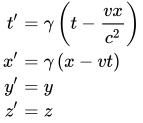
In physics, the Lorentz transformations are a six-parameter family of linear transformations from a coordinate frame in spacetime to another frame that moves at a constant velocity relative to the former. The respective inverse transformation is then parameterized by the negative of this velocity. The transformations are named after the Dutch physicist Hendrik Lorentz.
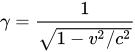
The most common form of the transformation, parametrized by the real constant representing a velocity confined to the x-direction, is expressed aswhere (t, x, y, z) and (t′, x′, y′, z′) are the coordinates of an event in two frames with the spatial origins coinciding at t = t′ = 0, where the primed frame is seen from the unprimed frame as moving with speed v along the x-axis, where c is the speed of light, and is the Lorentz factor. When speed v is much smaller than c, the Lorentz factor is negligibly different from 1, but as v approaches c, grows without bound. The value of v must be smaller than c for the transformation to make sense.
View the full Wikipedia page for Lorentz transformation

Velocity in the context of Inertia
Inertia is the natural tendency of objects in motion to stay in motion and objects at rest to stay at rest, unless a force causes its velocity to change. It is one of the fundamental principles in classical physics, and described by Isaac Newton in his first law of motion (also known as The Principle of Inertia). It is one of the primary manifestations of mass, one of the core quantitative properties of physical systems. Newton writes:
In his 1687 work Philosophiæ Naturalis Principia Mathematica, Newton defined inertia as a property:
View the full Wikipedia page for InertiaVelocity in the context of Three-body problem
In physics, specifically classical mechanics, the three-body problem is to take the initial positions and velocities (or momenta) of three point masses orbiting each other in space and then to calculate their subsequent trajectories using Newton's laws of motion and Newton's law of universal gravitation.
Unlike the two-body problem, the three-body problem has no general closed-form solution, meaning there is no explicit formula for the positions of the bodies. When three bodies orbit each other, the resulting dynamical system is chaotic for most initial conditions, and the only way to predict the motions of the bodies is to estimate them using numerical methods.
View the full Wikipedia page for Three-body problem