Veld in the context of "Karoo desert"

Play Trivia Questions online!

or

Skip to study material about Veld in the context of "Karoo desert"


⭐ Core Definition: Veld

Veld (/vɛlt/ or /fɛlt/, Afrikaans and Dutch: veld, field), also spelled veldt, is a type of wide-open, rural landscape in Southern Africa. Particularly, it is a flat area covered in grass or low scrub, especially in the countries of South Africa, Namibia, Lesotho, Eswatini, Zimbabwe, and Botswana. A certain subtropical woodland ecoregion of Southern Africa has been officially defined as the Bushveld by the World Wide Fund for Nature. Trees are not abundant; frost, fire, and grazing animals allow grass to grow, but prevent the build-up of dense foliage.

↓ Menu

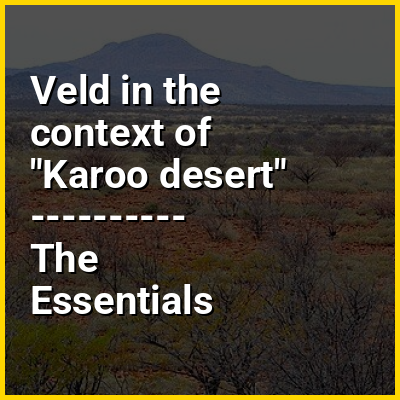
👉 Veld in the context of Karoo desert

The Karoo (/kəˈruə/ kə-ROO; from Khoikhoi (also known as Khoekhoegowab/Namagowab or Hottentot language) word Karo (Korana for 'Hardveld')) is a semidesert natural region of South Africa. No exact definition of what constitutes the Karoo is available, so its extent is also not precisely defined. The Karoo is partly defined by its topography, geology and climate, and above all, its low rainfall, arid air, cloudless skies, and extremes of heat and cold. The Karoo also hosted a well-preserved ecosystem hundreds of millions of years ago which is now represented by many fossils.

The Karoo formed an almost impenetrable barrier to the interior from Cape Town, and the early adventurers, explorers, hunters, and travelers on the way to the Highveld unanimously denounced it as a frightening place of great heat, great frosts, great floods, and great droughts. Today, it is still a place of great heat and frosts, and an annual rainfall of between 50 and 250 mm (2.0–9.8 in), though on some of the mountains it can be 250 to 500 mm (9.8–19.7 in) higher than on the plains. However, underground water is found throughout the Karoo, which can be tapped by boreholes, making permanent settlements and sheep farming possible.

↓ Explore More Topics
In this Dossier

Veld in the context of Temperate grasslands, savannas, and shrublands

Temperate grasslands, savannas, and shrublands are terrestrial biomes defined by the World Wide Fund for Nature. The predominant vegetation in these biomes consists of grass and/or shrubs. The climate is temperate and ranges from semi-arid to semi-humid. The habitat type differs from tropical grasslands in the annual temperature regime and the types of species found here.

The habitat type is known as prairie in North America, pampas in South America, veld in Southern Africa and steppe in Asia. Generally speaking, these regions are devoid of trees, except for riparian or gallery forests associated with streams and rivers.

↑ Return to Menu

Veld in the context of Ecological disturbance

In ecology, a disturbance is a change in environmental conditions that causes a pronounced change in an ecosystem. Disturbances often act quickly and with great effect, to alter the physical structure or arrangement of biotic and abiotic elements. A disturbance can also occur over a long period of time and can impact the biodiversity within an ecosystem. Ecological disturbances include fires, flooding, storms, insect outbreaks, trampling, human presence, earthquakes, plant diseases, infestations, volcanic eruptions, impact events, etc.

Not only invasive species can have a profound effect on an ecosystem, native species can also cause disturbance by their behavior. Disturbance forces can have profound immediate effects on ecosystems and can, accordingly, greatly alter the natural community’s population size or species richness. Because of these and the impacts on populations, disturbance determines the future shifts in dominance, various species successively becoming dominant as their life history characteristics, and associated life-forms, are exhibited over time.

↑ Return to Menu