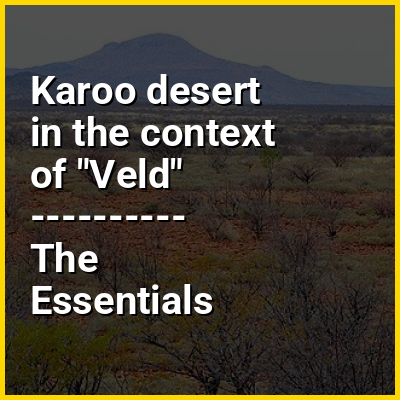
The Karoo (/kəˈruə/ kə-ROO-ə; from Khoikhoi (also known as Khoekhoegowab/Namagowab or Hottentot language) word Karo (Korana for 'Hardveld')) is a semidesert natural region of South Africa. No exact definition of what constitutes the Karoo is available, so its extent is also not precisely defined. The Karoo is partly defined by its topography, geology and climate, and above all, its low rainfall, arid air, cloudless skies, and extremes of heat and cold. The Karoo also hosted a well-preserved ecosystem hundreds of millions of years ago which is now represented by many fossils.
The Karoo formed an almost impenetrable barrier to the interior from Cape Town, and the early adventurers, explorers, hunters, and travelers on the way to the Highveld unanimously denounced it as a frightening place of great heat, great frosts, great floods, and great droughts. Today, it is still a place of great heat and frosts, and an annual rainfall of between 50 and 250 mm (2.0–9.8 in), though on some of the mountains it can be 250 to 500 mm (9.8–19.7 in) higher than on the plains. However, underground water is found throughout the Karoo, which can be tapped by boreholes, making permanent settlements and sheep farming possible.