Unification of Nepal in the context of "Nepal"

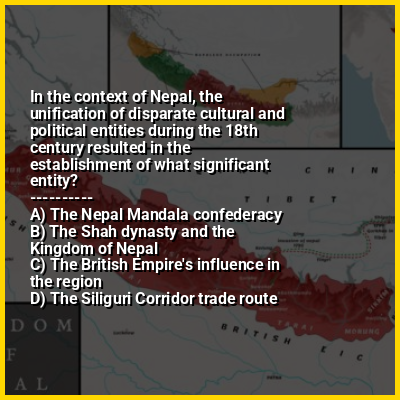
⭐ In the context of Nepal, the unification of disparate cultural and political entities during the 18th century resulted in the establishment of what significant entity?

Ad spacer

⭐ Core Definition: Unification of Nepal

The unification of Nepal (Nepali: नेपालको एकीकरण, romanized: Nēpālakō ēkīkaraṇa) was the process of building the modern Nepalese state, by invading fractured Malla kingdoms including the Baise Rajya's 22 kingdoms and the Chaubisi Rajya's 24 kingdoms. It began in 1743 CE (1799 BS), by Prithvi Narayan Shah, King of Gorkha. On 25 September 1768, he officially announced the creation of the Kingdom of Nepal and moved his capital from Gorkha to a city in Kathmandu Valley.

The Shah dynasty that Prithvi Narayan Shah founded would go on to absorb the various warring Malla kingdoms that once occupied parts of present-day Nepal into a nation-state that stretched up to the Sutlej River in the west and Sikkim-Jalpaiguri in the east. Before the Gorkha Empire, the Kathmandu Valley was known as Nepal after the Nepal Mandala, the region's name in Newar language.

↓ Menu

>>>PUT SHARE BUTTONS HERE<<<

👉 Unification of Nepal in the context of Nepal

Nepal, officially the Federal Democratic Republic of Nepal, is a landlocked country in South Asia. It is mainly situated in the Himalayas, but also includes parts of the Indo-Gangetic Plain. It borders the Tibet Autonomous Region of China to the north, and India to the south, east, and west, while it is narrowly separated from Bangladesh by the Siliguri Corridor, and from Bhutan by the Indian state of Sikkim. Nepal has a diverse geography, including fertile plains, subalpine forested hills, and eight of the world's ten highest mountains, including Mount Everest, the highest point above mean sea level on Earth. Kathmandu is the nation's capital and its largest city. Nepal is a multi-ethnic, multi-lingual, multi-religious, and multi-cultural state, with Nepali as the official language.

The name "Nepal" is first recorded in texts from the Vedic period of the Indian subcontinent, the era in ancient Nepal when Hinduism was founded, the predominant religion of the country. In the middle of the first millennium BC, Gautama Buddha, the founder of Buddhism, was born in Lumbini in southern Nepal. Parts of northern Nepal were intertwined with the culture of Tibet. The centrally located Kathmandu Valley is intertwined with the culture of Indo-Aryans, and was the seat of the prosperous Newar confederacy known as Nepal Mandala. The Himalayan branch of the ancient Silk Road was dominated by the valley's traders. The cosmopolitan region developed distinct traditional art and architecture. By the 18th century, the Gorkha Kingdom achieved the unification of Nepal. The Shah dynasty established the Kingdom of Nepal and later formed an alliance with the British Empire, under its Rana dynasty of premiers. The country was never colonised but served as a buffer state between Imperial China and British India. Parliamentary democracy was introduced in 1951 but was twice suspended by Nepalese monarchs, in 1960 and 2005. The Nepalese Civil War in the 1990s and early 2000s resulted in the establishment of a secular republic in 2008, ending the world's last Hindu monarchy. The Constitution of Nepal, adopted in 2015, affirms the country as a federal parliamentary republic divided into seven provinces. In September 2025, protests against a social media ban and economic inequality caused riots, resulting in casualties and resignation of the prime minister.

↓ Explore More Topics
In this Dossier

Unification of Nepal in the context of Kingdom of Nepal

The Kingdom of Nepal (Nepali: नेपाल अधिराज्य) was a Hindu kingdom in South Asia, formed in 1768 by the expansion of the Gorkha Kingdom, and disestablished and replaced by the Federal Democratic Republic of Nepal in 2008. The king of Nepal served as its head of state, and it was also known as the Gorkha Empire (Nepali: गोरखा अधिराज्य), or sometimes Asal Hindustan (Nepali: असल हिन्दुस्तान, lit.'Real Land of the Hindus'). The kingdom was founded by King Prithvi Narayan Shah, a Gorkha monarch of the Shah dynasty who claimed to be of Thakuri origin from chaubisi.

After the invasion of Tibet and plundering of Digarcha by Nepali forces under Prince Regent Bahadur Shah in 1792, the Dalai Lama and Chinese Ambans reported to the Chinese administration for military support. The Chinese and Tibetan forces under Fuk'anggan attacked Nepal but went for negotiations after failure at Nuwakot. Mulkaji Damodar Pande, who was the most influential among the four Kajis, was appointed after the removal of Bahadur Shah. Chief Kaji (Mulkaji) Kirtiman Singh Basnyat, tried to protect king Girvan Yuddha Shah and keep former king, Rana Bahadur Shah away from Nepal. However, on 4 March 1804, the former king came back and took over as Mukhtiyar and Damodar Pande was then beheaded in Thankot. The 1806 Bhandarkhal massacre instigated upon the death of Rana Bahadur Shah, set forth the rise of the authoritative Mukhtiyar Bhimsen Thapa, who became the de facto ruler of Nepal from 1806 to 1837. During the early nineteenth century, however, the expansion of the East India Company's rule in India led to the Anglo-Nepalese War (1814–1816), which resulted in Nepal's defeat.

↑ Return to Menu

Unification of Nepal in the context of Nepali Army

The Nepali Army (Nepali: नेपाली सेना, romanized: Nēpālī Sēnā), also referred to as the Gorkhali Army (गोरखाली सेना, Gōrakhālī Sēnā; see Gorkhas), formerly known as "Royal Nepal Army" is the land service branch of the Nepali Armed Forces. After the Gorkha Kingdom was founded in 1559, its army was established in 1560, and initially became known as the Gorkhali Army.

Later it was known as the Royal Nepali Army (RNA) following the Unification of Nepal, when the Gorkha Kingdom expanded its territory to include the whole country, by conquering and annexing the other states in the region, resulting in the establishment of a single united Hindu monarchy over all of Nepal. It was officially renamed simply to the Nepali Army on 28 May 2008, upon the abolition of the 240-year-old Nepalese monarchy, and of the 449-year-old rule of the Shah dynasty, shortly after the end of the Maoist insurgency.

↑ Return to Menu

Unification of Nepal in the context of Newar language

Newar (English: /nəˈwɑːr/; 𑐣𑐾𑐥𑐵𑐮 𑐨𑐵𑐲𑐵, nepāla bhāṣā) is a Sino-Tibetan language spoken by the Newar people, the indigenous inhabitants of Nepal Mandala, which consists of the Kathmandu Valley and surrounding regions in Nepal. The language is known officially in Nepal as Nepal Bhasa, a name that has been historically used for the language. The term "Newari" is also used to refer to the language, although the Indic -i suffix is considered inappropriate by some Newar speakers.

An early form of Newar appears in Sanskrit stone inscriptions from the time of the Licchavis. Texts written entirely in Newar emerged during the medieval period and the language was given the status of national language of Nepal by Jayasthiti Malla. Newar during this period was consistently referred as "nepāla bhāṣā", a term which literally means "Nepalese Language". It is distinct from the Nepali language, an Indo-Aryan language which replaced Newar as the national langauge after the conquest of Nepal by the Shah Dynasty, only adopting the name Nepali in the 1930s. From the start of the Rana dynasty in the 1840s until democratisation, Newar suffered from official suppression. From 1952 to 1991, the percentage of Newar speakers in the Kathmandu Valley dropped from 75% to 44% and today Newar culture and language are under threat. Today, the language has been listed as "Definitely endangered" by UNESCO.

↑ Return to Menu

Unification of Nepal in the context of Kathmandu Durbar Square

Kathmandu Durbar Square (Nepal Bhasa: येँ लायकु/𑐥𑐾𑑄 𑐮𑐵𑐫𑐎𑐹, Nepali: हनुमानढोका दरबार; Basantapur Durbar Kshetra) is a historically and culturally significant site in Kathmandu, Nepal. It is one of the three Durbar (royal palace) Squares in the Kathmandu Valley in Nepal that are UNESCO World Heritage Sites.

Although the construction of the square began in the 3rd century, the major structures within it were added in later periods. The outer complex consists of a number of 16th-century temples built during the reign of the Malla kings. These buildings are adorned with meticulously carved facades characteristic of Newar architecture. The central square is surrounded by palace complexes built during the Malla and Shah periods. The most well known among them is the Nautalle Durbar, a nine-story palace built by Prithvi Narayan Shah to commemorate the Unification of Nepal.

↑ Return to Menu

Unification of Nepal in the context of Bhaktapur

Bhaktapur (Nepali and Sanskrit: भक्तपुर, pronounced [ˈbʱʌkt̪ʌpur] ; lit. "City of Devotees"), known locally as Khwopa (Nepal Bhasa: 𑐏𑑂𑐰𑐥𑑅‎, Khvapa) and historically called Bhadgaon, is a city in the east corner of the Kathmandu Valley in Nepal located about 13 kilometres (8.1 mi) from the capital city, Kathmandu. Bhaktapur is the smallest city of Nepal as well as the most densely populated. Along with Kathmandu and Lalitpur, Bhaktapur is one of the three main cities of the Kathmandu Valley and is a major Newar settlement of the country. The city is also known for its Newar tradition, cuisine and artisans. Bhaktapur suffered heavy damage in the April 2015 earthquake.

As part of the Kathmandu Valley, it shares its history, culture and language with the other cities of the valley. Although chronicles like the Gopal Raj Vamshavali put the foundation of Bhaktapur in the 12th century, it has been the site of numerous settlements since at least the Licchavi dynasty. The capital place of Kasthamandu was Bhaktapur Nepal during the first half of Malla dynasty from the 12th century to 1482 when Nepal split into three independent kingdoms. The Malla dynasty is considered a golden period for Bhaktapur and even after its division in 1428, Bhaktapur managed to stay as a wealthy and a powerful Newar kingdom, mostly due to its position in the ancient India-Tibet trade route. In 1769, Bhaktapur was attacked and annexed into the expanding Gorkha Kingdom (which later became the Kingdom of Nepal). After its annexation, Bhaktapur remained largely isolated from other parts of Nepal which led to stagnation in the development of its economy and arts and to allowed it to remain as a homogeneous Newar city. Due to being isolated and overlooked by the central government in Kathmandu, its infrastructure and economy deteriorated and the 1934 earthquake further exacerbated the situation. Bhaktapur's economy and infrastructure would only improve from the 1980s, largely due to tourism and aid provided by West Germany as part of the Bhaktapur Development Project.

↑ Return to Menu

Unification of Nepal in the context of Magarat

Magarat is a name for the area settled and inhabited by Magars, one of the oldest and the largest indigenous ethnic groups of Nepal. It is a geographical cluster in Nepal that existed in the modern territory of Nepal before the Unification of Nepal. It extended westward from the Budhi Gandaki River and encompasses mordern-day districts like Palpa, Rukum, Rolpa, Myagdi, Baglung, Pyuthan, Arghakhanchi and many more.

Palpa district, Eastern Rukum and Rolpa of Nepal (majority of Kham Magars), located in Province 5 of Nepal, are the top three districts of Nepal with the highest indigenous Magar population, with significant population also in Baglung, Myagdi district and Parbat, and they are located in Gandaki Province in western Nepal.

↑ Return to Menu

Unification of Nepal in the context of Prithvi Narayan Shah

Prithvi Narayan Shah (Nepali: श्री ५ बडामहाराजाधिराज पृथ्वीनारायण शाह देव, romanized: Shri Panch Badamaharajadhiraj Prithvi Narayan Shah Dev; 7 January 1723 – 11 January 1775) was the last king of the Gorkha Kingdom and the first monarch of the unified Kingdom of Nepal, also referred to as the Kingdom of Gorkha. He is credited with initiating the unification of Nepal and relocating the royal seat of power to Kathmandu. His reign marked the end of the medieval period and the beginning of the modern history of Nepal.

Prithvi Narayan Shah played a central role in the formation of modern Nepal through his campaigns of territorial consolidation. He is considered a prominent figure in Nepalese history, and his efforts at political unification and national identity continue to be recognized in contemporary narratives.

↑ Return to Menu

Unification of Nepal in the context of Federal Democratic Republic of Nepal

Nepal, officially the Federal Democratic Republic of Nepal, is a landlocked country in South Asia. It is mainly situated in the Himalayas, but also includes parts of the Indo-Gangetic Plain. It borders the Tibet Autonomous Region of China to the north, and India to the south, east, and west, while it is narrowly separated from Bangladesh by the Siliguri Corridor, and from Bhutan by the Indian state of Sikkim. Nepal has a diverse geography, including fertile plains, subalpine forested hills, and eight of the world's ten highest mountains, including Mount Everest, the highest point above mean sea level on Earth. Kathmandu is the nation's capital and its largest city. Nepal is a multi-ethnic, multi-lingual, multi-religious, and multi-cultural state, with Nepali as the official language.

The name "Nepal" is first recorded in texts from the Vedic period of the Indian subcontinent, the era in ancient Nepal when Hinduism was founded, the predominant religion of the country. In the middle of the first millennium BC, Gautama Buddha, the founder of Buddhism, was born in Lumbini in southern Nepal. Parts of northern Nepal were intertwined with the culture of Tibet. The centrally located Kathmandu Valley is intertwined with the culture of Indo-Aryans, and was the seat of the prosperous Newar confederacy known as Nepal Mandala. The Himalayan branch of the ancient Silk Road was dominated by the valley's traders. The cosmopolitan region developed distinct traditional art and architecture. By the 18th century, the Gorkha Kingdom achieved the unification of Nepal. The Shah dynasty established the Kingdom of Nepal and later formed an alliance with the British Empire, under its Rana dynasty of premiers. The country was never colonised but served as a buffer state between Imperial China and British India. Parliamentary democracy was introduced in 1951 but was twice suspended by Nepalese monarchs, in 1960 and 2005. The Nepalese Civil War in the 1990s and early 2000s resulted in the establishment of a secular republic in 2008, ending the world's last Hindu monarchy. The Constitution of Nepal, adopted in 2015, affirms the country as a federal parliamentary republic divided into seven provinces. In September 2025, protests against a social media ban and economic inequality caused riots, resulting in casualties and the resignation of the prime minister.
↑ Return to Menu