Tur Abdin in the context of "Mor Hananyo Monastery"

Play Trivia Questions online!

or

Skip to study material about Tur Abdin in the context of "Mor Hananyo Monastery"

Ad spacer

⭐ Core Definition: Tur Abdin

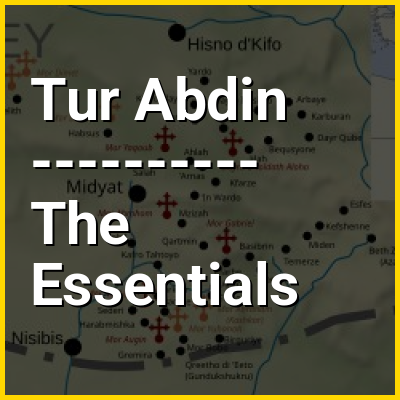
Tur Abdin (Arabic: طور عبدين; Kurdish: Tor; Latin: Turabdium; Syriac: ܛܽܘܪ ܥܰܒ݂ܕܺܝܢ or ܛܘܼܪ ܥܲܒ݂ܕܝܼܢ, Ṭūr ʿAḇdīn) is a hilly region situated in southeastern Turkey, including the eastern half of Mardin Province, and Şırnak Province west of the Tigris, on the border with Syria and famed since Late Antiquity for its Christian monasteries on the border of the Roman Empire and the Sasanian Empire. The area is a low plateau in the Anti-Taurus Mountains stretching from Mardin in the west to the Tigris in the east and delimited by the Mesopotamian plains to the south. The Tur Abdin is populated by more than 80 villages and nearly 70 monastery buildings and was mostly Syriac Orthodox with a Syriac Catholic minority until the early 20th century. The earliest surviving Christian buildings date from the 6th century.

The name "Tur Abdin" is Syriac: ܛܘܪ ܥܒܕܝܢ, lit.'Mountain of the Servants [of God]'.‌ Tur Abdin is of great importance to the Syriac Orthodox, for whom the region used to be a monastic and cultural heartland. The Assyrian community of Tur Abdin natively refer to themselves as Sūryāyê/Sūryōyê or Sūrāyê/Sūrōyê (Syriac: ܣܘܪ̈ܝܐ), and traditionally speak a central Neo-Aramaic dialect called Turoyo.
↓ Menu

>>>PUT SHARE BUTTONS HERE<<<

👉 Tur Abdin in the context of Mor Hananyo Monastery

The Mor Hananyo Monastery (Syriac: ܕܝܪܐ ܕܡܪܝ ܚܢܢܝܐ‎, romanisedDayro d-Mor Hananyo), also called Monastery of Saint Ananias, Deyrulzafaran (Arabic: ديرالزعفران, romanisedDayr al-Za'farān) or Dayro d-Kurkmo (Syriac: ܕܝܪܐ ܕܟܘܪܟܡܐ), and in Turkish, Deyrulzafaran Manastırı, commonly known in English as the Saffron Monastery, is one of the most renowned monasteries of the Syriac Orthodox Church. Located about 3 km (1.9 mi) east of Mardin, Turkey, in the Syriac cultural region Tur Abdin, it has served as a spiritual, cultural, and intellectual centre of Syriac Orthodox Christianity for centuries. From 1166 to 1932, it functioned as the Patriarchal See of Antioch, housing 53 patriarchs and metropolitans in its burial chambers.

Beginning as a temple to the Assyrian sun‑god Šamaš, the site was converted into a monastery in the Christian era. Over the centuries it endured repeated attacks by Mongols, Turks, and Kurds, during which the monastery, its artworks, and many manuscripts were abused and destroyed. Despite this, the monastery survives and today is headed by its abbot Mor Filüksinos (Philoxenos) Saliba Özmen.

↓ Explore More Topics
In this Dossier

Tur Abdin in the context of Ashur-dan II

Ashur-Dan II (Aššur-dān) (934–912 BC), son of Tiglath Pileser II, was the last king of the Middle Assyrian Empire, that contributed to the efforts that led to the birthing of the Neo-Assyrian Empire. He was best known for recapturing previously held Assyrian territory and restoring Assyria to its natural borders, from Tur Abdin (southeast Turkey) to the foothills beyond Arbel (Iraq). The reclaimed territory through his conquest was fortified with horses, ploughs, and grain stores. His military and economic expansions benefited four subsequent generations of kings that replicated his model.

↑ Return to Menu

Tur Abdin in the context of Terms for Syriac Christians

Terms for Syriac Christians are endonymic (native) and exonymic (foreign) terms, that are used as designations for Syriac Christians, as adherents of Syriac Christianity. In its widest scope, Syriac Christianity encompass all Christian denominations that follow East Syriac Rite or West Syriac Rite, and thus use Classical Syriac as their main liturgical language. Traditional divisions among Syriac Christians along denominational lines are reflected in the use of various theological and ecclesiological designations, both historical and modern. Specific terms such as: Jacobites, Saint Thomas Syrian Christians, Maronites, Melkites, Nasranis, and Nestorians have been used in reference to distinctive groups and branches of Eastern Christianity, including those of Syriac liturgical and linguistic traditions. Some of those terms are polysemic, and their uses (both historical and modern) have been a subject of terminological disputes between different communities, and also among scholars.

Territorially, Syriac Christians are divided in two principal groups: Syriac Christians of the Near East, and Syriac Christians of India. Terminology related to Syriac Christians of the Near East includes a specific group of ethnoreligious terms, related to various Semitic communities of Neo-Aramaic-speaking Christians, that are indigenous to modern Syria, Iraq, Iran, Turkey, Lebanon, Israel, Jordan, and Palestine.

↑ Return to Menu

Tur Abdin in the context of Turoyo

Turoyo (Turoyo: ܛܘܪܝܐ), also referred to as Surayt (Turoyo: ܣܘܪܝܬ), or modern Suryoyo (Turoyo: ܣܘܪܝܝܐ), is a Central Neo-Aramaic language traditionally spoken by the Syriac Christian community in the Tur Abdin region located in southeastern Turkey and in northeastern Syria. Turoyo speakers are mostly adherents of the Syriac Orthodox Church. Originally spoken and exclusive to Tur Abdin, it is now majority spoken in the diaspora. It is classified as a vulnerable language. Most speakers use the Classical Syriac language for literature and worship. Its closest relatives are Mlaḥsô and western varieties of Northeastern Neo-Aramaic like Suret. Turoyo is not mutually intelligible with Western Neo-Aramaic, having been separated for over a thousand years.

↑ Return to Menu

Tur Abdin in the context of Patriarchate of Tur Abdin

From 1364 to 1816 the region of Tur Abdin constituted a distinct patriarchate within the Syriac Orthodox Church, with the following patriarchs:

  • Ignatius Saba of Salah (1364–1389)
  • Ignatius Isho' of Midhyat (1389–1418), died 1421
  • Ignatius Mas'ud of Salah (1418–1420)
  • Ignatius Henoch of 'Ayn Ward (1421–1444)
  • Ignatius Qoma of Ba Sabrina (1444–1454)
  • Ignatius Isho' of Salah (1455–1460)
  • Ignatius 'Aziz (Philoxene) of Basila (1460–1482)
  • Ignatius Saba of Arbo (1482–1488)
  • Ignatius John Qofer of 'Ayn Ward (1489–1492)
  • Ignatius Mas'ud of Zaz (1492–1512)
  • Ignatius Isho' of Zaz (1515–1524)
  • Ignatius Simon of Hattakh (1524–1551)
  • Ignatius Jacob of Hisn (1551–1571)
  • Ignatius Sahdo of Midhyat (1584–1621)
  • Ignatius 'Abd Allah of Midhyat (1628–?)
  • Ignatius Habib of Midhyat (1674–1707)
  • Ignatius Denha of 'Arnas (1707–1725)
  • Ignatius Barsum of Midhyat (1740–1791)
  • Ignatius Aho and Ignatius Isaiah of Arbo (1791–1816), jointly

Between 1804 and c. 1840 there was a series of patriarchs of contested and limited authority:

↑ Return to Menu

Tur Abdin in the context of Central Neo-Aramaic

Central Neo-Aramaic, or Northwestern Neo-Aramaic (NWNA), languages represent a specific group of Neo-Aramaic languages, that is designated as Central in reference to its geographical position between Western Neo-Aramaic and other Eastern Aramaic groups. Its linguistic homeland is located in northern parts of the historical region of Syria (modern southeastern Turkey and northeastern Syria). The group includes the Turoyo language as a spoken language of the Tur Abdin region and various groups in diaspora, and Mlahsô language that is recently extinct as a spoken language.

Within Aramaic studies, several alternative groupings of Neo-Aramaic languages had been proposed by different researchers, and some of those groupings have used the term Central Neo-Aramaic in a wider meaning, including the widest scope, referring to all Neo-Aramaic languages except for Western Neo-Aramaic and Neo-Mandaic.

↑ Return to Menu

Tur Abdin in the context of Mlaḥsô language

Mlaḥsô or Mlahso (Classical Syriac: ܡܠܰܚܣܳܐ), sometimes referred to as Suryoyo or Surayt, is an extinct or dormant Central Neo-Aramaic language. It was traditionally spoken in eastern Turkey and later also in northeastern Syria by ethnically Assyrian Syriac Orthodox Christians.

The Mlaḥsô language (Surayt of Mlaḥsô) is closely related to the Surayt of Turabdin but sufficiently different to be considered a separate language, with the syntax of the language having retained more features of Classical Syriac than Turoyo. It was spoken in the villages of Mlaḥsô (Turkish: Yünlüce, Kurdish: Mela), a village established by two monks from the Tur Abdin mountain range, and in the village of ˁAnşa near Lice, Diyarbakır, Turkey.

↑ Return to Menu