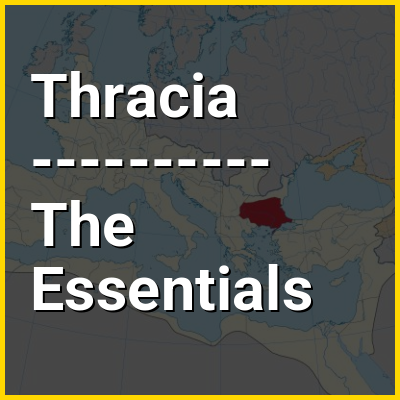
Thracia or Thrace (Ancient Greek: Θρᾴκη, romanized: Thrakē) is the ancient name given to the southeastern Balkan region, the land inhabited by the Thracians. Thrace was ruled by the Odrysian kingdom during the Classical and Hellenistic eras, and briefly by the Greek Diadochi ruler Lysimachus, but became a client state of the late Roman Republic and early Roman Empire as the Sapaean kingdom. Roman emperor Claudius annexed the kingdom as a Roman province in 46 AD.
>>>PUT SHARE BUTTONS HERE<<<
👉 Thracia in the context of Thraco-Roman
The term Thraco-Roman describes the Romanized culture of Thracians under the rule of the Roman Empire.
The Odrysian kingdom of Thrace became a Roman client kingdom c. 20 BC, while the Greek city-states on the Black Sea coast came under Roman control, first as civitates foederatae ("allied" cities with internal autonomy). After the death of the Thracian king Rhoemetalces III in 46 AD and an unsuccessful anti-Roman revolt, the kingdom was annexed as the Roman province of Thracia. The northern Thracians (Getae-Dacians) formed a unified kingdom of Dacia, before being conquered by the Romans in 106 and their land turned into the Roman province of Dacia.
In this Dossier
- ⭐ Core Definition: Thracia
- 👉 Thracia in the context of Thraco-Roman
- Thracia in the context of Philippopolis (Thrace)
- Thracia in the context of Via Egnatia
- Thracia in the context of Battle of Adrianople
- Thracia in the context of Sapaean kingdom
- Thracia in the context of Eurynome
- Thracia in the context of Gothic War (248–253)
- Thracia in the context of Lycus (mythology)
- Thracia in the context of Hippocoon
Thracia in the context of Philippopolis (Thrace)
Philippopolis (Ancient Greek: Φιλιππούπολις, Φιλιππόπολις) is one of the names of the ancient city (amongst which are Thracian Eumolpia/Pulpudeva, Roman Trimontium) situated where Plovdiv is today. The city became one of the largest and most important in the region and was called "the largest and most beautiful of all cities" by Lucian. During most of its recorded history, the city was known by the name Philippopolis (Ancient Greek: Φιλιππούπολις, romanized: Philippoúpolis, lit. 'Philip's city') after Philip II of Macedon. Philippopolis became part of the Roman Empire and capital of the Roman province of Thracia. According to Ammianus Marcellinus, Philippopolis had a population of 100,000 in the Roman period.
Philippopolis was in a fertile region on the banks of the Maritsa River (the ancient Hebrus). The city historically developed on seven syenite hills, some of which are 250 metres (820 feet) high, because of which Plovdiv is often referred to in Bulgaria as "The City of the Seven Hills".
Thracia in the context of Via Egnatia
The Via Egnatia was a road constructed by the Romans in the 2nd century BC. It crossed Illyricum, Macedonia, and Thracia, running through territory that is now part of modern Albania, North Macedonia, Greece, and European Turkey as a continuation of the Via Appia.
Starting at Dyrrachium (now Durrës) on the Adriatic Sea, the road followed a difficult route along the river Genusus (Shkumbin), over the Candaviae (Jablanica) mountains and thence to the highlands around Lake Ohrid. It then turned by parts south, following several high mountain passes to reach the northern coastline of the Aegean Sea at Thessalonica. From there it ran through Thrace to the city of Byzantium (later Constantinople, now Istanbul). It covered a total distance of about 1,120 km (696 miles/746 Roman miles). Like other major Roman roads, it was about six metres (19.6 ft) wide, paved with large polygonal stone slabs or covered with a hard layer of sand.
Thracia in the context of Battle of Adrianople
The Battle of Adrianople also known as Battle of Hadrianopolis was fought between the Eastern Roman army led by the Roman emperor Valens and Gothic rebels (largely Thervings as well as Greutungs, non-Gothic Alans, and various local rebels) led by Fritigern. The battle took place on 9 August 378 in the vicinity of Adrianople, in the Roman province of Thracia (modern Edirne in European Turkey). It ended with an overwhelming victory for the Goths and the death of Emperor Valens.
As part of the Gothic War of 376–382, the battle is often considered the start of the events which led to the fall of the Western Roman Empire in the 5th century.
Thracia in the context of Sapaean kingdom
The Thracian kingdom, also called the Sapaean kingdom, was an ancient Thracian state in the southeastern Balkans that existed from the middle of the 1st century BC to 46 AD. Succeeding the Classical and Hellenistic era Odrysian kingdom of Thrace, it was dominated by the Sapaean tribe, who ruled from their capital Bizye in what is now northwestern Turkey. Initially only of limited relevance, its power grew significantly in the ancient Roman world as a client state of the late Roman Republic. After the Battle of Actium in 31 BC, Octavian (later emperor Augustus) installed a new dynasty that proved to be highly loyal and expansive. Conquering and ruling much of Thrace on behalf of the Roman Empire, it lasted until 46 AD, when Emperor Claudius annexed the kingdom and made Thracia into a Roman province.
Thracia in the context of Eurynome
Eurynomê (/jʊəˈrɪnəmi/; Ancient Greek: Εὐρυνόμη, from εὐρύς, eurys, "broad" and νομός, nomos, "pasture" or νόμος "law") is a name that refers to the following characters in Greek mythology:
- Eurynome, pre-Olympian queen and wife of Ophion
- Eurynome (Oceanid), mother of the Charites
- Eurynome, one of the Cadmiades, the six daughters of Cadmus and Harmonia in a rare version of the myth. Her sisters were Ino, Agaue, Semele, Kleantho and Eurydike.
- Eurynome or Eurymede, daughter of King Nisus of Megara and mother of Bellerophon by Poseidon or Glaucus.
- Eurynome, mother by the Persian Orchamus of Leucothoe whom Helios loved.
- Eurynome, wife of Lycurgus of Arcadia and mother of Amphidamas, Epochus, Ancaeus, and Iasus. Elsewhere is also called Cleophyle or Antinoe.
- Eurynome, daughter of Iphitus and mother of Adrastus of Argos by Talaus. In some accounts, she was called the daughter of Apollo.
- Eurynome, waiting woman of Penelope in the Odyssey.
- Eurynome, a handmaiden of Harmonia.
- Eurynome, a Lemnian woman. The goddess Pheme paid a visit to her in the guise of her friend Neaera to inform her that Eurynome's husband Codrus was being unfaithful to her with a Thracian woman.
- Eurynome, an alternate name for Eidothea, the daughter of Proteus.
- Eurynome, a daughter of Asopus and mother of Ogygias by Zeus, according to a late source.
Thracia in the context of Gothic War (248–253)
The Gothic War of 248–253 took place between the years 248 and 249, as well as in the year 253. Within this war, a series of battles occurred and plundering was carried out by the Goths and their allies in the eastern territory of the Roman Empire, specifically in the Balkans. With the cessation of the payment of tribute previously made by the Roman emperor Philip the Arab (r. 244–249) to the tribes beyond the Danube, the Goths and their allies, led by King Ostrogotha and his subcommanders Argedo and Gundericus, moved towards the Roman border and began a series of attacks, including against the fortified city of Marcianopolis (today Devnya) in Thracia. After these actions, the Goths withdrew with their spoils of war.
In 250, the invasions continued, the Carpiani attacked Dacia, while the Gothic King Cniva commanding various groups of Goths and other allied peoples, defeated the Romans in two major battles, in one of these he killed the Roman emperor Decius (r. 249–251) and his co-emperor Herennius Etruscus (r. 251). The imperial successor Trebonianus Gallus (r. 251–253) pledged to pay an annual tribute if the invaders left, however, he did not keep his promise, which provoked new attacks in 253, although the governor and future emperor Aemilianus (r. 253) managed to stop these raids.
Thracia in the context of Lycus (mythology)
Lycus (/ˈlaɪkəs/ LY-kəs; Ancient Greek: Λύκος, romanized: Lúkos, lit. 'wolf') is the name of multiple people in Greek mythology:
- Lycus, one of the Telchines who fought under Dionysus in his Indian campaign. He is otherwise said to have erected a temple to Apollo Lycius on the banks of Xanthus river.
- Lycus, son of Prometheus and Celaeno, brother of Chimaerus. The brothers are said to have had tombs in the Troad; they are otherwise unknown.
- Lycus of Athens, a wolf-shaped herο, whose shrine stood by the jurycourt, and the first jurors were named after him.
- Lycus, an Egyptian prince as one of the sons of King Aegyptus. He suffered the same fate as his other brothers, save Lynceus of Argos, when they were slain on their wedding night by their wives who obeyed the command of their father King Danaus of Libya. Lycus was the son of Aegyptus by Argyphia, a woman of royal blood and thus full brother of Lynceus, Proteus, Enceladus, Busiris and Daiphron. In some accounts, he could be a son of Aegyptus either by Eurryroe, daughter of the river-god Nilus, or Isaie, daughter of King Agenor of Tyre. Lycus married the Danaid Agave, daughter of Danaus and Europe.
- Lycus, son of Poseidon and Celaeno.
- Lycus, the "loudvoiced" satyr herald of Dionysus during the Indian War. In secret union, Hermes fathered him, Pherespondus and Pronomus, by Iphthime, daughter of Dorus. Eiraphiotes (i.e. Dionysus) entrusted to these three satyr brothers the dignity of 'the staff of their wisdom-fostering father, the herald of heaven'.
- Lycus, son of Arrhetus and Laobie, who, together with his father and brothers, fought under Deriades against Dionysus.
- Lycus, son of Pandion II and brother of King Aegeus of Athens.
- Lycus, son of Hyrieus and Clonia, and brother of Nycteus. He became the guardian of Labdacus and Laius. Nycteus, unable to retrieve his daughter Antiope from Epopeus of Sicyon, sent his brother Lycus to take her. He invaded Sicyon, killed Epopeus and gave Antiope as a slave to his own wife, Dirce.
- Lycus, a descendant of the above Lycus, said to have usurped the power over Thebes.
- Lycus, son of Dascylus of Mysia or Mariandyne. He was hospitable towards the Argonauts and Heracles, who conquered the land of the Bebryces (Heraclea Pontica). He is apparently identical with the Lycus given as a son of Titias, brother of Priolaus and eponym of a city.
- Lycus, same as Lycurgus (of Nemea).
- Lycus, the mortal lover of Coronis, mother of Asclepius. He is otherwise commonly known as Ischys, son of Elatus.
- Lycus, a Thracian killed by Cycnus in single combat.
- Lycus, a centaur at the wedding of Pirithous and Hippodamia, was killed by Pirithous.
- Lycus, a defender of Thebes in the war of the Seven against Thebes.
- Lycus and Pernis are listed by Hyginus as parents of Ascalaphus and Ialmenus, who are otherwise known as sons of Ares and Astyoche.
- Lycus, son of Ares and a Libyan king.
- Lycus, a Cretan prince as the son of King Idomeneus and Meda, probably the brother of Orsilochus, Cleisithyra and Iphiclus. Together with the latter, they were slain by the usurper Leucus.
- Lycus, one of the companions of Diomedes that were changed into birds in Italy
- Lycus, a lost companion of Aeneas
- Lycus, another companion of Aeneas, killed by Turnus.
- Lycus and Termerus were two notorious brigands in Caria.
Thracia in the context of Hippocoon
In Greek mythology, the name Hippocoön (/hɪˈpɒkoʊˌɒn, -kəˌwɒn/; Ancient Greek: Ἱπποκόων, Hippokóōn) refers to several characters:
- Hippocoon, in one account, father of Neleus, who is otherwise called son of Cretheus or Poseidon.
- Hippocoon, a Spartan king, father of Enarephoros and brother of Tyndareus from whom Hippocoon seized the kingship, then exiled Tyndareus.
- Hippocoon, the great-grandfather of Amphiaraus. The lineage is as follows: Zeuxippe, daughter of this Hippocoön, married Antiphates and gave birth to Oecles and Amphalces; Oecles, in his turn, married Hypermnestra, daughter of Thespius, and to them were born Iphianeira, Polyboea and Amphiaraus.
- Hippocoon, a Thracian counsellor and a kinsman of Rhesus, who fought at Troy. Awakened by Apollo, he is the first to discover the damage caused by Odysseus and Diomedes in the Thracian camp.
- Hippocoon, in the Aeneid, son of Hyrtacus, one of the participants in the archery contest at Anchises's funeral games. His arrow misses, striking the mast to which the target dove is tied.