Tetrarchy in the context of "305"

Play Trivia Questions online!

or

Skip to study material about Tetrarchy in the context of "305"

Ad spacer

⭐ Core Definition: Tetrarchy

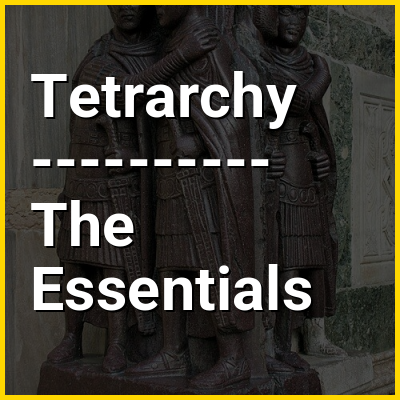
The Tetrarchy was the system instituted by Roman emperor Diocletian to govern the ancient Roman Empire by dividing it between two emperors, the augusti, and their junior colleagues and designated successors, the caesares. It was kept in place between AD 293 and 313.

Initially Diocletian chose Maximian as his caesar in 285, raising him to co-augustus the following year; Maximian was to govern the western provinces and Diocletian would administer the eastern ones. The role of the augustus was likened to Jupiter, while his caesar was akin to Jupiter's son Hercules. Galerius and Constantius were appointed caesares in March 293. Diocletian and Maximian retired on 1 May 305, raising Galerius and Constantius to the rank of augustus. Their places as caesares were in turn taken by Valerius Severus and Maximinus Daza.

↓ Menu

>>>PUT SHARE BUTTONS HERE<<<
In this Dossier

Tetrarchy in the context of Western Roman Empire

In modern historiography, the Western Roman Empire were the Roman Empire's western provinces, collectively, during any period in which they were administered separately from the eastern provinces by a separate, independent imperial court. Particularly during the period from AD 395 to 476, there were separate, coequal courts dividing the governance of the empire into the Western provinces and the Eastern provinces with a distinct imperial succession in the separate courts. The terms Western Roman Empire and Eastern Roman Empire were coined in modern times to describe political entities that were de facto independent; contemporary Romans did not consider the Empire to have been split into two empires but viewed it as a single polity governed by two imperial courts for administrative expediency. The Western Empire collapsed in 476, and the Western imperial court in Ravenna disappeared by 554, at the end of Justinian's Gothic War.

Though there were periods with more than one emperor ruling jointly before, the view that it was impossible for a single emperor to govern the entire Empire was institutionalized by emperor Diocletian following the disastrous civil wars and disintegrations of the Crisis of the Third Century. He introduced the system of the Tetrarchy in 286, with two senior emperors titled Augustus, one in the East and one in the West, each with an appointed subordinate and heir titled Caesar. Though the tetrarchic system would collapse in a matter of years, the East–West administrative division would endure in one form or another over the coming centuries. As such, the unofficial Western Roman Empire would exist intermittently in several periods between the 3rd and 5th centuries. Some emperors, such as Constantine I and Theodosius I, governed, if briefly, as the sole Augustus across the Roman Empire. On the death of Theodosius in 395, the empire was divided between his two infant sons, with Honorius as his successor in the West governing briefly from Mediolanum then from Ravenna, and Arcadius as his successor in the East governing from Constantinople.

↑ Return to Menu

Tetrarchy in the context of Denarius

The denarius (Latin: [deːˈnaːriʊs]; pl.: dēnāriī, Latin: [deːˈnaːriiː]) was the standard Roman silver coin from its introduction in the Second Punic War c. 211 BC to the reign of Gordian III (AD 238–244), when it was gradually replaced by the antoninianus. It continued to be minted in very small quantities, likely for ceremonial purposes, until and through the Tetrarchy (293–313).

The word dēnārius is derived from the Latin dēnī "containing ten", as its value was originally of 10 assēs. The word for "money" descends from it in Italian (denaro), Slovene (denar), Portuguese (dinheiro), and Spanish (dinero). Its name also survives in the dinar currency.

↑ Return to Menu

Tetrarchy in the context of Constantine the Great

Constantine I (27 February 272 – 22 May 337), also known as Constantine the Great, or known mononymously as Constantine, was Roman emperor from AD 306 to 337 and the first Roman emperor to convert to Christianity. He played a pivotal role in elevating the status of Christianity in Rome, the Edict of Milan decriminalising Christian practice and ceasing Christian persecution. This was a turning point in the Christianisation of the Roman Empire. He founded the city of Constantinople (now Istanbul) and made it the capital of the Empire, which it remained for over a millennium.

Born in Naissus, a city located in the province of Moesia Superior (now Niš, Serbia), Constantine was the son of Flavius Constantius, a Roman army officer from Moesia Superior, who would become one of the four emperors of the Tetrarchy. His mother, Helena, was a woman of low birth, probably from Bithynia. Later canonised as a saint, she is credited for the conversion of her son in some traditions, though others believe that Constantine converted her. He served with distinction under emperors Diocletian and Galerius. He began his career by campaigning in the eastern provinces against the Persians, before being recalled to the west in AD 305 to fight with his father in the province of Britannia. After his father's death in 306, Constantine was proclaimed as augustus (emperor) by his army at Eboracum (York, England). He eventually emerged victorious in Civil wars of the Tetrarchy against the emperors Maxentius and Licinius to become the sole ruler of the Roman Empire by 324.

↑ Return to Menu

Tetrarchy in the context of Constitution of the Late Roman Empire

The constitution of the late Roman Empire was an unwritten set of guidelines and principles passed down, mainly through precedent, which defined the manner in which the late Roman Empire was governed. As a matter of historical convention, the late Roman Empire emerged from the Roman Principate (the early Roman Empire), with the accession of Diocletian in AD 284, his reign marking the beginning of the Tetrarchy. The constitution of the Dominate outrightly recognized monarchy as the true source of power, and thus ended the facade of dyarchy, in which emperor and Senate governed the empire together.

Diocletian's reforms to the Imperial government finally put an end to the period when the old Republican magistracies (e.g. consuls and praetors) held real powers. From then, the consuls had almost no real duties beyond that of presiding at Senate meetings and the duties of the lesser magistrates were effectively just hosting various games, e.g. chariot racing. Most other lesser magistracies simply disappeared.

↑ Return to Menu

Tetrarchy in the context of Diocletian

Diocletian (/ˌd.əˈklʃən/ DY-ə-KLEE-shən; Latin: Gaius Aurelius Valerius Diocletianus; Ancient Greek: Διοκλητιανός, romanizedDiokletianós; 242/245 – 311/312), nicknamed Jovius, was Roman emperor from 284 until his abdication in 305. He was born Diocles to a family of low status in the Roman province of Dalmatia. As with other Illyrian soldiers of the period, Diocles rose through the ranks of the military early in his career, serving under Aurelian and Probus, and eventually becoming a cavalry commander for the army of Emperor Carus. After the deaths of Carus and his son Numerian on a campaign in Persia, Diocles was proclaimed emperor by the troops, taking the name "Diocletianus". The title was also claimed by Carus's surviving son, Carinus, but Diocletian defeated him in the Battle of the Margus.

Diocletian's reign stabilized the empire and ended the Crisis of the Third Century. He initiated the process of the Roman Empire split and appointed fellow officer Maximian as Augustus, co-emperor, in 286. Diocletian reigned in the Eastern Empire, and Maximian reigned in the Western Empire. Diocletian delegated further on 1 March 293, appointing Galerius and Constantius as junior colleagues (each with the title Caesar), under himself and Maximian respectively. Under the Tetrarchy, or "rule of four", each tetrarch would rule over a quarter-division of the empire. Diocletian secured the empire's borders and purged it of all threats to his power. He defeated the Sarmatians and Carpi during several campaigns between 285 and 299, the Alamanni in 288, and usurpers in Egypt between 297 and 298. Galerius, aided by Diocletian, campaigned successfully against Persia, the empire's traditional enemy, and in 299, he sacked their capital, Ctesiphon. Diocletian led the subsequent negotiations and achieved a lasting and favorable peace.
↑ Return to Menu

Tetrarchy in the context of Galatia (Roman province)

Galatia (/ɡəˈlʃə/) was the name of a province of the Roman Empire in Anatolia (modern central Turkey). It was established by the first emperor, Augustus (sole rule 30 BC – 14 AD), in 25 BC, covering most of formerly independent Celtic Galatia, with its capital at Ancyra.

Under the Tetrarchy reforms of Diocletian, its northern and southern parts were split to form the southern part of the province of Paphlagonia and the province of Lycaonia, respectively.

↑ Return to Menu

Tetrarchy in the context of Flavius Constantius

Flavius Valerius Constantius (c. 250 – 25 July 306), also called Constantius I, was a Roman emperor from 305 to 306. He was one of the four original members of the Tetrarchy established by Diocletian, first serving as caesar from 293 to 305 and then ruling as augustus until his death. Constantius was also father of Constantine the Great, the first Christian emperor of Rome. The nickname "Chlorus" (Ancient Greek: Χλωρός, lit.'the Pale') was first popularized by Byzantine-era historians and not used during the emperor's lifetime.

As an Illyrian soldier of humble origin, Constantius had a distinguished military career and rose to the top ranks of the army. Around 289, he set aside Helena, Constantine's mother, to marry a daughter of Emperor Maximian, and in 293 was added to the imperial college by Maximian's colleague Diocletian. Assigned to rule Gaul, Constantius defeated the usurper Carausius there and his successor Allectus in Britain, and campaigned extensively along the Rhine frontier, defeating the Alamanni and Franks. When the Diocletianic Persecution was announced in 303, Constantius ordered the demolition of churches but did not actively hunt down Christians in his domain. Upon becoming senior emperor in May 305, Constantius launched a successful punitive campaign against the Picts beyond the Antonine Wall. He died suddenly at Eboracum (York) in July the following year.

↑ Return to Menu