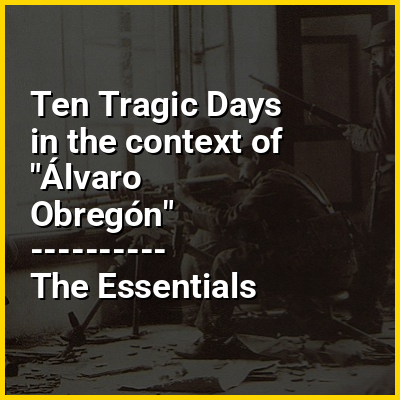
The Ten Tragic Days (Spanish: La Decena Trágica) is the name given to the multi-day coup d'état during the Mexican Revolution in Mexico City. It was staged by opponents of Francisco I. Madero, the democratically elected president of Mexico, between 9–19 February 1913. The coup instigated a second phase of the Mexican Revolution, after dictator Porfirio Díaz had been ousted and replaced in elections by Francisco I. Madero. The coup was carried out by general Victoriano Huerta and supporters of the old regime, with support from the United States, especially U.S. ambassador Henry Lane Wilson.
In the ten days of violence, the aim was to "create the illusion of chaos necessary to induce Madero to step down" from the presidency. Rebels led by General Félix Díaz, nephew of ex-president Porfirio Díaz, and General Bernardo Reyes escaped from jail and rallied forces to overthrow President Francisco I. Madero. The coup was strongly supported by U.S. Ambassador to Mexico, Henry Lane Wilson, who was implacably opposed to Madero. Madero had retained the Mexican Federal Army after rebels had forced the resignation of President Porfirio Díaz. The head of the Mexican Federal Army, General Victoriano Huerta, ostensibly the defender of the Madero government, defected to the rebels, who sought the return of the old political order. On 18 February the sitting president and vice president were captured by rebel General Aureliano Blanquet, effectively ending Madero's presidency. On 19 February, a dispute between General Díaz and General Huerta about who should head the provisional government was resolved by Ambassador Wilson mediating between the two in an in-person meeting at the U.S. embassy. They formalized an agreement known as the Pact of the Embassy.