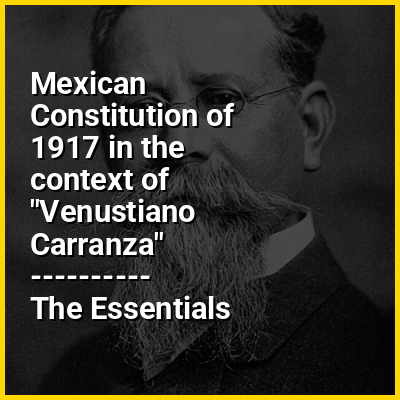
Mexican Constitution of 1917 in the context of "Venustiano Carranza"

Play Trivia Questions online!

or

Skip to study material about Mexican Constitution of 1917 in the context of "Venustiano Carranza"


👉 Mexican Constitution of 1917 in the context of Venustiano Carranza

José Venustiano Carranza de la Garza (Spanish pronunciation: [benusˈtjano kaˈransa ðe la ˈɣaɾsa]; 29 December 1859 – 21 May 1920), known as Venustiano Carranza, was a Mexican land owner, revolutionary, and politician who served as the 44th President of Mexico from 1917 until his assassination in 1920, during the Mexican Revolution. He was previously Mexico's de facto head of state as Primer Jefe (Spanish: "First Chief") of the Constitutionalist faction from 1914 to 1917, and previously served as a senator and governor for Coahuila. He played the leading role in drafting the Constitution of 1917 and maintained Mexican neutrality in World War I.

Born in Coahuila to a prominent landowning family, he served as a senator for his state during the Porfiriato, appointed by President and dictator Porfirio Díaz. After becoming alienated from Díaz, he supported the Liberal Francisco Madero's challenge to Díaz during the 1910 presidential election. Madero was defeated in a sham election and imprisoned. Madero ordered an overthrow of the government, sparking the Mexican Revolution, and Díaz resigned in May 1911. As president, Madero appointed Carranza as the governor of Coahuila. When Madero was murdered during the counter-revolutionary Ten Tragic Days coup in February 1913, Carranza drew up the Plan of Guadalupe, a political strategy to oust Madero's usurper, General Victoriano Huerta. Carranza organized militias loyal to his state and allied northern states in Mexico into a professional army, the Constitutional Army, to oppose Huerta. The Constitutionalists defeated Huerta's Federal Army and Huerta was ousted in July 1914. Carranza did not assume the title of provisional president of Mexico, as called for in his Plan of Guadalupe, since it would have prevented his running for constitutional president once elections were held. Furthermore his government in this period was in a pre-constitutional, extralegal state, to which both his best generals, Álvaro Obregón and Pancho Villa, objected to Carranza's seizure of the national presidency.

↓ Explore More Topics
In this Dossier

Mexican Constitution of 1917 in the context of Calles Law

The Calles Law (Spanish: Ley Calles), or Law for Reforming the Penal Code (ley de tolerancia de cultos, "law of worship tolerance"), was a statute enacted in Mexico in 1926, under the presidency of Plutarco Elías Calles, to enforce restrictions against the Catholic Church in Article 130 of the Mexican Constitution of 1917. Article 130 declared that the church and state are to remain separate. To that end, it required all "churches and religious groupings" to register with the state and placed restrictions on priests and ministers of all religions. Priests and ministers were prohibited from holding public office, canvassing on behalf of political parties or candidates, or inheriting property from persons other than close blood relatives. President Calles applied existing laws regarding the separation of church and state throughout Mexico and added his own legislation.

In June 1926, he signed the "Law for Reforming the Penal Code", which became known unofficially as the "Calles Law." This law provided specific penalties for priests and individuals who violated Article 130 of the 1917 Constitution. For example, wearing clerical garb in public was punishable by a fine of 500 pesos (approximately 250 U.S. dollars at the time, or worth $4,250 in 2010). A priest who criticized the government could be imprisoned up to five years. Some states enacted further measures in the name of church and state separation. Chihuahua, for example, enacted a law permitting only a single priest to serve the entire Catholic congregation of the state. Tabasco, on the other hand, introduced a law whereby all priests were required to be married to exercise their office (de facto banning the Catholic priesthood). To help enforce the law, Calles seized Church properties, expelled foreign priests, and closed monasteries, convents, and religious schools.

↑ Return to Menu