Tartu in the context of "Tallinn, Estonia"

Play Trivia Questions online!

or

Skip to study material about Tartu in the context of "Tallinn, Estonia"

Ad spacer

⭐ Core Definition: Tartu

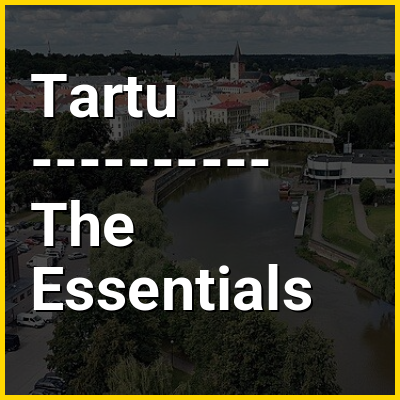
Tartu is the second largest city in Estonia after Tallinn. Tartu has a population of 97,759 (as of 2024). It is 186 kilometres (116 miles) southeast of Tallinn and 245 kilometres (152 miles) northeast of Riga, Latvia. Tartu lies on the Emajõgi river, which connects the two largest lakes in Estonia, Lake Võrtsjärv and Lake Peipus. From the 13th century until the end of the 19th century, Tartu was known in most of the world by variants of its historical name Dorpat.

Tartu, the largest urban centre of southern Estonia, is home to the nation's oldest and most renowned university, the University of Tartu (founded in 1632). Tartu also houses the Supreme Court of Estonia, the Ministry of Education and Research, the Estonian National Museum, and the oldest Estonian-language theatre, Vanemuine. It is also the birthplace of the Estonian Song Festivals.
↓ Menu

>>>PUT SHARE BUTTONS HERE<<<

👉 Tartu in the context of Tallinn, Estonia

Tallinn is the capital and most populous city of Estonia. Situated on a bay in north Estonia, on the shore of the Gulf of Finland of the Baltic Sea, it has a population of 456,518 as of 2025 and administratively lies in Harju County. Tallinn is the main governmental, financial, industrial, and cultural centre of Estonia. It is located 187 km (116 mi) northwest of the country's second largest city, Tartu, however, only 80 km (50 mi) south of Helsinki, Finland; it is also 320 km (200 mi) west of Saint Petersburg, Russia, 300 km (190 mi) north of Riga, Latvia, and 380 km (240 mi) east of Stockholm, Sweden. From the 13th century until the first half of the 20th century, Tallinn was known in most of the world by variants of its other historical name Reval.

Tallinn received Lübeck city rights in 1248; however, the earliest evidence of human settlement in the area dates back nearly 5,000 years. The medieval indigenous population of what is now Tallinn and north Estonia was one of the last "pagan" civilisations in Europe to adopt Christianity following the Papal-sanctioned Northern Crusades in the 13th century. The first recorded claim over the place was laid by Denmark after a successful raid in 1219 led by King Valdemar II, followed by a period of alternating Scandinavian and Teutonic rulers. Due to the strategic location by the sea, its port became a significant trade hub, especially in the 14–16th centuries, when Tallinn grew in importance as the northernmost member city of the Hanseatic League. Tallinn Old Town is one of the best-preserved medieval cities in Europe and is listed as a UNESCO World Heritage Site.

↓ Explore More Topics
In this Dossier

Tartu in the context of Estonia

Estonia, officially the Republic of Estonia, is a country in Northern Europe. It is bordered to the north by the Gulf of Finland across from Finland, to the west by the Baltic Sea across from Sweden, to the south by Latvia, and to the east by Russia. The territory of Estonia consists of the mainland, the larger islands of Saaremaa and Hiiumaa, and over 2,300 other islands and islets on the east coast of the Baltic Sea. Its capital Tallinn and Tartu are the two largest urban areas. The Estonian language, of the Finnic family, is the official language and the first language of the majority of its population of nearly 1.4 million. Estonia is one of the least populous members of the European Union and NATO.

Present-day Estonia has been inhabited since at least 9,000 BC. The medieval indigenous population of Estonia was one of the last pagan civilisations in Europe to adopt Christianity following the Northern Crusades in the 13th century. After centuries of successive rule by the Teutonic Order, Denmark, Sweden, and the Russian Empire, a distinct Estonian national identity began to emerge in the mid-19th century. This culminated in the 1918 Estonian Declaration of Independence from the then-warring Russian and German empires. Democratic throughout most of the interwar period, Estonia declared neutrality at the outbreak of World War II, but the country was repeatedly invaded and occupied, and ultimately annexed into the USSR. Throughout the de facto Soviet occupation, from World War II until 1991, Estonia's de jure state continuity was preserved by diplomatic representatives and the government-in-exile. Following the 1988–90 "Singing Revolution" against Soviet rule, full independence was restored on 20 August 1991.

↑ Return to Menu

Tartu in the context of Jan Zamoyski

Jan Sariusz Zamoyski (Latin: Ioannes Zamoyski de Zamoscie; 19 March 1542 – 3 June 1605) was a Polish nobleman, magnate, statesman and the 1st ordynat of Zamość. He served as the Royal Secretary from 1565, Deputy Chancellor from 1576, Grand Chancellor of the Crown from 1578, and Great Hetman of the Crown from 1581.

Zamoyski was the General Starost of the city of Kraków from 1580 to 1585, Starost of Bełz, Międzyrzecz, Krzeszów, Knyszyn and Tartu. An important advisor to Kings Sigismund II Augustus and Stephen Báthory, he was one of the major opponents of Bathory's successor, Sigismund III Vasa, and one of the most skilled diplomats, politicians and statesmen of his time, standing as a major figure in the politics of the Polish–Lithuanian Commonwealth throughout his life.

↑ Return to Menu

Tartu in the context of Friedrich Parrot

Johann Jacob Friedrich Wilhelm Parrot (14 October 1791 – 15 January [O.S. 3 January] 1841) was a Baltic German naturalist, explorer, and mountaineer, who lived and worked in Tartu, Estonia in what was then the Governorate of Livonia of the Russian Empire. A pioneer of Russian and Estonian scientific mountaineering, Parrot is best known for leading the first expedition to the summit of Mount Ararat in recorded history.

↑ Return to Menu

Tartu in the context of Anne Sulling

Anne Sulling (born 12 October 1976 in Tartu) is an Estonian politician and a member of Riigikogu. She represents the Tartu constituency as a member of the Estonian Reform Party.

Between 2005 and 2006, Sulling worked for the Ministry of Finance on the Estonia's euro changeover project. Between 2009 and 2014, Sulling was an adviser to the Prime Minister Andrus Ansip in matters related to macro-economics, the euro and the CO2 quota trade. She was named the “Person of the Year” by Postimees in 2011, for her work concerning CO2 quota sales.

↑ Return to Menu

Tartu in the context of University of Tartu

The University of Tartu (Estonian: Tartu Ülikool) is a public research university in Tartu, Estonia. It is the national university of Estonia, as well as the largest and oldest university in the country.

The university was founded in 1632 by Gustavus Adolphus, at the time the king of Sweden. Its first chancellor was Baron Johan Skytte, the governor-general of the Swedish province of Livonia.

↑ Return to Menu

Tartu in the context of Võros

Võros (Võro: võrokõsõq, pronounced [vɤrokɤsəʔ], Estonian: võrukesed, Finnish: võrolaiset) are the indigenous inhabitants of historical Võromaa (Vana Võromaa), a region in Southeastern Estonia (Võru and Põlva Counties with parts extending into Valga and Tartu Counties). The term is particularly used by proponents of a regional identity.

About 70,000 people live in historical Võromaa and many more identify as Võros although they live outside the territory, mostly in Tartu and Tallinn.

↑ Return to Menu

Tartu in the context of Ida-Viru County

Ida-Viru County (Estonian: Ida-Viru maakond or Ida-Virumaa; Russian: Ида-Вируский уезд, romanizedIda-Viruskij uezd) is one of the 15 counties of Estonia. It is the most northeastern part of the country. The county contains large deposits of oil shale – the main mineral mined in Estonia. Oil shale is used in the production of shale oil and in thermal power plants. The capital of the county is the town of Jõhvi which is administratively united with the Jõhvi Parish; nevertheless, Narva is the largest town in the county in terms of population and at the same time the third-largest city in Estonia after Tallinn and Tartu.

In January 2019, Ida-Viru County had a population of 136,240 – constituting 10.3% of the total population in Estonia. It borders Lääne-Viru County in the west, Jõgeva County in the southwest and Russia (Leningrad Oblast) in the east. It is the only county in Estonia where Russians constitute the majority of population (73.1% in 2010), the second highest being Harju (28%).

↑ Return to Menu