Sigismund III Vasa in the context of "Jan Zamoyski"

Play Trivia Questions online!

or

Skip to study material about Sigismund III Vasa in the context of "Jan Zamoyski"

Ad spacer

⭐ Core Definition: Sigismund III Vasa

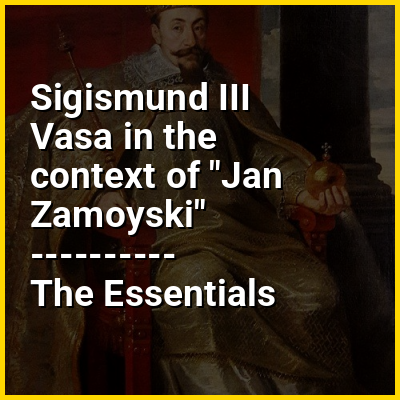
Sigismund III Vasa (Polish: Zygmunt III Waza, Lithuanian: Žygimantas Vaza; 20 June 1566 – 30 April 1632N.S.) was King of Poland and Grand Duke of Lithuania from 1587 to 1632 and, as Sigismund, King of Sweden from 1592 to 1599. He was the first Polish sovereign from the House of Vasa. Religiously zealous, he imposed Catholicism across the vast realm, and his crusades against neighbouring states marked Poland's largest territorial expansion. As an enlightened despot, he presided over an era of prosperity and achievement, further distinguished by the transfer of the country's capital from Kraków to Warsaw.

Sigismund was the son of King John III of Sweden and his first wife, Catherine Jagiellon, daughter of King Sigismund I of Poland. Elected monarch of the Polish–Lithuanian Commonwealth in 1587, he sought to unify Poland and Sweden under one Catholic kingdom, and when he succeeded his deceased father in 1592 the Polish–Swedish union was created. Opposition in Protestant Sweden caused a war against Sigismund headed by Sigismund's uncle Charles IX, who deposed him in 1599.
↓ Menu

>>>PUT SHARE BUTTONS HERE<<<

👉 Sigismund III Vasa in the context of Jan Zamoyski

Jan Sariusz Zamoyski (Latin: Ioannes Zamoyski de Zamoscie; 19 March 1542 – 3 June 1605) was a Polish nobleman, magnate, statesman and the 1st ordynat of Zamość. He served as the Royal Secretary from 1565, Deputy Chancellor from 1576, Grand Chancellor of the Crown from 1578, and Great Hetman of the Crown from 1581.

Zamoyski was the General Starost of the city of Kraków from 1580 to 1585, Starost of Bełz, Międzyrzecz, Krzeszów, Knyszyn and Tartu. An important advisor to Kings Sigismund II Augustus and Stephen Báthory, he was one of the major opponents of Bathory's successor, Sigismund III Vasa, and one of the most skilled diplomats, politicians and statesmen of his time, standing as a major figure in the politics of the Polish–Lithuanian Commonwealth throughout his life.

↓ Explore More Topics
In this Dossier

Sigismund III Vasa in the context of Time of Troubles

The Time of Troubles (Russian: Смутное время, romanizedSmutnoye vremya), also known as Smuta (Russian: Смута, lit.'troubles'), was a period of political crisis in Russia which began in 1598 with the death of Feodor I, the last of the House of Rurik, and ended in 1613 with the accession of Michael I of the House of Romanov at the 1613 Zemsky Sobor.

It was a period of deep social crisis and lawlessness following the death of Feodor I, a weak and possibly intellectually disabled ruler who died without an heir. His death ended the Rurik dynasty, leading to a violent succession crisis with numerous usurpers and false Dmitrys (impostors) claiming the title of tsar. Russia experienced the famine of 1601–1603, which killed almost a third of the population, within three years of Feodor's death. Russia was also occupied by the Polish–Lithuanian Commonwealth during the Polish–Russian War and lost Smolensk.

↑ Return to Menu

Sigismund III Vasa in the context of Kraków Old Town

Old Town (Polish: Stare Miasto) is the historic part of the city of Kraków within the Planty Park, Poland.

It is one of the most famous old areas in Poland today and was the centre of Poland's political life from 1038 until King Sigismund III Vasa relocated his court to Warsaw in 1596.

↑ Return to Menu

Sigismund III Vasa in the context of Constance of Austria

Constance of Austria (German: Konstanza; Polish: Konstancja; Lithuanian: Konstancija; 24 December 1588 – 10 July 1631) was Queen of Poland and Grand Duchess of Lithuania as the second wife of King-Grand Duke Sigismund III Vasa and the mother of King John II Casimir.

↑ Return to Menu

Sigismund III Vasa in the context of Polish–Muscovite War (1605–1618)

The Polish–Russian War was a conflict fought between the Polish–Lithuanian Commonwealth and the Tsardom of Russia from 1609 to 1618.

Russia had been experiencing the Time of Troubles since the death of Tsar Feodor I in 1598, which caused political instability and a violent succession crisis upon the extinction of the Rurik dynasty; furthermore, a major famine ravaged the country from 1601 to 1603. Poland exploited Russia's civil wars when powerful members of the Polish szlachta began influencing Russian boyars and supporting successive pretenders to the title of tsar of Russia against the crowned tsars Boris Godunov (r. 1598–1605) and Vasili IV Shuysky (r. 1606–1610). From 1605, Polish nobles conducted a series of skirmishes until the death of False Dmitry I in 1606, and they invaded again in 1607 until Russia formed a military alliance with Sweden two years later. The King of Poland, Sigismund III Vasa, declared war on Russia in response in 1609, aiming to gain territorial concessions and to weaken Sweden's ally. Polish forces won many early victories such as the 1610 Battle of Klushino. In 1610, Polish units entered Moscow and Sweden withdrew from the military alliance with Russia, instead triggering the Ingrian War of 1610-1617 between Sweden and Russia.

↑ Return to Menu

Sigismund III Vasa in the context of Sejm of the Polish–Lithuanian Commonwealth

The General Sejm (Polish: sejm walny, Latin: comitia generalia) was the bicameral legislature of the Polish–Lithuanian Commonwealth. It was established by the Union of Lublin in 1569 following the merger of the legislatures of the two states, the Sejm of the Kingdom of Poland and the Seimas of the Grand Duchy of Lithuania. It was one of the primary elements of the democratic governance in the Commonwealth (see Golden Liberty). The sejm was a powerful political institution. The king could not pass laws without its approval.

The two chambers of a sejm were the Senate (senat) consisting of high ecclesiastical and secular officials, and the lower house, Chamber of Deputies [pl] (izba poselska), the sejm proper, of lower ranking officials and the representatives of all szlachta. Together with the king, the three were known as the sejming estates, or estates of the sejm (stany sejmujące, literally, "deliberating estates").

↑ Return to Menu

Sigismund III Vasa in the context of John III of Sweden

John III (Swedish: Johan III; 20 December 1537 – 17 November 1592) was King of Sweden from 1569 until his death. He attained the Swedish throne after a rebellion against his half-brother Erik XIV. He is mainly remembered for his attempts to close the gap between the newly established Lutheran Church of Sweden and the Catholic Church, as well as his conflict with and possible murder of his brother.

John was also, quite autonomously, the Duke of Finland from 1556 to 1563. In 1581 he assumed the title Grand Duke of Finland. His first wife was Catherine Jagiellon of the Polish–Lithuanian ruling family, and their son Sigismund eventually ascended both the Polish–Lithuanian and Swedish thrones. He ended the Northern Seven Years' War, but instead Sweden was drawn into the 25 Years' War with Russia, where minor gains were eventually made. He worked for closer relations with Poland. John III was interested in religion and culture. During his reign, he countered the growing Lutheran tendencies of the Church of Sweden under the influence of Duke Charles, and worked for a reunion with the Catholic Church and the Pope in Rome.

↑ Return to Menu

Sigismund III Vasa in the context of Catherine Jagiellon

Catherine Jagiellon (Polish: Katarzyna Jagiellonka; Swedish: Katarina Jagellonica, Lithuanian: Kotryna Jogailaitė; 1 November 1526 – 16 September 1583) was a princess of the Polish–Lithuanian Commonwealth and Queen of Sweden from 1569 as the wife of King John III. Catherine had significant influence over state affairs during the reign of her spouse. She negotiated with the pope to introduce Counter-Reformation in Sweden. She was the mother of Sigismund III Vasa.

↑ Return to Menu

Sigismund III Vasa in the context of Polish–Swedish union

The Polish–Swedish union was a short-lived personal union between the Polish–Lithuanian Commonwealth and the Kingdom of Sweden between 1592 and 1599. It began when Sigismund III Vasa, elected King of Poland and Grand Duke of Lithuania, was crowned King of Sweden following the death of his father John III. The union ended following a civil war in Sweden in which he lost the crown to his uncle, who eventually became Charles IX. Sigismund afterwards returned to Warsaw and pursued a war against his former realm.

↑ Return to Menu