Steam engine in the context of "Steam turbine"

Play Trivia Questions online!

or

Skip to study material about Steam engine in the context of "Steam turbine"

Ad spacer

⭐ Core Definition: Steam engine

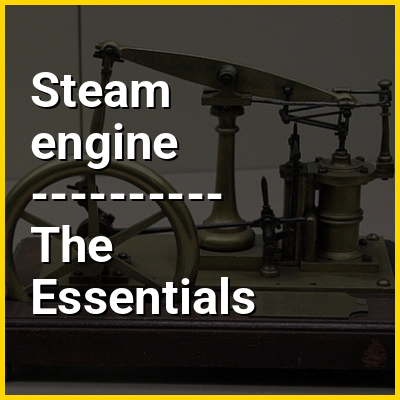
A steam engine is a heat engine that performs mechanical work using steam as its working fluid. The steam engine uses the force produced by steam pressure to push a piston back and forth inside a cylinder. This pushing force can be transformed by a connecting rod and crank into rotational force for work. The term "steam engine" is most commonly applied to reciprocating engines as just described, although some authorities have also referred to the steam turbine and devices such as Hero's aeolipile as "steam engines". The essential feature of steam engines is that they are external combustion engines, where the working fluid is separated from the combustion products. The ideal thermodynamic cycle used to analyze this process is called the Rankine cycle. In general usage, the term steam engine can refer to either complete steam plants (including boilers etc.), such as railway steam locomotives and portable engines, or may refer to the piston or turbine machinery alone, as in the beam engine and stationary steam engine.

Steam-driven devices such as the aeolipile were known in the first century AD, and there were a few other uses recorded in the 16th century. In 1606 Jerónimo de Ayanz y Beaumont patented his invention of the first steam-powered water pump for draining mines. Thomas Savery is considered the inventor of the first commercially used steam powered device, a steam pump that used steam pressure operating directly on the water. The first commercially successful engine that could transmit continuous power to a machine was developed in 1712 by Thomas Newcomen. In 1764, James Watt made a critical improvement by removing spent steam to a separate vessel for condensation, greatly improving the amount of work obtained per unit of fuel consumed. By the 19th century, stationary steam engines powered the factories of the Industrial Revolution. Steam engines replaced sails for ships on paddle steamers, and steam locomotives operated on the railways.
↓ Menu

>>>PUT SHARE BUTTONS HERE<<<
In this Dossier

Steam engine in the context of Exploitation of natural resources

The exploitation of natural resources describes using natural resources, often non-renewable or limited, for economic growth or development. Environmental degradation, human insecurity, and social conflict frequently accompany natural resource exploitation. The impacts of the depletion of natural resources include the decline of economic growth in local areas; however, the abundance of natural resources does not always correlate with a country's material prosperity. Many resource-rich countries, especially in the Global South, face distributional conflicts, where local bureaucracies mismanage or disagree on how resources should be used. Foreign industries also contribute to resource exploitation, where raw materials are outsourced from developing countries, with the local communities receiving little profit from the exchange. This is often accompanied by negative effects of economic growth around the affected areas such as inequality and pollution.

The exploitation of natural resources started to emerge on an industrial scale in the 19th century as the extraction and processing of raw materials (such as in mining, steam power, and machinery) expanded much further than it had in pre-industrial areas. During the 20th century, energy consumption rapidly increased. As of 2012, about 78.3% of the world's energy consumption is sustained by the extraction of fossil fuels, which consists of oil, coal and natural gas.

↑ Return to Menu

Steam engine in the context of Industrial Revolution

The Industrial Revolution, sometimes divided into the First Industrial Revolution and Second Industrial Revolution, was a transitional period of the global economy toward more widespread, efficient and stable manufacturing processes, succeeding the Second Agricultural Revolution. Beginning in Great Britain around 1760, the Industrial Revolution had spread to continental Europe and the United States by about 1840. This transition included going from hand production methods to machines; new chemical manufacturing and iron production processes; the increasing use of water power and steam power; the development of machine tools; and rise of the mechanised factory system. Output greatly increased, and the result was an unprecedented rise in population and population growth. The textile industry was the first to use modern production methods, and textiles became the dominant industry in terms of employment, value of output, and capital invested.

Many technological and architectural innovations were British. By the mid-18th century, Britain was the leading commercial nation, controlled a global trading empire with colonies in North America and the Caribbean, and had military and political hegemony on the Indian subcontinent. The development of trade and rise of business were among the major causes of the Industrial Revolution. Developments in law facilitated the revolution, such as courts ruling in favour of property rights. An entrepreneurial spirit and consumer revolution helped drive industrialisation.

↑ Return to Menu

Steam engine in the context of Engineering

Engineering is the practice of using natural science, mathematics, and the engineering design process to solve problems within technology, increase efficiency and productivity, and improve systems. The traditional disciplines of engineering are civil, mechanical, electrical, and chemical. The academic discipline of engineering encompasses a broad range of more specialized subfields, and each can have a more specific emphasis for applications of mathematics and science. In turn, modern engineering practice spans multiple fields of engineering, which include designing and improving infrastructure, machinery, vehicles, electronics, materials, and energy systems. For related terms, see glossary of engineering.

As a human endeavor, engineering has existed since ancient times, starting with the six classic simple machines. Examples of large-scale engineering projects from antiquity include impressive structures like the pyramids, elegant temples such as the Parthenon, and water conveyances like hulled watercraft, canals, and the Roman aqueduct. Early machines were powered by humans and animals, then later by wind. Machines of war were invented for siegecraft. In Europe, the scientific and industrial revolutions advanced engineering into a scientific profession and resulted in continuing technological improvements. The steam engine provided much greater power than animals, leading to mechanical propulsion for ships and railways. Further scientific advances resulted in the application of engineering to electrical, chemical, and aerospace requirements, plus the use of new materials for greater efficiencies.

↑ Return to Menu

Steam engine in the context of Matthew C. Perry

Matthew Calbraith Perry (April 10, 1794 – March 4, 1858) was a United States Navy officer who commanded ships in several wars, including the War of 1812 and the Mexican–American War. He led the Perry Expedition that ended Japan's isolationism and signed the Convention of Kanagawa between Japan and the United States in 1854.

Perry was interested in the education of naval officers and assisted in the development of an apprentice system that helped establish the curriculum at the United States Naval Academy. With the advent of the steam engine, he became a leading advocate of modernizing the U.S. Navy and came to be considered "The Father of the Steam Navy" in the United States.

↑ Return to Menu

Steam engine in the context of Coal

Coal is a combustible black or brownish-black sedimentary rock, formed as rock strata called coal seams. Coal is mostly carbon with variable amounts of other elements, chiefly hydrogen, sulfur, oxygen, and nitrogen. It is a type of fossil fuel, formed when dead plant matter decays into peat which is converted into coal by the heat and pressure of deep burial over millions of years. Vast deposits of coal originate in former wetlands called coal forests that covered much of the Earth's tropical land areas during the late Carboniferous (Pennsylvanian) and Permian times.

Coal is used primarily as a fuel. While coal has been known and used for thousands of years, its usage was limited until the Industrial Revolution. With the invention of the steam engine, coal consumption increased. In 2020, coal supplied about a quarter of the world's primary energy and over a third of its electricity. Some iron and steel-making and other industrial processes burn coal.

↑ Return to Menu

Steam engine in the context of Lubrication

Lubrication is the process or technique of using a lubricant to reduce friction and wear and tear in a contact between two surfaces. The study of lubrication is a discipline in the field of tribology.

Lubrication mechanisms such as fluid-lubricated systems are designed so that the applied load is partially or completely carried by hydrodynamic or hydrostatic pressure, which reduces solid body interactions (and consequently friction and wear). Depending on the degree of surface separation, different lubrication regimes can be distinguished.

↑ Return to Menu

Steam engine in the context of Hero of Alexandria

Hero of Alexandria (/ˈhɪər/; Ancient Greek: Ἥρων ὁ Ἀλεξανδρεύς, Hērōn hò Alexandreús, also known as Heron of Alexandria /ˈhɛrən/; probably 1st or 2nd century AD) was a Greek mathematician and engineer who was active in Alexandria in Egypt during the Roman era. He has been described as the greatest experimentalist of antiquity and a representative of the Hellenistic scientific tradition.

Hero published a well-recognized description of a steam-powered device called an aeolipile, also known as "Hero's engine". Among his most famous inventions was a windwheel, constituting the earliest instance of wind harnessing on land. In his work Mechanics, he described pantographs. Some of his ideas were derived from the works of Ctesibius.

↑ Return to Menu

Steam engine in the context of Aeolipile

An aeolipile, aeolipyle, or eolipile, also known as a Hero's (or Heron's) engine, is a simple, bladeless radial steam turbine which spins when the central water container is heated. Torque is produced by steam jets exiting the turbine. The Greek-Egyptian mathematician and engineer Hero of Alexandria described the device in the 1st century AD, and many sources give him the credit for its invention. However, Vitruvius was the first to describe this appliance in his De architectura (c. 30–20 BC).

The aeolipile is considered to be the first recorded steam engine or reaction steam turbine, but it is neither a practical source of power nor a direct predecessor of the type of steam engine invented during the Industrial Revolution.

↑ Return to Menu