Square in the context of Area (geometry)


Square in the context of Area (geometry)

Square Study page number 1 of 3

Play TriviaQuestions Online!

or

Skip to study material about Square in the context of "Area (geometry)"


⭐ Core Definition: Square

In geometry, a square is a regular quadrilateral. It has four straight sides of equal length and four equal angles. Squares are special cases of rectangles, which have four equal angles, and of rhombuses, which have four equal sides. As with all rectangles, a square's angles are right angles (90 degrees, or π/2 radians), making adjacent sides perpendicular. The area of a square is the side length multiplied by itself, and so in algebra, multiplying a number by itself is called squaring.

Equal squares can tile the plane edge-to-edge in the square tiling. Square tilings are ubiquitous in tiled floors and walls, graph paper, image pixels, and game boards. Square shapes are also often seen in building floor plans, origami paper, food servings, in graphic design and heraldry, and in instant photos and fine art.

↓ Menu
HINT:

In this Dossier

Square in the context of Pythagorean theorem

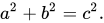
In mathematics, the Pythagorean theorem or Pythagoras's theorem is a fundamental relation in Euclidean geometry between the three sides of a right triangle. It states that the area of the square whose side is the hypotenuse (the side opposite the right angle) is equal to the sum of the areas of the squares on the other two sides.

The theorem can be written as an equation relating the lengths of the sides a, b and the hypotenuse c, sometimes called the Pythagorean equation:The theorem is named for the Greek philosopher Pythagoras, born around 570 BC. The theorem has been proved numerous times by many different methods – possibly the most for any mathematical theorem. The proofs are diverse, including both geometric proofs and algebraic proofs, with some dating back thousands of years.

View the full Wikipedia page for Pythagorean theorem
↑ Return to Menu

Square in the context of Octagon

In geometry, an octagon (from Ancient Greek ὀκτάγωνον (oktágōnon) 'eight angles') is an eight-sided polygon or 8-gon.

A regular octagon has Schläfli symbol {8} and can also be constructed as a quasiregular truncated square, t{4}, which alternates two types of edges. A truncated octagon, t{8} is a hexadecagon, {16}. A 3D analog of the octagon can be the rhombicuboctahedron with the triangular faces on it like the replaced edges, if one considers the octagon to be a truncated square.

View the full Wikipedia page for Octagon
↑ Return to Menu

Square in the context of Piazza del Campidoglio

Piazza del Campidoglio ("Capitoline Square") is a public square (piazza) on the top of the ancient Capitoline Hill, between the Roman Forum and the Campus Martius in Rome, Italy. The square includes three main buildings, the Palazzo Senatorio (Senatorial Palace) also known as the Comune di Roma Capitale (City Hall), and the two palaces that make up the Capitoline Museums, the Palazzo dei Conservatori and the Palazzo Nuovo, considered to be one of the oldest national museums, founded in 1471 when Pope Sixtus IV donated some of the museum's most impressive statues, the She-wolf, the Spinario, the Camillus and the colossal head of emperor Constantine. Over the centuries the museums' collection has grown to include many of ancient Roman's finest artworks and artifacts. If something was considered too valuable or fragile in Rome and a copy was made in its place for display, the original is likely now on display in the Capitoline Museum. The hilltop square was designed by Michelangelo in the 16th century. at the behest of Pope Paul III.

View the full Wikipedia page for Piazza del Campidoglio
↑ Return to Menu

Square in the context of Dimension

In physics and mathematics, the dimension of a mathematical space (or object) is informally defined as the minimum number of coordinates needed to specify any point within it. Thus, a line has a dimension of one (1D) because only one coordinate is needed to specify a point on it – for example, the point at 5 on a number line. A surface, such as the boundary of a cylinder or sphere, has a dimension of two (2D) because two coordinates are needed to specify a point on it – for example, both a latitude and longitude are required to locate a point on the surface of a sphere. A two-dimensional Euclidean space is a two-dimensional space on the plane. The inside of a cube, a cylinder or a sphere is three-dimensional (3D) because three coordinates are needed to locate a point within these spaces.

In classical mechanics, space and time are different categories and refer to absolute space and time. That conception of the world is a four-dimensional space but not the one that was found necessary to describe electromagnetism. The four dimensions (4D) of spacetime consist of events that are not absolutely defined spatially and temporally, but rather are known relative to the motion of an observer. Minkowski space first approximates the universe without gravity; the pseudo-Riemannian manifolds of general relativity describe spacetime with matter and gravity. 10 dimensions are used to describe superstring theory (6D hyperspace + 4D), 11 dimensions can describe supergravity and M-theory (7D hyperspace + 4D), and the state-space of quantum mechanics is an infinite-dimensional function space.

View the full Wikipedia page for Dimension
↑ Return to Menu

Square in the context of Tesserae

A tessera (plural: tesserae, diminutive tessella) is an individual tile, usually formed in the shape of a square, used in creating a mosaic. It is also known as an abaciscus or abaculus.

View the full Wikipedia page for Tesserae
↑ Return to Menu

Square in the context of Area

Area is the measure of a region's size on a surface. The area of a plane region or plane area refers to the area of a shape or planar lamina, while surface area refers to the area of an open surface or the boundary of a three-dimensional object. Area can be understood as the amount of material with a given thickness that would be necessary to fashion a model of the shape, or the amount of paint necessary to cover the surface with a single coat. It is the two-dimensional analogue of the length of a curve (a one-dimensional concept) or the volume of a solid (a three-dimensional concept).Two different regions may have the same area (as in squaring the circle); by synecdoche, "area" sometimes is used to refer to the region, as in a "polygonal area".

The area of a shape can be measured by comparing the shape to squares of a fixed size. In the International System of Units (SI), the standard unit of area is the square metre (written as m), which is the area of a square whose sides are one metre long. A shape with an area of three square metres would have the same area as three such squares. In mathematics, the unit square is defined to have area one, and the area of any other shape or surface is a dimensionless real number.

View the full Wikipedia page for Area
↑ Return to Menu

Square in the context of Town square

A town square (or public square, urban square, city square or simply square), also called a plaza or piazza, is an open public space commonly found in the heart of a traditional town or city, and which is used for community gatherings. Related concepts are the civic center, the market square and the village green.

Most squares are hardscapes suitable for open markets, concerts, political rallies, and other events that require firm ground. They are not necessarily a true geometric square.

View the full Wikipedia page for Town square
↑ Return to Menu

Square in the context of Square metre

The square metre (international spelling as used by the International Bureau of Weights and Measures) or square meter (American spelling) is the unit of area in the International System of Units (SI) with symbol m. It is the area of a square with sides one metre in length.

Adding and subtracting SI prefixes creates multiples and submultiples; however, as the unit is exponentiated, the quantities grow exponentially by the corresponding power of 10. For example, 1 kilometre is 10 (one thousand) times the length of 1 metre, but 1 square kilometre is (10) (10, one million) times the area of 1 square metre, and 1 cubic kilometre is (10) (10, one billion) cubic metres.

View the full Wikipedia page for Square metre
↑ Return to Menu

Square in the context of Parallelepipeds

In geometry, a parallelepiped is a three-dimensional figure formed by six parallelograms (the term rhomboid is also sometimes used with this meaning). By analogy, it relates to a parallelogram just as a cube relates to a square.

Three equivalent definitions of parallelepiped are

View the full Wikipedia page for Parallelepipeds
↑ Return to Menu

Square in the context of Perimeter of an ellipse

Unlike most other elementary shapes, such as the circle and square, there is no closed-form expression for the perimeter of an ellipse. Throughout history, a large number of closed-form approximations and expressions in terms of integrals or series have been given for the perimeter of an ellipse.

View the full Wikipedia page for Perimeter of an ellipse
↑ Return to Menu

Square in the context of Scaling (geometry)

In affine geometry, uniform scaling (or isotropic scaling) is a linear transformation that enlarges (increases) or shrinks (diminishes) objects by a scale factor that is the same in all directions (isotropically). The result of uniform scaling is similar (in the geometric sense) to the original. A scale factor of 1 is normally allowed, so that congruent shapes are also classed as similar. Uniform scaling happens, for example, when enlarging or reducing a photograph, or when creating a scale model of a building, car, airplane, etc.

More general is scaling with a separate scale factor for each axis direction. Non-uniform scaling (anisotropic scaling) is obtained when at least one of the scaling factors is different from the others; a special case is directional scaling or stretching (in one direction). Non-uniform scaling changes the shape of the object; e.g. a square may change into a rectangle, or into a parallelogram if the sides of the square are not parallel to the scaling axes (the angles between lines parallel to the axes are preserved, but not all angles). It occurs, for example, when a faraway billboard is viewed from an oblique angle, or when the shadow of a flat object falls on a surface that is not parallel to it.

View the full Wikipedia page for Scaling (geometry)
↑ Return to Menu

Square in the context of Rectangle

In Euclidean plane geometry, a rectangle is a rectilinear convex polygon or a quadrilateral with four right angles. It can also be defined as: an equiangular quadrilateral, since equiangular means that all of its angles are equal (360°/4 = 90°); or a parallelogram containing a right angle. A rectangle with four sides of equal length is a square. The term "oblong" is used to refer to a non-square rectangle. A rectangle with vertices ABCD would be denoted as  ABCD.

The word rectangle comes from the Latin rectangulus, which is a combination of rectus (as an adjective, right, proper) and angulus (angle).

View the full Wikipedia page for Rectangle
↑ Return to Menu

Square in the context of Rhombus

In geometry, a rhombus (pl.: rhombi or rhombuses) is an equilateral quadrilateral, a quadrilateral whose four sides all have the same length. Other names for rhombus include diamond, lozenge, and calisson.

Every rhombus is a simple polygon (having no self-intersections). A rhombus is a special case of a parallelogram and a kite. A rhombus with right angles is a square. A non-square rhombus has two opposite acute angles and two opposite obtuse angles.

View the full Wikipedia page for Rhombus
↑ Return to Menu

Square in the context of Square (algebra)

In mathematics, a square is the result of multiplying a number by itself. The verb "to square" is used to denote this operation. Squaring is the same as raising to the power 2, and is denoted by a superscript 2; for instance, the square of 3 may be written as 3, which is the number 9.In some cases when superscripts are not available, as for instance in programming languages or plain text files, the notations x^2 (caret) or x**2 may be used in place of x.The adjective which corresponds to squaring is quadratic.

The square of an integer may also be called a square number or a perfect square. In algebra, the operation of squaring is often generalized to polynomials, other expressions, or values in systems of mathematical values other than the numbers. For instance, the square of the linear polynomial x + 1 is the quadratic polynomial (x + 1) = x + 2x + 1.

View the full Wikipedia page for Square (algebra)
↑ Return to Menu

Square in the context of Completing the square

In elementary algebra, completing the square is a technique for converting a quadratic polynomial of the form to the form for some values of and . In terms of a new quantity , this expression is a quadratic polynomial with no linear term. By subsequently isolating and taking the square root, a quadratic problem can be reduced to a linear problem.

The name completing the square comes from a geometrical picture in which represents an unknown length. Then the quantity represents the area of a square of side and the quantity represents the area of a pair of congruent rectangles with sides and . To this square and pair of rectangles, one more square is added, of side length . This crucial step completes a larger square of side length .

View the full Wikipedia page for Completing the square
↑ Return to Menu