Spectral radiance in the context of "Radiance"

Play Trivia Questions online!

or

Skip to study material about Spectral radiance in the context of "Radiance"

Ad spacer

⭐ Core Definition: Spectral radiance

In radiometry, spectral radiance or specific intensity is the radiance of a surface per unit frequency or wavelength, depending on whether the spectrum is taken as a function of frequency or of wavelength. The SI unit of spectral radiance in frequency is the watt per steradian per square metre per hertz (W·sr·m·Hz) and that of spectral radiance in wavelength is the watt per steradian per square metre per metre (W·sr·m)—commonly the watt per steradian per square metre per nanometre (W·sr·m·nm). The microflick is also used to measure spectral radiance in some fields.

Spectral radiance gives a full radiometric description of the field of classical electromagnetic radiation of any kind, including thermal radiation and light. It is conceptually distinct from the descriptions in explicit terms of Maxwellian electromagnetic fields or of photon distribution. It refers to material physics as distinct from psychophysics.

↓ Menu

>>>PUT SHARE BUTTONS HERE<<<

👉 Spectral radiance in the context of Radiance

In radiometry, radiance is the radiant flux emitted, reflected, transmitted or received by a given surface, per unit solid angle per unit projected area. Radiance is used to characterize diffuse emission and reflection of electromagnetic radiation, and to quantify emission of neutrinos and other particles. The SI unit of radiance is the watt per steradian per square metre (W·sr·m). It is a directional quantity: the radiance of a surface depends on the direction from which it is being observed.

The related quantity spectral radiance is the radiance of a surface per unit frequency or wavelength, depending on whether the spectrum is taken as a function of frequency or of wavelength.

↓ Explore More Topics
In this Dossier

Spectral radiance in the context of Rayleigh–Jeans law

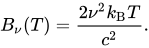
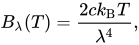
In physics, the Rayleigh–Jeans law is an approximation to the spectral radiance of electromagnetic radiation as a function of wavelength from a black body at a given temperature through classical arguments. For wavelength λ, it iswhere is the spectral radiance (the power emitted per unit emitting area, per steradian, per unit wavelength), is the speed of light, is the Boltzmann constant, and is the temperature in kelvins. For frequency , the expression is instead

The Rayleigh–Jeans law agrees with experimental results at large wavelengths (low frequencies) but strongly disagrees at short wavelengths (high frequencies). This inconsistency between observations and the predictions of classical physics is commonly known as the ultraviolet catastrophe. Planck's law, which gives the correct radiation at all frequencies, has the Rayleigh–Jeans law as its low-frequency limit.

↑ Return to Menu