Sine in the context of Ratio


Sine in the context of Ratio

Sine Study page number 1 of 2

Play TriviaQuestions Online!

or

Skip to study material about Sine in the context of "Ratio"


⭐ Core Definition: Sine

In mathematics, sine and cosine are trigonometric functions of an angle. The sine and cosine of an acute angle are defined in the context of a right triangle: for the specified angle, its sine is the ratio of the length of the side opposite that angle to the length of the longest side of the triangle (the hypotenuse), and the cosine is the ratio of the length of the adjacent leg to that of the hypotenuse. For an angle , the sine and cosine functions are denoted as and .

The definitions of sine and cosine have been extended to any real value in terms of the lengths of certain line segments in a unit circle. More modern definitions express the sine and cosine as infinite series, or as the solutions of certain differential equations, allowing their extension to arbitrary positive and negative values and even to complex numbers.

↓ Menu
HINT:

In this Dossier

Sine in the context of Trigonometry

Trigonometry (from Ancient Greek τρίγωνον (trígōnon) 'triangle' and μέτρον (métron) 'measure') is a branch of mathematics concerned with relationships between angles and side lengths of triangles. In particular, the trigonometric functions relate the angles of a right triangle with ratios of its side lengths. The field emerged in the Hellenistic world during the 3rd century BC from applications of geometry to astronomical studies. The Greeks focused on the calculation of chords, while mathematicians in India created the earliest-known tables of values for trigonometric ratios (also called trigonometric functions) such as sine.

Throughout history, trigonometry has been applied in areas such as geodesy, surveying, celestial mechanics, and navigation.

View the full Wikipedia page for Trigonometry
↑ Return to Menu

Sine in the context of Circle of latitude

A circle of latitude or line of latitude on Earth is an abstract eastwest small circle connecting all locations around Earth (ignoring elevation) at a given latitude coordinate line.

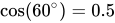
Circles of latitude are often called parallels because they are parallel to each other; that is, planes that contain any of these circles never intersect each other. A location's position along a circle of latitude is given by its longitude. Circles of latitude are unlike circles of longitude, which are all great circles with the centre of Earth in the middle, as the circles of latitude get smaller as the distance from the Equator increases. Their length can be calculated by a common sine or cosine function. For example, the 60th parallel north or south is half as long as the Equator (disregarding Earth's minor flattening by 0.335%), stemming from . On the Mercator projection or on the Gall-Peters projection, a circle of latitude is perpendicular to all meridians. On the ellipsoid or on spherical projection, all circles of latitude are rhumb lines, except the Equator.

View the full Wikipedia page for Circle of latitude
↑ Return to Menu

Sine in the context of Unary operation

In mathematics, a unary operation is an operation with only one operand, i.e. a single input. This is in contrast to binary operations, which use two operands. An example is any function , where A is a set; the function is a unary operation on A.

Common notations are prefix notation (e.g. ¬, ), postfix notation (e.g. factorial n!), functional notation (e.g. sinx or sin(x)), and superscripts (e.g. transpose A). Other notations exist as well, for example, in the case of the square root, a horizontal bar extending the square root sign over the argument can indicate the extent of the argument.

View the full Wikipedia page for Unary operation
↑ Return to Menu

Sine in the context of Phase shift

In physics and mathematics, the phase (symbol φ or ϕ) of a wave or other periodic function of some real variable (such as time) is an angle-like quantity representing the fraction of the cycle covered up to . It is expressed in such a scale that it varies by one full turn as the variable goes through each period (and goes through each complete cycle). It may be measured in any angular unit such as degrees or radians, thus increasing by 360° or as the variable completes a full period.

This convention is especially appropriate for a sinusoidal function, since its value at any argument then can be expressed as , the sine of the phase, multiplied by some factor (the amplitude of the sinusoid). (The cosine may be used instead of sine, depending on where one considers each period to start.)

View the full Wikipedia page for Phase shift
↑ Return to Menu

Sine in the context of Indian mathematics

Indian mathematics emerged in the Indian subcontinent from 1200 BCE until the end of the 18th century. In the classical period of Indian mathematics (400 CE to 1200 CE), important contributions were made by scholars like Aryabhata, Brahmagupta, Bhaskara II, Varāhamihira, and Madhava. The decimal number system in use today was first recorded in Indian mathematics. Indian mathematicians made early contributions to the study of the concept of zero as a number, negative numbers, arithmetic, and algebra. In addition, trigonometrywas further advanced in India, and, in particular, the modern definitions of sine and cosine were developed there. These mathematical concepts were transmitted to the Middle East, China, and Europe and led to further developments that now form the foundations of many areas of mathematics.

Ancient and medieval Indian mathematical works, all composed in Sanskrit, usually consisted of a section of sutras in which a set of rules or problems were stated with great economy in verse in order to aid memorization by a student. This was followed by a second section consisting of a prose commentary (sometimes multiple commentaries by different scholars) that explained the problem in more detail and provided justification for the solution. In the prose section, the form (and therefore its memorization) was not considered so important as the ideas involved. All mathematical works were orally transmitted until approximately 500 BCE; thereafter, they were transmitted both orally and in manuscript form. The oldest extant mathematical document produced on the Indian subcontinent is the birch bark Bakhshali Manuscript, discovered in 1881 in the village of Bakhshali, near Peshawar (modern day Pakistan) and is likely from the 7th century CE.

View the full Wikipedia page for Indian mathematics
↑ Return to Menu

Sine in the context of Trigonometric functions

In mathematics, the trigonometric functions (also called circular functions, angle functions or goniometric functions) are real functions which relate an angle of a right-angled triangle to ratios of two side lengths. They are widely used in all sciences that are related to geometry, such as navigation, solid mechanics, celestial mechanics, geodesy, and many others. They are among the simplest periodic functions, and are widely used for studying periodic phenomena through Fourier analysis.

The trigonometric functions most widely used in modern mathematics are the sine, the cosine, and the tangent functions. Their reciprocals are respectively the cosecant, the secant, and the cotangent functions, which are less used. Each of these six trigonometric functions has a corresponding inverse function and has an analog among the hyperbolic functions.

View the full Wikipedia page for Trigonometric functions
↑ Return to Menu

Sine in the context of Ptolemy's table of chords

The table of chords, created by the Greek astronomer, geometer, and geographer Ptolemy in Egypt during the 2nd century AD, is a trigonometric table in Book I, chapter 11 of Ptolemy's Almagest, a treatise on mathematical astronomy. It is essentially equivalent to a table of values of the sine function. It was the earliest trigonometric table extensive enough for many practical purposes, including those of astronomy (an earlier table of chords by Hipparchus gave chords only for arcs that were multiples of ⁠7+1/2° = π/24 radians). Since the 8th and 9th centuries, the sine and other trigonometric functions have been used in Islamic mathematics and astronomy, reforming the production of sine tables. Khwarizmi and Habash al-Hasib later produced a set of trigonometric tables.

View the full Wikipedia page for Ptolemy's table of chords
↑ Return to Menu

Sine in the context of Sine wave

A sine wave, sinusoidal wave, or sinusoid (symbol: ) is a periodic wave whose waveform (shape) is the trigonometric sine function. In mechanics, as a linear motion over time, this is simple harmonic motion; as rotation, it corresponds to uniform circular motion. Sine waves occur often in physics, including wind waves, sound waves, and light waves, such as monochromatic radiation. In engineering, signal processing, and mathematics, Fourier analysis decomposes general functions into a sum of sine waves of various frequencies, relative phases, and magnitudes.

When any two sine waves of the same frequency (but arbitrary phase) are linearly combined, the result is another sine wave of the same frequency; this property is unique among periodic waves. Conversely, if some phase is chosen as a zero reference, a sine wave of arbitrary phase can be written as the linear combination of two sine waves with phases of zero and a quarter cycle, the sine and cosine components, respectively.

View the full Wikipedia page for Sine wave
↑ Return to Menu

Sine in the context of Oscilloscope

An oscilloscope (formerly known as an oscillograph, informally scope or O-scope) is a type of electronic test instrument that graphically displays varying voltages of one or more signals as a function of time. Their main purpose is capturing information on electrical signals for debugging, analysis, or characterization. The displayed waveform can then be analyzed for properties such as amplitude, frequency, rise time, time interval, distortion, and others. Originally, calculation of these values required manually measuring the waveform against the scales built into the screen of the instrument. Modern digital instruments may calculate and display these properties directly.

Oscilloscopes are used in the sciences, engineering, biomedical, automotive and the telecommunications industry. General-purpose instruments are used for maintenance of electronic equipment and laboratory work. Special-purpose oscilloscopes may be used to analyze an automotive ignition system or to display the waveform of the heartbeat as an electrocardiogram, for instance.

View the full Wikipedia page for Oscilloscope
↑ Return to Menu

Sine in the context of Pure tone

In psychoacoustics and signal processing, a pure tone is a sound or other signal with a sinusoidal waveform; that is, a sine wave of constant frequency, phase-shift, and amplitude.A pure tone has the property – unique among real-valued wave shapes – that its wave shape is unchanged by linear time-invariant systems; that is, only the phase and amplitude change between such a system's pure-tone input and its output.

Sine and cosine waves can be used as basic building blocks of more complex waves. As additional sine waves having different frequencies are combined, the waveform transforms from a sinusoidal shape into a more complex shape.When considered as part of a whole spectrum, a pure tone may also be called a spectral component.

View the full Wikipedia page for Pure tone
↑ Return to Menu

Sine in the context of Bhāskara I

Bhāskara I (c. 600 – c. 680) was a 7th-century Indian mathematician and astronomer who was the first to write numbers in the Hindu–Arabic decimal system with a circle for the zero, and who gave a unique and remarkable rational approximation of the sine function in his commentary on Aryabhata's work. This commentary, Āryabhaṭīyabhāṣya, written in 629, is among the oldest known prose works in Sanskrit on mathematics and astronomy. He also wrote two astronomical works in the line of Aryabhata's school: the Mahābhāskarīya ("Great Book of Bhāskara") and the Laghubhāskarīya ("Small Book of Bhāskara").

On 7 June 1979, the Indian Space Research Organisation launched the Bhāskara I satellite, named in honour of the mathematician.

View the full Wikipedia page for Bhāskara I
↑ Return to Menu

Sine in the context of Inverse trigonometric functions

In mathematics, the inverse trigonometric functions (occasionally also called antitrigonometric, cyclometric, or arcus functions) are the inverse functions of the trigonometric functions, under suitably restricted domains. Specifically, they are the inverses of the sine, cosine, tangent, cotangent, secant, and cosecant functions, and are used to obtain an angle from any of the angle's trigonometric ratios. Inverse trigonometric functions are widely used in engineering, navigation, physics, and geometry.

View the full Wikipedia page for Inverse trigonometric functions
↑ Return to Menu

Sine in the context of Pythagorean identity

The Pythagorean trigonometric identity, also called simply the Pythagorean identity, is an identity expressing the Pythagorean theorem in terms of trigonometric functions. Along with the sum-of-angles formulae, it is one of the basic relations between the sine and cosine functions.

View the full Wikipedia page for Pythagorean identity
↑ Return to Menu