Serpentine subgroup in the context of "Lizardite"

Play Trivia Questions online!

or

Skip to study material about Serpentine subgroup in the context of "Lizardite"

Ad spacer

⭐ Core Definition: Serpentine subgroup

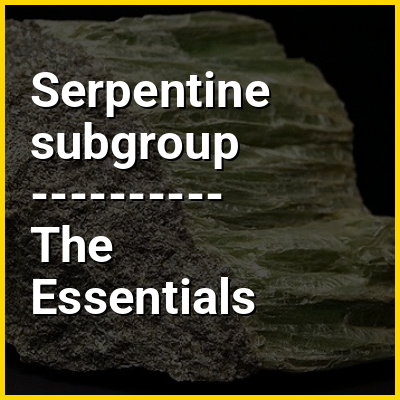
Serpentine subgroup (part of the kaolinite-serpentine group in the category of phyllosilicates) are greenish, brownish, or spotted minerals commonly found in serpentinite. They are used as a source of magnesium and asbestos, and as decorative stone. The name comes from the greenish color and smooth or scaly appearance from the Latin serpentinus, meaning "snake-like".

Serpentine subgroup is a set of common rock-forming hydrous magnesium iron phyllosilicate ((Mg,Fe)
3
Si
2
O
5
(OH)
4
) minerals, resulting from the metamorphism of the minerals that are contained in mafic to ultramafic rocks. They may contain minor amounts of other elements including chromium, manganese, cobalt or nickel. In mineralogy and gemology, serpentine may refer to any of the 20 varieties belonging to the serpentine subgroup. Owing to admixture, these varieties are not always easy to individualize, and distinctions are not usually made. There are three important mineral polymorphs of serpentine: antigorite, lizardite and chrysotile.
↓ Menu

>>>PUT SHARE BUTTONS HERE<<<

👉 Serpentine subgroup in the context of Lizardite

Lizardite is a mineral from the serpentine subgroup with formula Mg3(Si2O5)(OH)4, and the most common type of mineral in the subgroup. It is also a member of the kaolinite-serpentine group.

Lizardite may form a solid-solution series with the nickel-bearing népouite (pure end-member: Ni3(Si2O5)(OH)4). Intermediate compositions (Mg,Ni)3(Si2O5)(OH)4 are possible, with varying proportions of magnesium and nickel. However, the lizardite end-member is much more common than pure népouite, a relatively rare mineral most often formed by the alteration of ultramafic rocks.

↓ Explore More Topics
In this Dossier

Serpentine subgroup in the context of Volcanic arc

A volcanic arc (also known as a magmatic arc) is a belt of volcanoes formed above a subducting oceanic tectonic plate, with the belt arranged in an arc shape as seen from above. Volcanic arcs typically parallel an oceanic trench, with the arc located further from the subducting plate than the trench. The oceanic plate is saturated with water, mostly in the form of hydrous minerals such as micas, amphiboles, and serpentines. As the oceanic plate is subducted, it is subjected to increasing pressure and temperature with increasing depth. The heat and pressure break down the hydrous minerals in the plate, releasing water into the overlying mantle. Volatiles such as water drastically lower the melting point of the mantle, causing some of the mantle to melt and form magma at depth under the overriding plate. The magma ascends to form an arc of volcanoes parallel to the subduction zone.

Volcanic arcs are distinct from volcanic chains formed over hotspots in the middle of a tectonic plate. Volcanoes often form one after another as the plate moves over the hotspot, and so the volcanoes progress in age from one end of the chain to the other. The Hawaiian Islands form a typical hotspot chain, with the older islands to the northwest and Hawaii Island itself, which is just 400,000 years old, at the southeast end of the chain over the hotspot. Volcanic arcs do not generally exhibit such a simple age-pattern.

↑ Return to Menu

Serpentine subgroup in the context of Antigorite

Antigorite is a lamellated, monoclinic mineral in the phyllosilicate serpentine subgroup with the ideal chemical formula of (Mg,Fe)3Si2O5(OH)4. It is the high-pressure polymorph of serpentine and is commonly found in metamorphosed serpentinites. Antigorite, and its serpentine polymorphs, play an important role in subduction zone dynamics due to their relative weakness and high weight percent of water (up to 13 weight % H2O). It is named after its type locality, the Geisspfad serpentinite, Valle Antigorio in the border region of Italy/Switzerland and is commonly used as a gemstone in jewelry and carvings.

↑ Return to Menu

Serpentine subgroup in the context of Chrysotile

Chrysotile (/ˈkrɪsəˌtʌɪl/, /ˈkrɪsəˌtaɪl/, or /ˈkrɪsətɪl/) or white asbestos is the most commonly encountered form of asbestos, accounting for approximately 95% of the asbestos in the United States and a similar proportion in other countries. It is a soft, fibrous silicate mineral in the serpentine subgroup of phyllosilicates; as such, it is distinct from other asbestiform minerals in the amphibole group. Its idealized chemical formula is Mg3(Si2O5)(OH)4. The material has physical properties which make it desirable for inclusion in building materials, but poses serious health risks when dispersed into air and inhaled.

↑ Return to Menu

Serpentine subgroup in the context of Serpentinization

Serpentinization is a hydration and metamorphic transformation of ferromagnesian minerals, such as olivine and pyroxene, in mafic and ultramafic rock to produce serpentinite. Minerals formed by serpentinization include the serpentine group minerals (antigorite, lizardite, chrysotile), brucite, talc, Ni-Fe alloys, and magnetite. The mineral alteration is particularly important at the sea floor at tectonic plate boundaries.

↑ Return to Menu

Serpentine subgroup in the context of Greenschist facies

Greenschists are metamorphic rocks that formed under the lowest temperatures and pressures usually produced by regional metamorphism, typically 300–450 °C (570–840 °F) and 2–10 kilobars (29,000–145,000 psi). Greenschists commonly have an abundance of green minerals such as chlorite, serpentine, and epidote, and platy minerals such as muscovite and platy serpentine. The platiness gives the rock schistosity (a tendency to split into layers). Other common minerals include quartz, orthoclase, talc, carbonate minerals and amphibole (actinolite).

Greenschist is a general field petrologic term for metamorphic or altered mafic volcanic rock. In Europe, the term prasinite is sometimes used. A greenstone is sometimes a greenschist but can also be rock types without any schistosity, especially metabasalt (spilite). However, basalts may remain quite black if primary pyroxene does not revert to chlorite or actinolite. To qualify for the name, a rock must also exhibit schistosity or some foliation or layering. The rock is derived from basalt, gabbro or similar rocks containing sodium-rich plagioclase feldspar, chlorite, epidote and quartz.

↑ Return to Menu