Semi-major axis in the context of Damocloid


Semi-major axis in the context of Damocloid

Semi-major axis Study page number 1 of 2

Play TriviaQuestions Online!

or

Skip to study material about Semi-major axis in the context of "Damocloid"


⭐ Core Definition: Semi-major axis

In geometry, the major axis of an ellipse is its longest diameter: a line segment that runs through the center and both foci, with ends at the two most widely separated points of the perimeter. The semi-major axis (major semiaxis) is the longest semidiameter or one half of the major axis, and thus runs from the centre, through a focus, and to the perimeter. The semi-minor axis (minor semiaxis) of an ellipse or hyperbola is a line segment that is at right angles with the semi-major axis and has one end at the center of the conic section. For the special case of a circle, the lengths of the semi-axes are both equal to the radius of the circle.

The length of the semi-major axis a of an ellipse is related to the semi-minor axis's length b through the eccentricity e and the semi-latus rectum , as follows:

↓ Menu
HINT:

In this Dossier

Semi-major axis in the context of Lunar distance

The instantaneous Earth–Moon distance, or distance to the Moon, is the distance from the center of Earth to the center of the Moon. In contrast, the Lunar distance (LD or ), or Earth–Moon characteristic distance, is a unit of measure in astronomy. More technically, it is the semi-major axis of the geocentric lunar orbit. The average lunar distance is approximately 385,000 km (239,000 mi), or 1.3 light-seconds. It is roughly 30 times Earth's diameter and a non-stop plane flight traveling that distance would take more than two weeks. Around 389 lunar distances make up an astronomical unit (roughly the distance from Earth to the Sun).

Lunar distance is commonly used to express the distance to near-Earth object encounters. Lunar semi-major axis is an important astronomical datum. It has implications for testing gravitational theories such as general relativity and for refining other astronomical values, such as the mass, radius, and rotation of Earth. The measurement is also useful in measuring the lunar radius, as well as the distance to the Sun.

View the full Wikipedia page for Lunar distance
↑ Return to Menu

Semi-major axis in the context of Jupiter trojan

The Jupiter trojans, commonly called trojan asteroids or simply trojans, are a large group of asteroids that share the planet Jupiter's orbit around the Sun. Relative to Jupiter, each trojan librates around one of Jupiter's stable Lagrange points: either L4, existing 60° ahead of the planet in its orbit, or L5, 60° behind. Jupiter trojans are distributed in two elongated, curved regions around these Lagrangian points with an average semi-major axis of about 5.2 AU.

The first Jupiter trojan discovered, 588 Achilles, was spotted in 1906 by German astronomer Max Wolf. More than 15,300 Jupiter trojans have been found as of October 2025. By convention, they are each named from Greek mythology after a figure of the Trojan War, hence the name "trojan". The total number of Jupiter trojans larger than 1 km in diameter is believed to be about 1 million, approximately equal to the number of asteroids larger than 1 km in the asteroid belt. Like main-belt asteroids, Jupiter trojans form families.

View the full Wikipedia page for Jupiter trojan
↑ Return to Menu

Semi-major axis in the context of Sednoid

A sednoid is a trans-Neptunian object with a large semi-major axis, a distant perihelion and a highly eccentric orbit, similar to that of the dwarf planet Sedna. The consensus among astronomers is that there are only four objects that are known from this population: Sedna, 2012 VP113, 541132 Leleākūhonua, and 2023 KQ14. All four have perihelia greater than 60 AU. The sednoids are also classified as detached objects, since their perihelion distances are large enough that Neptune's gravity does not strongly influence their orbits. Some astronomers consider the sednoids to be Inner Oort Cloud (IOC) objects. The inner Oort cloud, or Hills cloud, lies at 1,000–10,000 AU from the Sun.

One attempt at a precise definition of sednoids is any body with a perihelion greater than 50 AU and a semi-major axis greater than 150 AU.However, this definition applies to the objects 2013 SY99, 2020 MQ53, and 2021 RR205 which have perihelia beyond 50 AU and semi-major axes over 700 AU. Despite this, astronomers do not classify these objects as sednoids because their orbits still experience gradual orbital migration as a result of perturbations by galactic tides and Neptune's weak gravitational influence.

View the full Wikipedia page for Sednoid
↑ Return to Menu

Semi-major axis in the context of Trans-Neptunian object

A trans-Neptunian object (TNO), also written transneptunian object, is any minor planet in the Solar System that orbits the Sun at a greater average distance than Neptune, which has an orbital semi-major axis of 30.1 astronomical units (AU).

Typically, TNOs are further divided into the classical and resonant objects of the Kuiper belt, the scattered disc and detached objects with the sednoids being the most distant ones. As of February 2025, the catalog of minor planets contains 1006 numbered and more than 4000 unnumbered TNOs. However, nearly 5900 objects with semimajor axis over 30 AU are present in the MPC catalog, with 1009 being numbered.

View the full Wikipedia page for Trans-Neptunian object
↑ Return to Menu

Semi-major axis in the context of Moons of Mars

The two moons of Mars are Phobos and Deimos. They are irregular in shape. Both were discovered by American astronomer Asaph Hall in August 1877 and are named after the Greek mythological twin characters Phobos (fear and panic) and Deimos (terror and dread) who accompanied their father Ares (Mars in Roman mythology, hence the name of the planet) into battle.

Compared to the Earth's Moon, the moons Phobos and Deimos are very small. Phobos has a diameter of 22.2 km (13.8 mi) and a mass of 1.08×10 kg, while Deimos measures 12.6 km (7.8 mi) across, with a mass of 1.5×10 kg. Phobos orbits closer to Mars, with a semi-major axis of 9,377 km (5,827 mi) and an orbital period of 7.66 hours; while Deimos orbits farther with a semi-major axis of 23,460 km (14,580 mi) and an orbital period of 30.35 hours.

View the full Wikipedia page for Moons of Mars
↑ Return to Menu

Semi-major axis in the context of Classical Kuiper belt

A classical Kuiper belt object, also called a cubewano (/ˌkjuːbˈwʌn/ "QB1-o"), is a low-eccentricity Kuiper belt object (KBO) that orbits beyond Neptune and is not controlled by an orbital resonance with Neptune. Cubewanos have orbits with semi-major axes in the 40–50 AU range and, unlike Pluto, do not cross Neptune's orbit. That is, they have low-eccentricity and sometimes low-inclination orbits like the classical planets.

The name "cubewano" derives from the first trans-Neptunian object (TNO) found after Pluto and Charon: 15760 Albion, which until January 2018 had only the provisional designation (15760) 1992 QB1. Similar objects found later were often called "QB1-os", or "cubewanos", after this object, though the term "classical" is much more frequently used in the scientific literature.

View the full Wikipedia page for Classical Kuiper belt
↑ Return to Menu

Semi-major axis in the context of Distant minor planet

A distant minor planet, or distant object, is any minor planet found beyond Jupiter in the outer Solar System that is not commonly thought of as an "asteroid". The umbrella term is used by IAU's Minor Planet Center (MPC), which is responsible for the identification, designation and orbit computation of these objects. As of January 2025, the MPC maintains 6101 distant objects in its data base.

Most distant minor planets are trans-Neptunian objects and centaurs, while relatively few are damocloids, Neptune trojans or Uranus trojans. All distant objects have a semi-major axis (average distance from the Sun) greater than 6 AU. This threshold, which is just beyond the orbit of Jupiter (5.2 AU), ensures that the vast majority of "true asteroids" – such as the near-Earth, Mars-crosser, main-belt and Jupiter trojan populations – are excluded from the distant minor planets.

View the full Wikipedia page for Distant minor planet
↑ Return to Menu

Semi-major axis in the context of Planetary migration

Planetary migration occurs when a planet or other body in orbit around a star interacts with a disk of gas or planetesimals, resulting in the alteration of its orbital parameters, especially its semi-major axis. Planetary migration is the most likely explanation for hot Jupiters (exoplanets with Jovian masses but orbits of only a few days). The generally accepted theory of planet formation from a protoplanetary disk predicts that such planets cannot form so close to their stars, as there is insufficient mass at such small radii and the temperature is too high to allow the formation of rocky or icy planetesimals.

It has also become clear that terrestrial-mass planets may be subject to rapid inward migration if they form while the gas disk is still present. This may affect the formation of the cores of the giant planets (which have masses of the order of 10 to 1000 Earth masses), if those planets form via the core-accretion mechanism.

View the full Wikipedia page for Planetary migration
↑ Return to Menu

Semi-major axis in the context of Superellipse

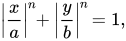
A superellipse, also known as a Lamé curve after Gabriel Lamé, is a closed curve resembling the ellipse, retaining the geometric features of semi-major axis and semi-minor axis, and symmetry about them, but defined by an equation that allows for various shapes between a rectangle and an ellipse.

In two dimensional Cartesian coordinate system, a superellipse is defined as the set of all points on the curve that satisfy the equationwhere and are positive numbers referred to as semi-diameters or semi-axes of the superellipse, and is a positive parameter that defines the shape. When , the superellipse is an ordinary ellipse. For , the shape is more rectangular with rounded corners, and for , it is more pointed.

View the full Wikipedia page for Superellipse
↑ Return to Menu

Semi-major axis in the context of Hilda asteroid

The Hilda asteroids (adj. Hildian) are a dynamical group of more than 6,000 asteroids located beyond the asteroid belt but within Jupiter's orbit, in a 3:2 orbital resonance with Jupiter; that is, while Jupiter orbits twice, the Hildas orbit three times. The namesake is the asteroid 153 Hilda.

Hildas move in their elliptical orbits in such a fashion that they arrive closest to Jupiter's orbit (i.e. at their aphelion) just when either one of Jupiter's L5, L4 or L3 Lagrange points arrives there. On their next orbit their aphelion will synchronize with the next Lagrange point in the L5L4L3 sequence. Since L5, L4 and L3 are 120° apart, by the time a Hilda completes an orbit, Jupiter will have completed 360° − 120° or two-thirds of its own orbit. A Hilda's orbit has a semi-major axis between 3.7 and 4.2 AU (the average over a long time span is 3.97), an eccentricity less than 0.3, and an inclination less than 20°. Two collisional families exist within the Hilda group: the Hilda family and the Schubart family. The namesake for the latter family is 1911 Schubart.

View the full Wikipedia page for Hilda asteroid
↑ Return to Menu

Semi-major axis in the context of Asteroid family

An asteroid family is a population of asteroids that share similar proper orbital elements, such as semi-major axis, eccentricity, and orbital inclination. The members of the families are thought to be fragments of past asteroid collisions. An asteroid family is a more specific term than asteroid group whose members, while sharing some broad orbital characteristics, may be otherwise unrelated to each other.

View the full Wikipedia page for Asteroid family
↑ Return to Menu

Semi-major axis in the context of 2013 SY99

2013 SY99, also known by its OSSOS survey designation uo3L91, is a trans-Neptunian object discovered on September 29, 2013 by the Outer Solar System Origins Survey using the Canada–France–Hawaii Telescope at Mauna Kea Observatory. This object orbits the Sun between 50 and 1,300 AU (7.5 and 190 billion km), and has a barycentric orbital period of nearly 20,000 years. It has the fourth largest semi-major axis for an orbit with perihelion beyond 38 AU. 2013 SY99 has one of highest perihelia of any known extreme trans-Neptunian object, behind sednoids including Sedna (76 AU), 2012 VP113 (80 AU), and Leleākūhonua (65 AU).

View the full Wikipedia page for 2013 SY99
↑ Return to Menu

Semi-major axis in the context of 2021 RR205

2021 RR205 is an extreme trans-Neptunian object discovered by astronomers Scott Sheppard, David Tholen, and Chad Trujillo with the Subaru Telescope at Mauna Kea Observatory on 5 September 2021. It resides beyond the outer extent of the Kuiper belt on a distant and highly eccentric orbit detached from Neptune's gravitational influence, with a large perihelion distance of 55.5 astronomical units (AU). Its large orbital semi-major axis (~1,000 AU) suggests it is potentially from the inner Oort cloud. 2021 RR205 and 2013 SY99 both lie in the 50–75 AU perihelion gap that separates the detached objects from the more distant sednoids; dynamical studies indicate that such objects in the inner edge of this gap weakly experience "diffusion", or inward orbital migration due to minuscule perturbations by Neptune. While Sheppard considers 2021 RR205 a sednoid, researchers Yukun Huang and Brett Gladman do not.

2021 RR205's heliocentric distance was 60 AU when it was discovered. It has been detected in precovery observations by the Dark Energy Survey at Cerro Tololo Observatory from as early as July 2017. It last passed perihelion in the early 1990s and is now moving outbound from the Sun.

View the full Wikipedia page for 2021 RR205
↑ Return to Menu

Semi-major axis in the context of Kirkwood gap

A Kirkwood gap is a gap or dip in the distribution of the semi-major axes (or equivalently of the orbital periods) of the orbits of main-belt asteroids. They correspond to the locations of orbital resonances with Jupiter. The gaps were first noticed in 1866 by Daniel Kirkwood, who also correctly explained their origin in the orbital resonances with Jupiter while a professor at Jefferson College in Canonsburg, Pennsylvania.

For example, there are very few asteroids with semimajor axis near 2.50 AU, period 3.95 years, which would make three orbits for each orbit of Jupiter (hence, called the 3:1 orbital resonance). Other orbital resonances correspond to orbital periods whose lengths are simple fractions of Jupiter's. The weaker resonances lead only to a depletion of asteroids, while spikes in the histogram are often due to the presence of a prominent asteroid family (see List of asteroid families).

View the full Wikipedia page for Kirkwood gap
↑ Return to Menu

Semi-major axis in the context of List of trans-Neptunian objects

This is a list of trans-Neptunian objects (TNOs), which are minor planets in the Solar System that orbit the Sun at a greater distance on average than Neptune, which means all of their orbits have a semi-major axis greater than 30.1 astronomical units (AU). The Kuiper belt, scattered disk, and Oort cloud are three conventional divisions of this volume of space. As of October 2025, the catalog of minor planets contains 1,037 numbered TNOs. In addition, there are 4,518 unnumbered TNOs, which have been observed since 1993.

This list consists of all types of TNO subgroups: classical Kuiper belt objects, also known as "cubewanos", the resonant trans-Neptunian objects with their main and higher-order resonant subgroups, the scattered disc objects (SDOs), and the extreme trans-Neptunian objects including the ESDOs, EDDOs, and sednoids, which have a semi-major axis of at least 150 AU and a perihelion (closest approach to the Sun) greater than that of Neptune. The list also contains several centaurs, if the object's orbit has a sufficiently large semi-major axis (a). Centaurs have unstable orbits in which the perihelion (q) is well inside of Neptune's orbit but the farthest point (aphelion, Q) is very distant.

View the full Wikipedia page for List of trans-Neptunian objects
↑ Return to Menu