Sea urchin in the context of "Deep sea"

Play Trivia Questions online!

or

Skip to study material about Sea urchin in the context of "Deep sea"

Ad spacer

⭐ Core Definition: Sea urchin

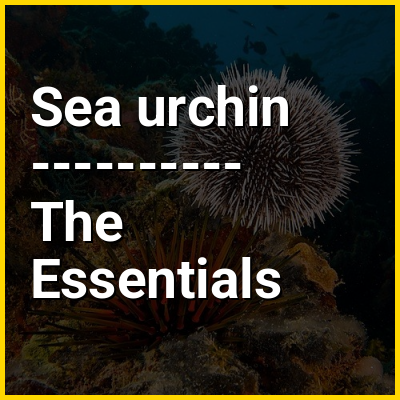
Sea urchins or urchins (/ˈɜːrɪnz/) are echinoderms in the class Echinoidea. About 950 species live on the seabed, inhabiting all oceans and depth zones from the intertidal zone to deep seas of 5,000 m (16,000 ft). They typically have a globular body covered by a spiny protective tests (hard shells), typically from 3 to 10 cm (1 to 4 in) across. Sea urchins move slowly, crawling with their tube feet, and sometimes pushing themselves with their spines. They feed primarily on algae but also eat slow-moving or sessile animals such as crinoids and sponges. Their predators include sharks, sea otters, starfish, wolf eels, and triggerfish. When unchecked by predators, urchins can create urchin barrens, damaged environments devoid of large algae and the animals associated with them.

Like all echinoderms, adult sea urchins have pentagonal symmetry with their pluteus larvae featuring bilateral (mirror) symmetry; The latter indicates that they belong to the Bilateria, along with chordates, arthropods, annelids and molluscs. Sea urchins are found in every ocean and in every climate, from the tropics to the polar regions, and inhabit marine benthic (sea bed) habitats, from rocky shores to hadal zone depths. The fossil record of the echinoids dates from the Ordovician period, some 450 million years ago. The closest echinoderm relatives of the sea urchin are the sea cucumbers (Holothuroidea), which like them are deuterostomes, a clade that includes the chordates. (Sand dollars are a separate order in the sea urchin class Echinoidea.)
↓ Menu

>>>PUT SHARE BUTTONS HERE<<<
In this Dossier

Sea urchin in the context of Fishing

Fishing is the activity of trying to catch fish. Fish are often caught as wildlife from the natural environment (freshwater or marine), but may also be caught from stocked bodies of water such as ponds, canals, park wetlands and reservoirs. Fishing techniques include trawling, longlining, jigging, hand-gathering, spearing, netting, angling, shooting and trapping, as well as more destructive and often illegal techniques such as electrocution, blasting and poisoning.

The term fishing is also used more broadly to include catching aquatic animals other than fish, such as crustaceans (shrimp/lobsters/crabs), shellfish, cephalopods (octopus/squid) and echinoderms (starfish/sea urchins). The term is not normally applied to harvesting fish raised in controlled cultivations (fish farming). Nor is it normally applied to hunting aquatic mammals, where terms like whaling and sealing are used instead.

↑ Return to Menu

Sea urchin in the context of Exoskeleton

An exoskeleton (from Ancient Greek έξω (éxō) 'outer' and σκελετός (skeletós) 'skeleton') is a skeleton that is on the exterior of an animal in the form of hardened integument, which both supports the body's shape and protects the internal organs, in contrast to an internal endoskeleton (e.g. that of a human) which is enclosed underneath other soft tissues. Some large, hard and non-flexible protective exoskeletons are known as shell or armour.

Examples of exoskeletons in animals include the cuticle skeletons shared by arthropods (insects, chelicerates, myriapods and crustaceans) and tardigrades, as well as the skeletal cups formed by hardened secretion of stony corals, the test/tunic of sea squirts and sea urchins, and the prominent mollusc shell shared by snails, clams, tusk shells, chitons and nautilus. Some vertebrate animals, such as the turtle, have both an endoskeleton and a protective exoskeleton.

↑ Return to Menu

Sea urchin in the context of Echinoderm

An echinoderm (/ɪˈknəˌdɜːrm, ˈɛkə-/) is any animal of the phylum Echinodermata (/ɪˌknˈdɜːrmətə/), which includes starfish, brittle stars, sea urchins, sand dollars and sea cucumbers, as well as the sessile sea lilies or "stone lilies". While bilaterally symmetrical as larvae, as adults echinoderms are recognisable by their usually five-pointed radial symmetry (pentamerous symmetry), and are found on the sea bed at every ocean depth from the intertidal zone to the abyssal zone. The phylum contains about 7,600 living species, making it the second-largest group of deuterostomes after the chordates, as well as the largest marine-only phylum. The first definitive echinoderms appeared near the start of the Cambrian.

Echinoderms are important both ecologically and geologically. Ecologically, there are few other groupings so abundant in the deep sea, as well as shallower oceans. Most echinoderms are able to reproduce asexually and regenerate tissue, organs and limbs; in some cases, they can undergo complete regeneration from a single limb. Geologically, the value of echinoderms is in their ossified dermal endoskeletons, which are major contributors to many limestone formations and can provide valuable clues as to the geological environment. They were the most used species in regenerative research in the 19th and 20th centuries. Further, some scientists hold that the radiation of echinoderms was responsible for the Mesozoic Marine Revolution.

↑ Return to Menu

Sea urchin in the context of Intertidal zone

The intertidal zone or foreshore is the area above water level at low tide and underwater at high tide; in other words, it is the part of the littoral zone within the tidal range. This area can include several types of habitats with various species of life, such as sea stars, sea urchins, and many species of coral with regional differences in biodiversity. Sometimes it is referred to as the littoral zone or seashore, although those can be defined as a wider region.

The intertidal zone also includes steep rocky cliffs, sandy beaches, bogs or wetlands (e.g., vast mudflats). This area can be a narrow strip, such as in Pacific islands that have only a narrow tidal range, or can include many meters of shoreline where shallow beach slopes interact with high tidal excursion. The peritidal zone is similar but somewhat wider, extending from above the highest tide level to below the lowest. Organisms in the intertidal zone are well-adapted to their environment, facing high levels of interspecific competition and the rapidly changing conditions that come with the tides. The intertidal zone is also home to several species from many different phyla (Porifera, Annelida, Coelenterata, Mollusca, Arthropoda, etc.).

↑ Return to Menu

Sea urchin in the context of Tube feet

Tube feet (technically podia) are small active tubular projections on the oral face of an echinoderm, such as the arms of a starfish, or the undersides of sea urchins, sand dollars and sea cucumbers; they are more discreet though present on brittle stars, and have only a feeding function in feather stars. They are part of the water vascular system.

↑ Return to Menu

Sea urchin in the context of Water vascular system

The water vascular system or hydrovascular system is a hydraulic system used by echinoderms, such as sea stars and sea urchins, for locomotion, food and waste transportation, and respiration. The system is composed of canals connecting numerous tube feet. Echinoderms move by alternately contracting muscles that force water into the tube feet, causing them to extend and push against the ground, then relaxing to allow the feet to retract.

The exact structure of the system varies somewhat between the five classes of echinoderm. The system is part of the coelomic cavities of echinoderms, together with the haemal coelom (or haemal system), perivisceral coelom, gonadal coelom and perihaemal coelom.

↑ Return to Menu

Sea urchin in the context of Strongylocentrotus purpuratus

Strongylocentrotus purpuratus is a species of sea urchin in the family Strongylocentrotidae, which is commonly known as the purple sea urchin. It lives along the eastern edge of the Pacific Ocean extending from Ensenada, Mexico, to British Columbia, Canada.

After one of its main predators, the sea otter, experienced a population decline, Strongylocentrotus purpuratus became a threat to the health of kelp forests as its own population boomed. The species is also used as a model organism and its genome was the first echinoderm genome to be sequenced.

↑ Return to Menu

Sea urchin in the context of Roe

Roe, (/r/ ROH) or hard roe, is the fully ripe internal egg masses in the ovaries, or the released external egg masses, of fish and certain marine animals such as shrimp, scallop, sea urchins and squid. As a seafood, roe is used both as a cooked ingredient in many dishes, and as a raw ingredient for delicacies such as caviar.

The roe of marine animals, such as the roe of lumpsucker, hake, mullet, salmon, Atlantic bonito, mackerel, squid, and cuttlefish are especially rich sources of omega-3 fatty acids, but omega-3s are present in all fish roe. Also, a significant amount of vitamin B12 is among the nutrients present in fish roes.

↑ Return to Menu