In mathematics, scalar multiplication is one of the basic operations defining a vector space in linear algebra (or more generally, a module in abstract algebra). In common geometrical contexts, scalar multiplication of a real Euclidean vector by a positive real number multiplies the magnitude of the vector without changing its direction. Scalar multiplication is the multiplication of a vector by a scalar (where the product is a vector), and is to be distinguished from inner product of two vectors (where the product is a scalar).

HINT:
In this Dossier
- ⭐ Core Definition: Scalar multiplication
- Scalar multiplication in the context of Direction (geometry)
- Scalar multiplication in the context of Linear map
- Scalar multiplication in the context of Scalar (physics)
- Scalar multiplication in the context of Linear space
- Scalar multiplication in the context of Complex coordinate space
- Scalar multiplication in the context of Scalar (mathematics)
- Scalar multiplication in the context of Associative algebra
- Scalar multiplication in the context of Algebra over a field
- Scalar multiplication in the context of Eigenvalue
Scalar multiplication in the context of Direction (geometry)
In geometry, direction, also known as spatial direction or vector direction, is the common characteristic of all rays which coincide when translated to share a common endpoint; equivalently, it is the common characteristic of vectors (such as the relative position between a pair of points) which can be made equal by scaling (by some positive scalar multiplier).
Two vectors sharing the same direction are said to be codirectional or equidirectional. All codirectional line segments sharing the same size (length) are said to be equipollent. Two equipollent segments are not necessarily coincident; for example, a given direction can be evaluated at different starting positions, defining different unit directed line segments (as a bound vector instead of a free vector). Two colinear rays or oriented line segments (sharing the same supporting line) are not necessarily codirectional and vice versa.
View the full Wikipedia page for Direction (geometry)Scalar multiplication in the context of Linear map
In mathematics, and more specifically in linear algebra, a linear map (or linear mapping) is a particular kind of function between vector spaces, which respects the basic operations of vector addition and scalar multiplication. A standard example of a linear map is an matrix, which takes vectors in -dimensions into vectors in -dimensions in a way that is compatible with addition of vectors, and multiplication of vectors by scalars.


A linear map is a homomorphism of vector spaces. Thus, a linear map satisfies , where and are scalars, and and are vectors (elements of the vector space ). A linear mapping always maps the origin of to the origin of , and linear subspaces of onto linear subspaces in (possibly of a lower dimension); for example, it maps a plane through the origin in to either a plane through the origin in , a line through the origin in , or just the origin in . Linear maps can often be represented as matrices, and simple examples include rotation and reflection linear transformations.
View the full Wikipedia page for Linear map


Scalar multiplication in the context of Scalar (physics)
Scalar quantities or simply scalars are physical quantities that can be described by a single pure number (a scalar, typically a real number), accompanied by a unit of measurement, as in "10 cm" (ten centimeters).Examples of scalar are length, mass, charge, volume, and time. Scalars may represent the magnitude of physical quantities, such as speed is to velocity. Scalars do not represent a direction.
Scalars are unaffected by changes to a vector space basis (i.e., a coordinate rotation) but may be affected by translations (as in relative speed).A change of a vector space basis changes the description of a vector in terms of the basis used but does not change the vector itself, while a scalar has nothing to do with this change. In classical physics, like Newtonian mechanics, rotations and reflections preserve scalars, while in relativity, Lorentz transformations or space-time translations preserve scalars. The term "scalar" has origin in the multiplication of vectors by a unitless scalar, which is a uniform scaling transformation.
View the full Wikipedia page for Scalar (physics)Scalar multiplication in the context of Linear space
In mathematics and physics, a vector space (also called a linear space) is a set whose elements, often called vectors, can be added together and multiplied ("scaled") by numbers called scalars. The operations of vector addition and scalar multiplication must satisfy certain requirements, called vector axioms. Real vector spaces and complex vector spaces are kinds of vector spaces based on different kinds of scalars: real numbers and complex numbers. Scalars can also be, more generally, elements of any field.
Vector spaces generalize Euclidean vectors, which allow modeling of physical quantities (such as forces and velocity) that have not only a magnitude, but also a direction. The concept of vector spaces is fundamental for linear algebra, together with the concept of matrices, which allows computing in vector spaces. This provides a concise and synthetic way for manipulating and studying systems of linear equations.
View the full Wikipedia page for Linear spaceScalar multiplication in the context of Complex coordinate space
In mathematics, the n-dimensional complex coordinate space (or complex n-space) is the set of all ordered n-tuples of complex numbers, also known as complex vectors. The space is denoted , and is the n-fold Cartesian product of the complex line with itself. Symbolically,orThe variables are the (complex) coordinates on the complex n-space. The special case , called the complex coordinate plane, is not to be confused with the complex plane, a graphical representation of the complex line.



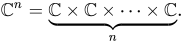


Complex coordinate space is a vector space over the complex numbers, with componentwise addition and scalar multiplication. The real and imaginary parts of the coordinates set up a bijection of with the 2n-dimensional real coordinate space, . With the standard Euclidean topology, is a topological vector space over the complex numbers.
View the full Wikipedia page for Complex coordinate space
Scalar multiplication in the context of Scalar (mathematics)
A scalar is an element of a field which is used to define a vector space.In linear algebra, real numbers or generally elements of a field are called scalars and relate to vectors in an associated vector space through the operation of scalar multiplication (defined in the vector space), in which a vector can be multiplied by a scalar in the defined way to produce another vector. Generally speaking, a vector space may be defined by using any field instead of real numbers (such as complex numbers). Then scalars of that vector space will be elements of the associated field (such as complex numbers).
A scalar product operation – not to be confused with scalar multiplication – may be defined on a vector space, allowing two vectors to be multiplied in the defined way to produce a scalar. A vector space equipped with a scalar product is called an inner product space.
View the full Wikipedia page for Scalar (mathematics)Scalar multiplication in the context of Associative algebra
In mathematics, an associative algebra A over a commutative ring (often a field) K is a ring A together with a ring homomorphism from K into the center of A. This is thus an algebraic structure with an addition, a multiplication, and a scalar multiplication (the multiplication by the image of the ring homomorphism of an element of K). The addition and multiplication operations together give A the structure of a ring; the addition and scalar multiplication operations together give A the structure of a module or vector space over K. In this article we will also use the term K-algebra to mean an associative algebra over K. A standard first example of a K-algebra is a ring of square matrices over a commutative ring K, with the usual matrix multiplication.
A commutative algebra is an associative algebra for which the multiplication is commutative, or, equivalently, an associative algebra that is also a commutative ring.
View the full Wikipedia page for Associative algebraScalar multiplication in the context of Algebra over a field
In mathematics, an algebra over a field (often simply called an algebra) is a vector space equipped with a bilinear product. Thus, an algebra is an algebraic structure consisting of a set together with operations of multiplication and addition and scalar multiplication by elements of a field and satisfying the axioms implied by "vector space" and "bilinear".
The multiplication operation in an algebra may or may not be associative, leading to the notions of associative algebras where associativity of multiplication is assumed, and non-associative algebras, where associativity is not assumed (but not excluded, either). Given an integer n, the ring of real square matrices of order n is an example of an associative algebra over the field of real numbers under matrix addition and matrix multiplication since matrix multiplication is associative. Three-dimensional Euclidean space with multiplication given by the vector cross product is an example of a nonassociative algebra over the field of real numbers since the vector cross product is nonassociative, satisfying the Jacobi identity instead.
View the full Wikipedia page for Algebra over a fieldScalar multiplication in the context of Eigenvalue
In linear algebra, an eigenvector (/ˈaɪɡən-/ EYE-gən-) or characteristic vector is a (nonzero) vector that has its direction unchanged (or reversed) by a given linear transformation. More precisely, an eigenvector of a linear transformation is scaled by a constant factor when the linear transformation is applied to it: . The corresponding eigenvalue, characteristic value, or characteristic root is the multiplying factor (possibly a negative or complex number).


Geometrically, vectors are multi-dimensional quantities with magnitude and direction, often pictured as arrows. A linear transformation rotates, stretches, or shears the vectors upon which it acts. A linear transformation's eigenvectors are those vectors that are only stretched or shrunk, with neither rotation nor shear. The corresponding eigenvalue is the factor by which an eigenvector is stretched or shrunk. If the eigenvalue is negative, the eigenvector's direction is reversed.
View the full Wikipedia page for Eigenvalue