Saxhorn in the context of "Baritone horn"

Play Trivia Questions online!

or

Skip to study material about Saxhorn in the context of "Baritone horn"


👉 Saxhorn in the context of Baritone horn

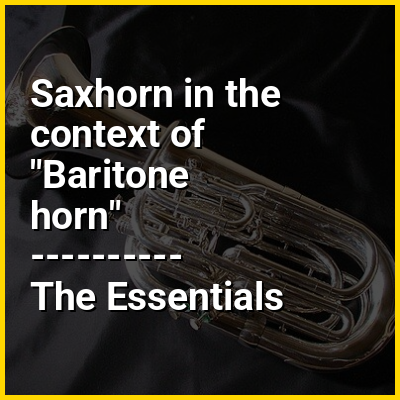
The baritone horn, or often simply the baritone, is a valved brass instrument pitched in B♭ in the saxhorn family, employed chiefly in brass, military and concert bands. It has three or sometimes four valves, usually piston valves, although rotary valves are common in Eastern and Central Europe, where it is called the Tenorhorn. The bore is moderately conical, like the E♭ tenor horn and cornet, although narrower than the closely related euphonium and other valved bugles, like the flugelhorn and tuba. It uses a wide-rimmed cup mouthpiece of similar dimensions to trombone and euphonium mouthpieces. Like the trombone and the euphonium, the baritone can be considered either a transposing instrument reading B♭ treble clef, or a non-transposing instrument in bass clef.

In British brass bands, the standard instrumentation includes parts for two baritones, in addition to two euphoniums. In US concert band music there is often a part marked baritone, but these parts are commonly intended for, and played on, the euphonium. A baritone can also play music written for a trombone due to similarities in timbre and range.

↓ Explore More Topics
In this Dossier

Saxhorn in the context of Adolphe Sax

Antoine-Joseph "Adolphe" Sax (French: [ɑ̃twan ʒozɛf adɔlf saks]; 6 November 1814 – 7 February 1894) was a Belgian inventor and musician who invented the saxophone in the early 1840s, patenting it in 1846. He also invented the saxotromba, saxhorn and saxtuba, and redesigned the bass clarinet in a fashion still used in the 21st century. He played the flute and clarinet.

↑ Return to Menu

Saxhorn in the context of Flugelhorn

The flugelhorn (/ˈflɡəlhɔːrn/), also spelled fluegelhorn, flugel horn, or flügelhorn, is a brass instrument that resembles the trumpet and cornet, but has a wider, more conical bore. Like trumpets and cornets, most flugelhorns are pitched in B♭, though some are in C. It is a type of valved bugle, developed in Germany in the early 19th century from a traditional English valveless bugle. The first version of a valved bugle was sold by Heinrich Stölzel in Berlin in 1828. The valved bugle provided Adolphe Sax (creator of the saxophone) with the inspiration for his B♭ soprano (contralto) saxhorns, on which the modern-day flugelhorn is modelled.

↑ Return to Menu

Saxhorn in the context of Tenor horn

The tenor horn (British English; alto horn in American English, sometimes E♭ horn) is a brass instrument in the saxhorn family pitched in E♭ with three piston valves. It has a bore that is moderately conical, like the cornet and baritone, and normally uses a deep funnel-shaped mouthpiece. In Europe it is known as the Althorn and has rotary valves and an oval shape.

It is most commonly used to play inner harmonies and off-beats in British brass bands and Mexican banda music, reading transposing treble clef, whereas the horn dominates in concert bands and orchestras. In the late 20th century it began to be considered as a serious solo voice, and has amassed a repertoire of contemporary concertos and other solo works.

↑ Return to Menu