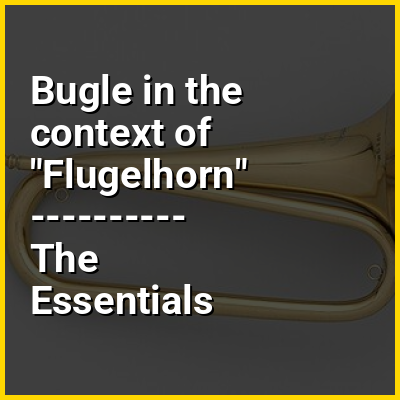
Bugle in the context of "Flugelhorn"

Play Trivia Questions online!

or

Skip to study material about Bugle in the context of "Flugelhorn"


👉 Bugle in the context of Flugelhorn

The flugelhorn (/ˈflɡəlhɔːrn/), also spelled fluegelhorn, flugel horn, or flügelhorn, is a brass instrument that resembles the trumpet and cornet, but has a wider, more conical bore. Like trumpets and cornets, most flugelhorns are pitched in B♭, though some are in C. It is a type of valved bugle, developed in Germany in the early 19th century from a traditional English valveless bugle. The first version of a valved bugle was sold by Heinrich Stölzel in Berlin in 1828. The valved bugle provided Adolphe Sax (creator of the saxophone) with the inspiration for his B♭ soprano (contralto) saxhorns, on which the modern-day flugelhorn is modelled.

↓ Explore More Topics
In this Dossier

Bugle in the context of Martial music

Martial music or military music is a specific genre of music intended for use in military settings performed by professional soldiers called field musicians. Much of the military music has been composed to announce military events as with bugle calls and fanfares, or accompany marching formations with drum cadences, or mark special occasions as by military bands. However, music has been employed in battle for centuries, sometimes to intimidate the enemy and other times to encourage combatants, or to assist in organization and timing of actions in warfare. Depending on the culture, a variety of percussion and musical instruments have been used, such as drums, fifes, bugles, trumpets or other horns, bagpipes, triangles, cymbals, as well as larger military bands or full orchestras. Although some martial music has been composed in written form, other music has been developed or taught by ear, such as bugle calls or drum cadences, relying on group memory to coordinate the sounds.

↑ Return to Menu

Bugle in the context of Shofar

A shofar (/ʃˈfɑːr/ shoh-FAR; from שׁוֹפָר‎, pronounced [ʃoˈfar] ) is an ancient musical horn, typically a ram's horn, used for Jewish ritual purposes. Like the modern bugle, the shofar lacks pitch-altering devices, with all pitch control done by the player's varying their embouchure. The shofar is blown in synagogue services on Rosh Hashanah and at the end of Yom Kippur; it is also blown every weekday morning in the month of Elul running up to Rosh Hashanah. Shofars come in a variety of sizes and shapes, depending on the choice of animal and level of finish.

↑ Return to Menu

Bugle in the context of Clarion (instrument)

Clarion is a name for a high-pitched trumpet used in the Middle Ages and the Renaissance. It is also a name for a 4' organ reed stop that produces a high-pitched or clarion-like sound on a pipe organ in the clarion trumpet's range of notes.

The word clarion has changed meanings over centuries and across languages. Today, in modern French clairon refers to the bugle, while in Italy chiarina refers to modern trumpets of historic design, made from bent tubing and without valves, similar to the natural trumpet. Resembling these instruments is the modern fanfare trumpet, like the chiarina or natural trumpet, but with the option of using valves.

↑ Return to Menu