Rodinia in the context of "Mesoproterozoic"

Play Trivia Questions online!

or

Skip to study material about Rodinia in the context of "Mesoproterozoic"

Ad spacer

⭐ Core Definition: Rodinia

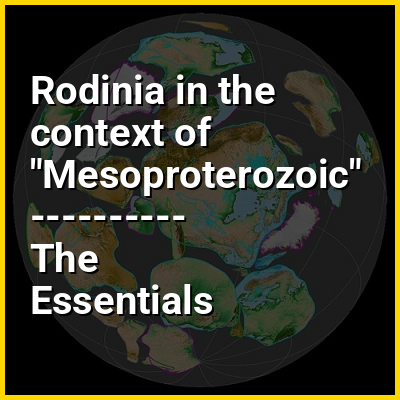
Rodinia (from the Russian родина, rodina, meaning "motherland, birthplace") was a Mesoproterozoic and Neoproterozoic supercontinent that assembled 1.26–0.90 billion years ago (Ga) and broke up 750–633 million years ago (Ma). Valentine & Moores 1970 were probably the first to recognise a Precambrian supercontinent, which they named "Pangaea I." It was renamed "Rodinia" by McMenamin & McMenamin 1990, who also were the first to produce a plate reconstruction and propose a temporal framework for the supercontinent.

Rodinia formed at c. 1.23 Ga by accretion and collision of fragments produced by breakup of an older supercontinent, Columbia, assembled by global-scale 2.0–1.8 Ga collisional events. Rodinia broke up in the Neoproterozoic, with its continental fragments reassembled to form Pannotia 633–573 Ma. In contrast with Pannotia, little is known about Rodinia's configuration and geodynamic history. Paleomagnetic evidence provides some clues to the paleolatitude of individual pieces of the Earth's crust, but not to their longitude, which geologists have pieced together by comparing similar geologic features, often now widely dispersed.
↓ Menu

>>>PUT SHARE BUTTONS HERE<<<
In this Dossier

Rodinia in the context of Tonian

The Tonian (from Ancient Greek: τόνος, romanizedtónos, meaning "stretch") is the first geologic period of the Neoproterozoic Era. It lasted from 1000 to 720 Mya (million years ago). Instead of being based on stratigraphy, these dates are defined by the ICS based on radiometric chronometry. The Tonian is preceded by the Stenian Period of the Mesoproterozoic Era and followed by the Cryogenian.

Rifting leading to the breakup of supercontinent Rodinia, which had formed in the mid-Stenian, occurred during this period, starting from 900 to 850 Mya.

↑ Return to Menu

Rodinia in the context of Eastern Ghats

The Eastern Ghats is a mountain range that stretches 1,750 km (1,090 mi) along the eastern coast of the Indian peninsula. Covering an area of 75,000 km (29,000 sq mi), it traverses the states of Odisha, Telangana, Andhra Pradesh, Karnataka, and Tamil Nadu. The range forms a discontinuous chain of mountains along the eastern edge of the Deccan Plateau, stretching from north of the Mahanadi River in Odisha to Vaigai River in Tamil Nadu at the southern end of the peninsula. The Eastern Ghats meet the Western Ghats at the Nilgiris. The average elevation is around 600 m (2,000 ft) and Arma Konda is the highest peak in the mountains at 1,680 m (5,510 ft).

Geological evidence indicates that the mountains were formed during the archeozoic era and became part of the Indian subcontinent post the break-up of the supercontinent of Rodinia and the formation of Gondwana. The mountains were formed through further metamorphism during the mid-Proterozoic era. The northern section of the range has an elevation ranging from 900–1,400 m (3,000–4,600 ft) and lies mostly in Odisha. The middle section stretches up to the Penna River and consists of two parallel ranges with an average elevation of 520 m (1,710 ft). At the southern end, the range is made up of several smaller hills.

↑ Return to Menu

Rodinia in the context of Stenian

The Stenian Period (/ˈstni.ən/ STEE-nee-ən, from Ancient Greek: στενός, romanizedstenós, meaning "narrow") is the final geologic period in the Mesoproterozoic Era and lasted from 1200 Mya to 1000 Mya (million years ago). Instead of being based on stratigraphy, these dates are defined chronometrically. The name derives from narrow polymetamorphic belts formed over this period. It is preceded by the Ectasian Period and followed by the Neoproterozoic era and the Tonian period.

The supercontinent Rodinia assembled during the Stenian. It would last into the Tonian period before breaking up in the Cryogenian.

↑ Return to Menu

Rodinia in the context of Superocean

A superocean is an ocean that surrounds a supercontinent. It is less commonly defined as any ocean larger than the current Pacific Ocean. Named global superoceans include Mirovia, which surrounded the supercontinent Rodinia, and Panthalassa, which surrounded the supercontinent Pangaea. Pannotia and Columbia, along with landmasses before Columbia (such as Ur and Kenorland), were also surrounded by superoceans.

As surface water moves unobstructed east to west in superoceans, it tends to warm from the exposure to sunlight so that the western edge of the ocean is warmer than the eastern. Additionally, seasonal changes in temperature, which would have been significantly more rapid inland, probably caused powerful monsoons. In general, however, the mechanics of superoceans are not well understood.

↑ Return to Menu

Rodinia in the context of South China craton

The South China Craton or South China Block is one of the Precambrian continental blocks in China. It is traditionally divided into the Yangtze Block in the NW and the Cathaysia Block in the SE. The Jiangshan–Shaoxing Fault represents the suture boundary between the two sub-blocks. Recent study suggests that the South China Block possibly has one more sub-block which is named the Tolo Terrane. The oldest rocks in the South China Block occur within the Kongling Complex, which yields zircon U–Pb ages of 3.3–2.9 Ga.

There are three important reasons to study the South China Block. First, South China hosts a great deal of rare-earth element (REE) ores. Second, the South China Block is a key component of the Rodinia supercontinent. Therefore, such study helps us understand more about the supercontinent cycle. Third, almost all major known clades of Triassic marine reptiles have been recovered from the South China sedimentary sequences. They are important to understand the marine recovery after the Permian-Triassic mass extinction.

↑ Return to Menu

Rodinia in the context of Baltica

Baltica is a paleocontinent that formed in the Paleoproterozoic and now constitutes northwestern Eurasia, or Europe north of the Trans-European Suture Zone and west of the Ural Mountains.The thick core of Baltica, the East European Craton, is more than three billion years old and formed part of the Rodinia supercontinent at c.Ga.

↑ Return to Menu

Rodinia in the context of Yangtze plate

The Yangtze plate, also called the South China block or the South China subplate, comprises the bulk of southern China. It is separated on the east from the Okinawa plate by a rift that forms the Okinawa Trough which is a back-arc basin, on the south by the Sunda plate and the Philippine Sea plate, and on the north and west by the Eurasian plate. The Longmenshan Fault on the latter border was the site of the 2008 Wenchuan earthquake.

The Yangtze plate was formed by the disaggregation of the Rodinia supercontinent 750 million years ago, in the Neoproterozoic era. South China rifted away from the Gondwana supercontinent in the Silurian. During the formation of the great supercontinent Pangaea, South China was a smaller, separate continent located off the east coast of the supercontinent and drifting northward. In the Triassic, the Yangtze plate collided with the North China plate, thereby connecting with Pangaea, and formed the Sichuan basin. In the Cenozoic, the Yangtze plate was influenced by the collision of the Indian plate and Eurasian plate creating the uplifting of the Longmen Mountains. Its southward motion is accommodated along the Red River fault.

↑ Return to Menu

Rodinia in the context of Grenville orogeny

The Grenville orogeny was a long-lived Mesoproterozoic mountain-building event associated with the assembly of the supercontinent Rodinia. Its record is a prominent orogenic belt which spans a significant portion of the North American continent, from Labrador to Mexico, as well as to Scotland.

Grenville orogenic crust of mid-late Mesoproterozoic age (c.1250—980 Ma) is found worldwide, but generally only events which occurred on the southern and eastern margins of Laurentia are recognized under the "Grenville" name. These orogenic events are also known as the Kibaran orogeny in Africa, the Dalslandian orogeny in Western Europe, and the Sunsás orogeny in Brazil.

↑ Return to Menu