Rio Grande do Norte in the context of "Nísia Floresta"

Play Trivia Questions online!

or

Skip to study material about Rio Grande do Norte in the context of "Nísia Floresta"


⭐ Core Definition: Rio Grande do Norte

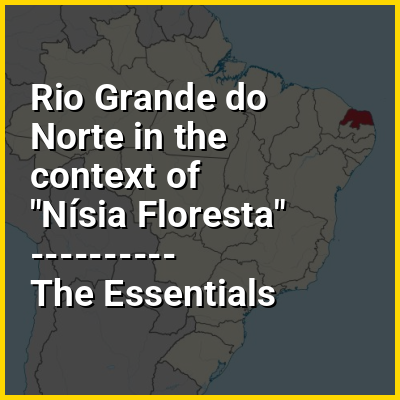
Rio Grande do Norte (UK: /ˌr ˌɡrændi d ˈnɔːrti/, US: /- ˌɡrɑːn-/, Portuguese: [ˈʁi.u ˈɡɾɐ̃dʒ(i) du ˈnɔʁtʃi] ) is one of the states of Brazil. It is located in the northeastern region of the country, forming the northeasternmost tip of the South American continent. The name literally translates as "Great Northern River", referring to the mouth of the Potenji River.

The state is divided into 167 municipalities and the capital and largest city is Natal. The state has 410 km (254 mi) of sandy beaches and contains Rocas Atoll, the only atoll in the South Atlantic Ocean. The main economic activity is tourism, followed by the extraction of petroleum (the second largest producer in the country), agriculture, fruit growing and extraction of minerals, including considerable production of seasalt, among other economic activities. The state is home to 1.7% of the Brazilian population and produces 1% of the country's GDP. In 2017, the murder rate rose by 655%, making Rio Grande do Norte the state with the highest murder rate in Brazil: 63.9 per 100,000. But since then, it has experienced a gradual decline, dropping 6 percentage points in 2023 to 21.65.
↓ Menu

👉 Rio Grande do Norte in the context of Nísia Floresta

Nísia Floresta Brasileira Augusta, pseudonym of Dionísia Gonçalves Pinto, (October 12, 1810 in Papari, Rio Grande do Norte – April 24, 1885 in Rouen, France) was a Brazilian educator, translator, writer, poet, philosopher, and feminist.

She is considered the "first Brazilian feminist" and possibly the first still in the 19th century to break through public-private boundaries by publishing her works in newspapers, when the local press was just beginning. She also coordinated a girls' school in Rio de Janeiro and wrote a book in defense of the rights of women, Native Americans and slaves.

↓ Explore More Topics
In this Dossier

Rio Grande do Norte in the context of Northeast Region, Brazil

The Northeast Region of Brazil (Portuguese: Região Nordeste do Brasil [ʁeʒiˈɐ̃w nɔʁˈdɛstʃi du bɾaˈziw]) is one of the five official and political regions of the country according to the Brazilian Institute of Geography and Statistics. Of Brazil's twenty-six states, it comprises nine: Maranhão, Piauí, Ceará, Rio Grande do Norte, Paraíba, Pernambuco, Alagoas, Sergipe and Bahia, along with the Fernando de Noronha archipelago (formerly a separate territory, now part of Pernambuco).

Chiefly known as Nordeste ("Northeast") in Brazil, this region was the first to be colonized by the Portuguese and other European peoples, playing a crucial role in the country's history. Nordeste's dialects and rich culture, including its folklore, cuisines, music and literature, became the most easily distinguishable across the country. To this day, Nordeste is known for its history and culture, as well as for its natural environment and its hot weather.

↑ Return to Menu

Rio Grande do Norte in the context of Atlantic Forest

The Atlantic Forest (Portuguese: Mata Atlântica), also called Missionary rainforest (Spanish: Selva Misionera), is a moist broadleaf forest that extends along the Atlantic coast of Brazil from Rio Grande do Norte state in the northeast to Rio Grande do Sul state in the south and inland as far as Paraguay and the Misiones Province of Argentina.

The Atlantic Forest has ecoregions within the following biome categories: seasonal moist and dry broad-leaf tropical forests, tropical and subtropical grasslands, savannas, and shrublands, and mangrove forests. The Atlantic Forest is characterized by a high biodiversity and endemism.

↑ Return to Menu

Rio Grande do Norte in the context of Ítalo Ferreira

Ítalo Ferreira da Costa (born 6 May 1994) is a Brazilian professional surfer hailing from a small community of Baía Formosa, in Rio Grande do Norte on the northeastern coast of Brazil.

↑ Return to Menu

Rio Grande do Norte in the context of Zona da Mata

The Zona da Mata ([ˈzõnɐ da ˈmatɐ], "Forest Belt") is the narrow coastal plain between the Atlantic Ocean and the dry agreste and sertão regions in the northeastern Brazilian states of Maranhão, Piauí, Rio Grande do Norte, Paraíba, Pernambuco, Alagoas, Sergipe and Bahia.

The zona da mata consists of a narrow plain, generally about 50–100 km (31–62 mi) wide and very flat and low (below 100 m (330 ft) in elevation), below the northeastern edge of the Brazilian Highlands. The climate is tropical hot and wet (humid), with most rain coming from the southeasterly winds between April and July. Annual rainfall generally totals 1,300–2,000 mm (51–79 in), with averages in June as high as 300 mm (12 in).

↑ Return to Menu

Rio Grande do Norte in the context of Paraíba

Paraíba (/ˌpærəˈbə/ PARR-ə-EE-bə, Brazilian Portuguese: [paɾaˈibɐ] ; Tupinambá: pa'ra a'íba) is a state in Brazil. It is located in the Brazilian Northeast, and it is bordered by Rio Grande do Norte to the north, Ceará to the west, Pernambuco to the south and the Atlantic Ocean to the east. Paraíba is the third most densely populated state of the Northeast; João Pessoa, the coastal state capital, and Campina Grande, in the countryside, rank among the fifteen largest municipalities in the Northeast of Brazil. The state is home to 1.9% of the Brazilian population and produces 0.9% of the Brazilian GDP and it is divided into 223 municipalities.

Paraíba is mostly populated along the Atlantic coast, which extends as far as Ponta do Seixas, the easternmost point of the mainland Americas. The state is a tourist and industrial hotspot; it is known for its cultural heritage, amenable climate and geographical features, ranging from the seaside beaches to the Borborema Plateau. It is named after the Paraíba river.

↑ Return to Menu

Rio Grande do Norte in the context of Carnauba wax

Carnauba (/kɑːrˈnɔːbə, -ˈn-, -ˈn-, -nɑːˈ-/; Portuguese: carnaúba [kaʁnaˈubɐ]), also called Brazil wax and palm wax, is a wax of the leaves of the carnauba palm Copernicia prunifera (synonym: Copernicia cerifera), a plant native to and grown only in the northeastern Brazilian states of Ceará, Piauí, Paraíba, Pernambuco, Rio Grande do Norte, Maranhão and Bahia. It is known as the "Queen of Waxes". In its pure state, it is usually available in the form of hard yellow-brown flakes. It is obtained by collecting and drying the leaves, beating them to loosen the wax, then refining and bleaching it.As a food additive, its E number is E903.

↑ Return to Menu

Rio Grande do Norte in the context of Captaincy of Pernambuco

The Captaincy of Pernambuco or New Lusitania (Portuguese: Nova Lusitânia) was a hereditary land grant and administrative subdivision of northern Portuguese Brazil during the colonial period from 1534 to 1821, with a brief interruption from 1630 to 1654 when it was part of Dutch Brazil. At the time of the Independence of Brazil, it became a province of United Kingdom of Portugal, Brazil and the Algarves. Captaincies were originally horizontal tracts of land (generally) 50 leagues wide extending from the Atlantic Ocean to the Tordesillas meridian.

During the earliest years of colonial Brazil, the Captaincy of Pernambuco was one of only two prosperous captaincies in Brazil (the other being Captaincy of São Vicente), primarily due to growing sugar cane. As a result of the failure of other captaincies, in part due to the invasion of the Northeast coast of Brazil by the Dutch during the Seventeenth Century, Pernambuco's geographical area grew as failed captaincies were attached. At its height, the Captaincy of Pernambuco included the territories of the modern states of Pernambuco, Paraíba, Alagoas, Rio Grande do Norte, Ceará and the western portion of Bahia (north and west of the São Francisco River) having thus a southern border with Minas Gerais. In the years surrounding Brazilian independence, the captaincy was reduced by repartitioning of several previously merged territories, until today's state with the same name was left.

↑ Return to Menu