Recreational mathematics in the context of "Ulam spiral"

⭐ In the context of the Ulam spiral, the observed patterns of prime number concentration along lines are linked to which mathematical concept?

Ad spacer

⭐ Core Definition: Recreational mathematics

Recreational mathematics is mathematics carried out for recreation (entertainment) rather than as a strictly research-and-application-based professional activity or as a part of a student's formal education. Although it is not necessarily limited to being an endeavor for amateurs, many topics in this field require no knowledge of advanced mathematics. Recreational mathematics involves mathematical puzzles and games, often appealing to children and untrained adults and inspiring their further study of the subject.

The Mathematical Association of America (MAA) includes recreational mathematics as one of its seventeen Special Interest Groups, commenting:

↓ Menu

>>>PUT SHARE BUTTONS HERE<<<

👉 Recreational mathematics in the context of Ulam spiral

The Ulam spiral or prime spiral is a graphical depiction of the set of prime numbers, devised by mathematician Stanisław Ulam in 1963 and popularized in Martin Gardner's Mathematical Games column in Scientific American a short time later. It is constructed by writing the positive integers in a square spiral and specially marking the prime numbers.

Ulam and Gardner emphasized the striking appearance in the spiral of prominent diagonal, horizontal, and vertical lines containing large numbers of primes. Both Ulam and Gardner noted that the existence of such prominent lines is not unexpected, as lines in the spiral correspond to quadratic polynomials, and certain such polynomials, such as Euler's prime-generating polynomial x − x + 41, are believed to produce a high density of prime numbers. Nevertheless, the Ulam spiral is connected with major unsolved problems in number theory such as Landau's problems. In particular, no quadratic polynomial has ever been proved to generate infinitely many primes, much less to have a high asymptotic density of them, although there is a well-supported conjecture as to what that asymptotic density should be.

↓ Explore More Topics
In this Dossier

Recreational mathematics in the context of Martin Gardner

Martin Gardner (October 21, 1914 – May 22, 2010) was an American popular mathematics and popular science writer with interests also encompassing magic, scientific skepticism, micromagic, philosophy, religion, and literature – especially the writings of Lewis Carroll, L. Frank Baum, and G. K. Chesterton. He was a leading authority on Lewis Carroll; The Annotated Alice, which incorporated the text of Carroll's two Alice books, was his most successful work and sold over a million copies. He had a lifelong interest in magic and illusion and in 1999, MAGIC magazine named him as one of the "100 Most Influential Magicians of the Twentieth Century". He was considered the doyen of American puzzlers. He was a prolific and versatile author, publishing more than 100 books.

Gardner was best known for creating and sustaining interest in recreational mathematics—and by extension, mathematics in general—throughout the latter half of the 20th century, principally through his "Mathematical Games" columns. These appeared for twenty-five years in Scientific American, and his subsequent books collecting them.

↑ Return to Menu

Recreational mathematics in the context of Magic square

In mathematics, especially historical and recreational mathematics, a square array of numbers, usually positive integers, is called a magic square if the sums of the numbers in each row, each column, and both main diagonals are the same. The order of the magic square is the number of integers along one side (n), and the constant sum is called the magic constant. If the array includes just the positive integers , the magic square is said to be normal. Many authors take magic square to mean normal magic square.

Magic squares that include repeated entries do not fall under this definition and are referred to as trivial. Some well-known examples, including the Sagrada Família magic square are trivial in this sense. When all the rows and columns but not both diagonals sum to the magic constant, this gives a semimagic square (sometimes called orthomagic square).

↑ Return to Menu

Recreational mathematics in the context of Egyptian fractions

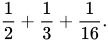
An Egyptian fraction is a finite sum of distinct unit fractions, such asThat is, each fraction in the expression has a numerator equal to 1 and a denominator that is a positive integer, and all the denominators differ from each other. The value of an expression of this type is a positive rational number ; for instance the Egyptian fraction above sums to . Every positive rational number can be represented by an Egyptian fraction. Sums of this type, and similar sums also including and as summands, were used as a serious notation for rational numbers by the ancient Egyptians, and continued to be used by other civilizations into medieval times. In modern mathematical notation, Egyptian fractions have been superseded by vulgar fractions and decimal notation. However, Egyptian fractions continue to be an object of study in modern number theory and recreational mathematics, as well as in modern historical studies of ancient mathematics.

↑ Return to Menu

Recreational mathematics in the context of John Horton Conway

John Horton Conway FRS (26 December 1937 – 11 April 2020) was an English mathematician. He was active in the theory of finite groups, knot theory, number theory, combinatorial game theory and coding theory. He also made contributions to many branches of recreational mathematics, most notably the invention of the cellular automaton called the Game of Life.

Born and raised in Liverpool, Conway spent the first half of his career at the University of Cambridge before moving to the United States, where he held the John von Neumann Professorship at Princeton University for the rest of his career. On 11 April 2020, at age 82, he died of complications from COVID-19.

↑ Return to Menu

Recreational mathematics in the context of Mathematical puzzle

Mathematical puzzles make up an integral part of recreational mathematics. They have specific rules, but they do not usually involve competition between two or more players. Instead, to solve such a puzzle, the solver must find a solution that satisfies the given conditions. Mathematical puzzles require mathematics to solve them. Logic puzzles are a common type of mathematical puzzle.

Conway's Game of Life and fractals, as two examples, may also be considered mathematical puzzles even though the solver interacts with them only at the beginning by providing a set of initial conditions. After these conditions are set, the rules of the puzzle determine all subsequent changes and moves. Many of the puzzles are well known because they were discussed by Martin Gardner in his "Mathematical Games" column in Scientific American. Mathematical puzzles are sometimes used to motivate students in teaching elementary school math problem solving techniques. Creative thinking – or "thinking outside the box" – often helps to find the solution.

↑ Return to Menu

Recreational mathematics in the context of Icosian game

The icosian game is a mathematical game invented in 1856 by Irish mathematician William Rowan Hamilton. It involves finding a Hamiltonian cycle on a dodecahedron, a polygon using edges of the dodecahedron that passes through all its vertices. Hamilton's invention of the game came from his studies of symmetry, and from his invention of the icosian calculus, a mathematical system describing the symmetries of the dodecahedron.

Hamilton sold his work to a game manufacturing company, and it was marketed both in the UK and Europe, but it was too easy to become commercially successful. Only a small number of copies of it are known to survive in museums. Although Hamilton was not the first to study Hamiltonian cycles, his work on this game became the origin of the name of Hamiltonian cycles. Several works of recreational mathematics studied his game. Other puzzles based on Hamiltonian cycles are sold as smartphone apps, and mathematicians continue to study combinatorial games based on Hamiltonian cycles.

↑ Return to Menu