Rauma River in the context of "Troll Wall"

Play Trivia Questions online!

or

Skip to study material about Rauma River in the context of "Troll Wall"

Ad spacer

⭐ Core Definition: Rauma River

The Rauma is a river that runs through the Romsdalen valley in Møre og Romsdal and Innlandet counties in Norway. It runs for 68 kilometres (42 mi) from the lake Lesjaskogsvatnet in Lesja Municipality (in Innlandet county), through the valley all the way to the town of Åndalsnes in Rauma Municipality (in Møre og Romsdal county) where it empties into the Romsdalsfjorden. The river was once famous for its salmon-fishing, but since an infection with Gyrodactylus salaris only 5 to 10% of the original stock survives. This, however, has begun to recover rapidly after a successful revitalisation project. The salmon runs up to the Slettafossen, a 16-metre (52 ft) high combination of waterfalls and rapids more than 42 kilometres (26 mi) upriver from the estuary.

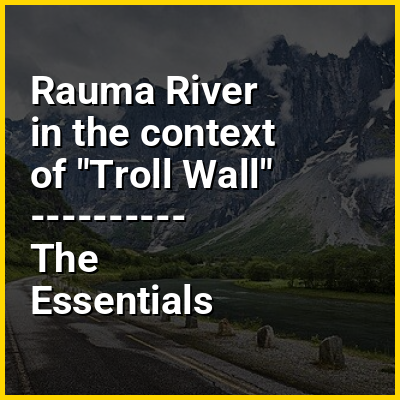
The Rauma River and its valley are regarded as one of the most beautiful in Norway. The river runs very clear with a green tint and the mountains tower some 1,500 to 1,800 metres (4,900 to 5,900 ft) above the river in the lower and middle parts of the valley. The Reinheimen National Park and the Trollveggen cliff are both located along the southwestern shores of the river through the municipality of Rauma. The Romsdalsalpene mountains surround the river and the valley, including the mountains Store Trolltinden, Store Venjetinden, Trollryggen, and Romsdalshornet. The Rauma Line railroad follows the river through the valley on its way north to Åndalsnes. The railroad crosses the river on the Kylling Bridge at the village of Verma.
↓ Menu

>>>PUT SHARE BUTTONS HERE<<<

👉 Rauma River in the context of Troll Wall

The Troll Wall (English) or Trollveggen (Norwegian) is part of the mountain massif Trolltindene (lit.'Troll Peaks') in the Romsdalen valley in Rauma Municipality in Møre og Romsdal county, Norway. It is located to the south of the towns of Åndalsnes and Molde inside the Reinheimen National Park.

The Troll Wall is the tallest vertical rock face in Europe, about 1,100 metres (3,600 ft) from its base to the summit of its highest point. At its steepest, the summit ridge overhangs the base of the wall by nearly 50 metres (160 ft). The Rauma River, the Rauma railway and the European Route E136 run just to the east of the wall.

↓ Explore More Topics
In this Dossier

Rauma River in the context of Store Trolltinden

Store Trolltinden a mountain summit in Rauma Municipality in Møre og Romsdal county, Norway. At 1,788 metres (5,866 ft) in height, it is the highest point along the Trolltindane ridge. It has the vertical Trollveggen cliff separating the peak from the Romsdalen valley below, a drop of about 1,700 metres (5,600 ft) which makes it the highest vertical cliff in Europe. The Rauma River and the European route E136 highway lie 1 kilometre (0.62 mi) to the east in the valley. The Trollryggen peak is located about 700 metres (2,300 ft) to the south.

The easiest access to the summit is by walking from the parking lot at Trollstigen about 5 kilometres (3.1 mi) to the southwest. Directly beneath the summit, one might prefer a rope for securing the last climb.

↑ Return to Menu

Rauma River in the context of Lesjaskogsvatnet

Lesjaskogsvatnet (lit.'the Lesjaskog lake') is a lake in Lesja Municipality in Innlandet county, Norway. The 4.3-square-kilometre (1.7 sq mi) lake lies in the upper Gudbrandsdalen valley, between the villages of Lesjaskog (on the west end) and Lesjaverk (on the east end). The European route E136 highway and the Raumabanen railway line both run along the north side of the lake.

The lake is unusual by having two outlets, one in each end. It flows east into the Gudbrandsdalslågen river and it also flows out to the west into the Rauma river in the Romsdalen valley. This bifurcation lake serves as the headwaters for two major rivers: Gudbrandsdalslågen (flowing south/east) and for Rauma river (flowing west). Gudbrandsdalslågen (also known as Lågen) flows through the Gudbrandsdalen valley, ending when it flows into the lake Mjøsa. The lake sits on the watershed in the north-western corner of Glomma drainage system that includes large parts of eastern Norway.

↑ Return to Menu