Rational choice theory in the context of Cognitive science


Rational choice theory in the context of Cognitive science

Rational choice theory Study page number 1 of 1

Play TriviaQuestions Online!

or

Skip to study material about Rational choice theory in the context of "Cognitive science"


⭐ Core Definition: Rational choice theory

Rational choice modeling refers to the use of decision theory (the theory of rational choice) as a set of guidelines to help understand economic and social behavior. The theory tries to approximate, predict, or mathematically model human behavior by analyzing the behavior of a rational actor facing the same costs and benefits.

Rational choice models are most closely associated with economics, where mathematical analysis of behavior is standard. However, they are widely used throughout the social sciences, and are commonly applied to cognitive science, criminology, political science, and sociology.

↓ Menu
HINT:

In this Dossier

Rational choice theory in the context of Lottery (probability)

In expected utility theory, a lottery is a discrete distribution of probability on a set of states of nature. The elements of a lottery correspond to the probabilities that each of the states of nature will occur, (e.g. Rain: 0.70, No Rain: 0.30). Much of the theoretical analysis of choice under uncertainty involves characterizing the available choices in terms of lotteries.

In economics, individuals are assumed to rank lotteries according to a rational system of preferences, although it is now accepted that people make irrational choices systematically. Behavioral economics studies what happens in markets in which some of the agents display human complications and limitations.

View the full Wikipedia page for Lottery (probability)
↑ Return to Menu

Rational choice theory in the context of Expected utility hypothesis

The expected utility hypothesis is a foundational assumption in mathematical economics concerning decision making under uncertainty. It postulates that rational agents maximize utility, meaning the subjective desirability of their actions. Rational choice theory, a cornerstone of microeconomics, builds this postulate to model aggregate social behaviour.

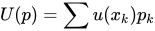
The expected utility hypothesis states an agent chooses between risky prospects by comparing expected utility values (i.e., the weighted sum of adding the respective utility values of payoffs multiplied by their probabilities). The summarised formula for expected utility is where is the probability that outcome indexed by with payoff is realized, and function u expresses the utility of each respective payoff. Graphically the curvature of the u function captures the agent's risk attitude.

View the full Wikipedia page for Expected utility hypothesis
↑ Return to Menu

Rational choice theory in the context of Profit motive

In economics, the profit motive is the motivation of firms that operate so as to maximize their profits. Mainstream microeconomic theory posits that the ultimate goal of a business is "to make money" - not in the sense of increasing the firm's stock of means of payment (which is usually kept to a necessary minimum because means of payment incur costs, i.e. interest or foregone yields), but in the sense of "increasing net worth". Stated differently, the reason for a business's existence is to turn a profit.The profit motive is a key tenet of rational choice theory, or the theory that economic agents tend to pursue what is in their own best interests. In accordance with this doctrine, businesses seek to benefit themselves and/or their shareholders by maximizing profits.

As it extends beyond economics into ideology, the profit motive has been a major matter of contention.

View the full Wikipedia page for Profit motive
↑ Return to Menu

Rational choice theory in the context of John Mearsheimer

John Joseph Mearsheimer (/ˈmɪərʃmər/; born December 14, 1947) is an American political scientist and international relations scholar. He is the R. Wendell Harrison Distinguished Service Professor of Political Science at the University of Chicago.

Mearsheimer is best known for developing the neorealist (or structural realist) theory of offensive realism, which describes the interaction between great powers as being primarily driven by the rational desire to achieve regional hegemony in an anarchic international system. In accordance with his theory, in the 2001 book The Tragedy of Great Power Politics, Mearsheimer says that China's growing power will likely bring it into conflict with the United States.

View the full Wikipedia page for John Mearsheimer
↑ Return to Menu

Rational choice theory in the context of Neoclassical economics

Neoclassical economics is an approach to economics in which the production, consumption, and valuation (pricing) of goods and services are observed as driven by the supply and demand model. According to this line of thought, the value of a good or service is determined through a hypothetical maximization of utility by income-constrained individuals and of profits by firms facing production costs and employing available information and factors of production. This approach has often been justified by appealing to rational choice theory.

Neoclassical economics is the dominant approach to microeconomics and, together with Keynesian economics, formed the neoclassical synthesis which dominated mainstream economics as "neo-Keynesian economics" from the 1950s onward.

View the full Wikipedia page for Neoclassical economics
↑ Return to Menu

Rational choice theory in the context of Preference (economics)

In economics, and in other social sciences, preference refers to an order by which an agent, while in search of an "optimal choice", ranks alternatives based on their respective utility. Preferences are evaluations that concern matters of value, in relation to practical reasoning. Individual preferences are determined by taste, need, ..., as opposed to price, availability or personal income. Classical economics assumes that people act in their best (rational) interest. In this context, rationality would dictate that, when given a choice, an individual will select an option that maximizes their self-interest. But preferences are not always transitive, both because real humans are far from always being rational and because in some situations preferences can form cycles, in which case there exists no well-defined optimal choice. An example of this is Efron dice.

The concept of preference plays a key role in many disciplines, including moral philosophy and decision theory. The logical properties that preferences possess also have major effects on rational choice theory, which in turn affects all modern economic topics.

View the full Wikipedia page for Preference (economics)
↑ Return to Menu

Rational choice theory in the context of Reciprocity (social and political philosophy)

The social norm of reciprocity is the expectation that people will respond to each other in similar ways—responding to gifts and kindnesses from others with similar benevolence of their own, and responding to harmful, hurtful acts from others with either indifference or some form of retaliation. Such norms can be crude and mechanical, such as a literal reading of the eye-for-an-eye rule lex talionis, or they can be complex and sophisticated, such as a subtle understanding of how anonymous donations to an international organization can be a form of reciprocity for the receipt of very personal benefits, such as the love of a parent.

The norm of reciprocity varies widely in its details from situation to situation, and from society to society. Anthropologists and sociologists have often claimed, however, that having some version of the norm appears to be a social inevitability. Reciprocity figures prominently in social exchange theory, evolutionary psychology, social psychology, cultural anthropology and rational choice theory.

View the full Wikipedia page for Reciprocity (social and political philosophy)
↑ Return to Menu

Rational choice theory in the context of Philosophy of economics

Philosophy and economics studies topics such as public economics, behavioural economics, rationality, justice, history of economic thought, rational choice, the appraisal of economic outcomes, institutions and processes, the status of highly idealized economic models, the ontology of economic phenomena and the possibilities of acquiring knowledge of them.

It is useful to divide philosophy of economics in this way into three subject matters which can be regarded respectively as branches of action theory, ethics (or normative social and political philosophy), and philosophy of science. Economic theories of rationality, welfare, and social choice defend substantive philosophical theses often informed by relevant philosophical literature and of evident interest to those interested in action theory, philosophical psychology, and social and political philosophy.

View the full Wikipedia page for Philosophy of economics
↑ Return to Menu

Rational choice theory in the context of New institutional economics

New Institutional Economics (NIE) is an economic perspective that attempts to extend economics by focusing on the institutions (that is to say the social and legal norms and rules) that underlie economic activity and with analysis beyond earlier institutional economics and neoclassical economics.

The NIE assume that individuals are rational and that they seek to maximize their preferences, but that they also have cognitive limitations, lack complete information and have difficulties monitoring and enforcing agreements. As a result, institutions form in large part as an effective way to deal with transaction costs.

View the full Wikipedia page for New institutional economics
↑ Return to Menu

Rational choice theory in the context of Sonnenschein–Mantel–Debreu theorem

The Sonnenschein–Mantel–Debreu theorem is an important result in general equilibrium economics, proved by Gérard Debreu, Rolf Mantel (es), and Hugo F. Sonnenschein in the 1970s. It states that the excess demand curve for an exchange economy populated with utility-maximizing rational agents can take the shape of any function that is continuous, has homogeneity degree zero, and is in accordance with Walras's law. This implies that the excess demand function does not take a well-behaved form even if each agent has a well-behaved utility function. Market processes will not necessarily reach a unique and stable equilibrium point.

More recently, Jordi Andreu, Pierre-André Chiappori, and Ivar Ekeland extended this result to market demand curves, both for individual commodities and for the aggregate demand of an economy as a whole. This means that demand curves may take on highly irregular shapes, even if all individual agents in the market are perfectly rational. In contrast with usual assumptions, the quantity demanded of a commodity may not decrease when the price increases. Frank Hahn regarded the theorem as a dangerous critique of mainstream neoclassical economics.

View the full Wikipedia page for Sonnenschein–Mantel–Debreu theorem
↑ Return to Menu

Rational choice theory in the context of Cultural criminology

Cultural criminology is a subfield in the study of crime that focuses on the ways in which the "dynamics of meaning underpin every process in criminal justice, including the definition of crime itself." In other words, cultural criminology seeks to understand crime through the context of culture and cultural processes. Rather than representing a conclusive paradigm per se, this particular form of criminological analysis interweaves a broad range of perspectives that share a sensitivity to “image, meaning, and representation” to evaluate the convergence of cultural and criminal processes.

As opposed to other theories, cultural criminology views crime in the context of an offenders culture as a motive to commit crime. The theory gives motives to a crime, whereas other theories, such as rational choice theory, explain what was gained.

View the full Wikipedia page for Cultural criminology
↑ Return to Menu

Rational choice theory in the context of Utility maximization problem

Utility maximization was first developed by utilitarian philosophers Jeremy Bentham and John Stuart Mill. In microeconomics, the utility maximization problem is the problem consumers face: "How should I spend my money in order to maximize my utility?" It is a type of optimal decision problem. It consists of choosing how much of each available good or service to consume, taking into account a constraint on total spending (income), the prices of the goods and their preferences.

Utility maximization is an important concept in consumer theory as it shows how consumers decide to allocate their income. Because consumers are modelled as being rational, they seek to extract the most benefit for themselves. However, due to bounded rationality and other biases, consumers sometimes pick bundles that do not necessarily maximize their utility. The utility maximization bundle of the consumer is also not set and can change over time depending on their individual preferences of goods, price changes and increases or decreases in income.

View the full Wikipedia page for Utility maximization problem
↑ Return to Menu

Rational choice theory in the context of Economic calculation problem

The economic calculation problem (ECP) is a criticism of using central economic planning (rather than market-based mechanisms) for the allocation of the factors of production. It was first proposed by Ludwig von Mises in his 1920 article "Economic Calculation in the Socialist Commonwealth" and later expanded upon by Friedrich Hayek.

In his first article, Mises described the nature of the price system under capitalism and described how individual subjective values (while criticizing other theories of value) are translated into the objective information necessary for rational allocation of resources in society. He argued that central planning necessarily leads to an irrational and inefficient allocation of resources. In market exchanges, prices reflect the supply and demand of resources, labor and products. In the article, Mises focused his criticism on the deficiencies of the socialisation of capital goods, but he later went on to elaborate on various different forms of socialism in his book Socialism. He briefly mentioned the problem in the 3rd book of Human Action: a Treatise on Economics, where he also elaborated on the different types of socialism, namely the "Hindenburg" and "Lenin" models, which he viewed as fundamentally flawed despite their ideological differences.

View the full Wikipedia page for Economic calculation problem
↑ Return to Menu

Rational choice theory in the context of Satisficing

Satisficing is a decision-making strategy or cognitive heuristic that entails searching through the available alternatives until an acceptability threshold is met, without necessarily maximizing any specific objective. The term satisficing, a portmanteau of satisfy and suffice, was introduced by Herbert A. Simon in 1956, although the concept was first posited in his 1947 book Administrative Behavior. Simon used satisficing to explain the behavior of decision makers under circumstances in which an optimal solution cannot be determined. He maintained that many natural problems are characterized by computational intractability or a lack of information, both of which preclude the use of mathematical optimization procedures. He observed in his Nobel Prize in Economics speech that "decision makers can satisfice either by finding optimum solutions for a simplified world, or by finding satisfactory solutions for a more realistic world. Neither approach, in general, dominates the other, and both have continued to co-exist in the world of management science".

Simon formulated the concept within a novel approach to rationality, which posits that rational choice theory is an unrealistic description of human decision processes and calls for psychological realism. He referred to this approach as bounded rationality. Moral satisficing is a branch of bounded rationality that views moral behavior as based on pragmatic social heuristics rather than on moral rules or optimization principles. These heuristics are neither good nor bad per se, but only in relation to the environments in which they are used. Some consequentialist theories in moral philosophy use the concept of satisficing in a similar sense, though most call for optimization instead.

View the full Wikipedia page for Satisficing
↑ Return to Menu