Expected utility in the context of Rational choice theory


Expected utility in the context of Rational choice theory

Expected utility Study page number 1 of 1

Play TriviaQuestions Online!

or

Skip to study material about Expected utility in the context of "Rational choice theory"


⭐ Core Definition: Expected utility

The expected utility hypothesis is a foundational assumption in mathematical economics concerning decision making under uncertainty. It postulates that rational agents maximize utility, meaning the subjective desirability of their actions. Rational choice theory, a cornerstone of microeconomics, builds this postulate to model aggregate social behaviour.

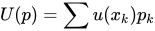
The expected utility hypothesis states an agent chooses between risky prospects by comparing expected utility values (i.e., the weighted sum of adding the respective utility values of payoffs multiplied by their probabilities). The summarised formula for expected utility is where is the probability that outcome indexed by with payoff is realized, and function u expresses the utility of each respective payoff. Graphically the curvature of the u function captures the agent's risk attitude.
↓ Menu
HINT:

In this Dossier

Expected utility in the context of Choice under uncertainty

Decision theory or the theory of rational choice is a branch of probability, economics, and analytic philosophy that uses expected utility and probability to model how individuals would behave rationally under uncertainty. It differs from the cognitive and behavioral sciences in that it is mainly prescriptive and concerned with identifying optimal decisions for a rational agent, rather than describing how people actually make decisions. Despite this, the field is important to the study of real human behavior by social scientists, as it lays the foundations to mathematically model and analyze individuals in fields such as sociology, economics, criminology, cognitive science, moral philosophy and political science.

View the full Wikipedia page for Choice under uncertainty
↑ Return to Menu