Expected utility theory in the context of Rational choice theory


Expected utility theory in the context of Rational choice theory

Expected utility theory Study page number 1 of 1

Play TriviaQuestions Online!

or

Skip to study material about Expected utility theory in the context of "Rational choice theory"


⭐ Core Definition: Expected utility theory

The expected utility hypothesis is a foundational assumption in mathematical economics concerning decision making under uncertainty. It postulates that rational agents maximize utility, meaning the subjective desirability of their actions. Rational choice theory, a cornerstone of microeconomics, builds this postulate to model aggregate social behaviour.

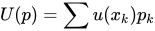
The expected utility hypothesis states an agent chooses between risky prospects by comparing expected utility values (i.e., the weighted sum of adding the respective utility values of payoffs multiplied by their probabilities). The summarised formula for expected utility is where is the probability that outcome indexed by with payoff is realized, and function u expresses the utility of each respective payoff. Graphically the curvature of the u function captures the agent's risk attitude.

↓ Menu
HINT:

In this Dossier

Expected utility theory in the context of Von Neumann–Morgenstern utility theorem

In decision theory, the von Neumann–Morgenstern (VNM) utility theorem demonstrates that rational choice under uncertainty involves making decisions that take the form of maximizing the expected value of some cardinal utility function. The theorem forms the foundation of expected utility theory.

In 1947, John von Neumann and Oskar Morgenstern proved that any individual whose preferences satisfied four axioms has a utility function, where such an individual's preferences can be represented on an interval scale and the individual will always prefer actions that maximize expected utility. That is, they proved that an agent is (VNM-)rational if and only if there exists a real-valued function u defined by possible outcomes such that every preference of the agent is characterized by maximizing the expected value of u, which can then be defined as the agent's VNM-utility (it is unique up to affine transformations i.e. adding a constant and multiplying by a positive scalar). No claim is made that the agent has a "conscious desire" to maximize u, only that u exists.

View the full Wikipedia page for Von Neumann–Morgenstern utility theorem
↑ Return to Menu

Expected utility theory in the context of Contract theory

From an economic perspective, contract theory studies how economic actors can and do construct contractual arrangements, generally in the presence of information asymmetry. Because of its connections with both agency and incentives, contract theory is often categorized within a field known as law and economics. One prominent application of it is the design of optimal schemes of managerial compensation. In the field of economics, the first formal treatment of this topic was given by Kenneth Arrow in the 1960s. In 2016, Oliver Hart and Bengt R. Holmström both received the Nobel Memorial Prize in Economic Sciences for their work on contract theory, covering many topics from CEO pay to privatizations. Holmström focused more on the connection between incentives and risk, while Hart on the unpredictability of the future that creates holes in contracts.

A standard practice in the microeconomics of contract theory is to represent the behaviour of a decision maker under certain numerical utility structures, and then apply an optimization algorithm to identify optimal decisions. Such a procedure has been used in the contract theory framework to several typical situations, labeled moral hazard, adverse selection and signalling. The spirit of these models lies in finding theoretical ways to motivate agents to take appropriate actions, even under an insurance contract. The main results achieved through this family of models involve: mathematical properties of the utility structure of the principal and the agent, relaxation of assumptions, and variations of the time structure of the contract relationship, among others. It is customary to model people as maximizers of some von Neumann–Morgenstern utility functions, as stated by expected utility theory.

View the full Wikipedia page for Contract theory
↑ Return to Menu