Quantum entanglement in the context of Quantum sensor


Quantum entanglement in the context of Quantum sensor

Quantum entanglement Study page number 1 of 1

Play TriviaQuestions Online!

or

Skip to study material about Quantum entanglement in the context of "Quantum sensor"


⭐ Core Definition: Quantum entanglement

Quantum entanglement is the phenomenon wherein the quantum state of each particle in a group cannot be described independently of the state of the others, even when the particles are separated by a large distance. The topic of quantum entanglement is at the heart of the disparity between classical physics and quantum physics: entanglement is a primary feature of quantum mechanics not present in classical mechanics.

Measurements of physical properties such as position, momentum, spin, and polarization performed on entangled particles can, in some cases, be found to be perfectly correlated. For example, if a pair of entangled particles is generated such that their total spin is known to be zero, and one particle is found to have clockwise spin on a first axis, then the spin of the other particle, measured on the same axis, is found to be anticlockwise. This behavior gives rise to seemingly paradoxical effects: any measurement of a particle's properties results in an apparent and irreversible wave function collapse of that particle and changes the original quantum state. With entangled particles, such measurements affect the entangled system as a whole.


↓ Menu
HINT:

👉 Quantum entanglement in the context of Quantum sensor

Within quantum technology, a quantum sensor utilizes quantum mechanical phenomena, such as quantum superposition, quantum entanglement, and quantum squeezing, to measure things. If a quantum system is measurable, and it interacts with its environment in a known way, then measurements of that system can provide information about its environment. Theoretically such sensor technology would have precision limited only by the uncertainty principle.The field of quantum sensing deals with the design and engineering of quantum mechanical systems and measurements with potential for better performance than any classical strategy in a number of technological applications. Of the wide range of quantum mechanical systems that can be used as a quantum sensor, most can be classified as photonic systems or solid state systems.

↓ Explore More Topics
In this Dossier

Quantum entanglement in the context of Quantum optics

Quantum optics is a branch of atomic, molecular, and optical physics and quantum chemistry that studies the behavior of photons (individual quanta of light). It includes the study of the particle-like properties of photons and their interaction with, for instance, atoms and molecules. Photons have been used to test many of the counter-intuitive predictions of quantum mechanics, such as entanglement and teleportation, and are a useful resource for quantum information processing.

View the full Wikipedia page for Quantum optics
↑ Return to Menu

Quantum entanglement in the context of Erwin Schrödinger

Erwin Rudolf Josef Alexander Schrödinger (/ˈʃrdɪŋər/ SHROH-ding-er, German: [ˈʃʁøːdɪŋɐ] ; 12 August 1887 – 4 January 1961), sometimes written as Schroedinger or Schrodinger, was an Austrian–Irish theoretical physicist who developed fundamental results in quantum theory. In particular, he is recognized for devising the Schrödinger equation, an equation that provides a way to calculate the wave function of a system and how it changes dynamically in time. He coined the term "quantum entanglement" in 1935.

In addition, Schrödinger wrote many works on various aspects of physics: statistical mechanics and thermodynamics, physics of dielectrics, color theory, electrodynamics, general relativity, and cosmology, and he made several attempts to construct a unified field theory. In his book, What Is Life?, Schrödinger addressed the problems of genetics, looking at the phenomenon of life from the point of view of physics. He also paid great attention to the philosophical aspects of science, ancient, and oriental philosophical concepts, ethics, and religion. He also wrote on philosophy and theoretical biology. In popular culture, he is best known for his "Schrödinger's cat" thought experiment.

View the full Wikipedia page for Erwin Schrödinger
↑ Return to Menu

Quantum entanglement in the context of Quantum information science

Quantum information science is an interdisciplinary field that combines the principles of quantum mechanics, information theory, and computer science to explore how quantum phenomena can be harnessed for the processing, analysis, and transmission of information. Quantum information science covers both theoretical and experimental aspects of quantum physics, including the limits of what can be achieved with quantum information. The term quantum information theory is sometimes used, but it refers to the theoretical aspects of information processing and does not include experimental research.

At its core, quantum information science explores how information behaves when stored and manipulated using quantum systems. Unlike classical information, which is encoded in bits that can only be 0 or 1, quantum information uses quantum bits or qubits that can exist simultaneously in multiple states because of superposition. Additionally, entanglement—a uniquely quantum linkage between particles—enables correlations that have no classical counterpart.

View the full Wikipedia page for Quantum information science
↑ Return to Menu

Quantum entanglement in the context of Quantum spin liquid

In condensed matter physics, a quantum spin liquid is a phase of matter that can be formed by interacting quantum spins in certain magnetic materials. Quantum spin liquids (QSL) are generally characterized by their long-range quantum entanglement, fractionalized excitations, and absence of ordinary magnetic order.

The quantum spin liquid state was first proposed by physicist Phil Anderson in 1973 as the ground state for a system of spins on a triangular lattice that interact antiferromagnetically with their nearest neighbors, i.e. neighboring spins seek to be aligned in opposite directions. Quantum spin liquids generated further interest when in 1987 Anderson proposed a theory that described high-temperature superconductivity in terms of a disordered spin-liquid state.

View the full Wikipedia page for Quantum spin liquid
↑ Return to Menu

Quantum entanglement in the context of Quantum materials

Quantum materials is an umbrella term in condensed matter physics that encompasses all materials whose essential properties cannot be described in terms of semiclassical particles and low-level quantum mechanics. These are materials that present strong electronic correlations or some type of electronic order, such as superconducting or magnetic orders, or materials whose electronic properties are linked to non-generic quantum effects – topological insulators, Dirac electron systems such as graphene, as well as systems whose collective properties are governed by genuinely quantum behavior, such as ultra-cold atoms, cold excitons, polaritons, and so forth. On the microscopic level, four fundamental degrees of freedom – that of charge, spin, orbit and lattice – become intertwined, resulting in complex electronic states; the concept of emergence is a common thread in the study of quantum materials.

Quantum materials exhibit puzzling properties with no counterpart in the macroscopic world: quantum entanglement, quantum fluctuations, robust boundary states dependent on the topology of the materials' bulk wave functions, etc. Quantum anomalies such as the chiral magnetic effect link some quantum materials with processes in high-energy physics of quark-gluon plasmas.

View the full Wikipedia page for Quantum materials
↑ Return to Menu

Quantum entanglement in the context of Topological order

In physics, topological order describes a state or phase of matter that arises in a system with non-local interactions, such as entanglement in quantum mechanics, and floppy modes in elastic systems. Whereas classical phases of matter such as gases and solids correspond to microscopic patterns in the spatial arrangement of particles arising from short range interactions, topological orders correspond to patterns of long-range quantum entanglement. States with different topological orders (or different patterns of long range entanglements) cannot change into each other without a phase transition.

Technically, topological order occurs at zero temperature. Various topologically ordered states have interesting properties, such as (1) ground state degeneracy and fractional statistics or non-abelian group statistics that can be used to realize a topological quantum computer; (2) perfect conducting edge states that may have important device applications; (3) emergent gauge field and Fermi statistics that suggest a quantum information origin of elementary particles; (4) topological entanglement entropy that reveals the entanglement origin of topological order, etc. Topological order is important in the study of several physical systems such as spin liquids, and the quantum Hall effect, along with potential applications to fault-tolerant quantum computation.

View the full Wikipedia page for Topological order
↑ Return to Menu

Quantum entanglement in the context of Quantum computing

A quantum computer is a (real or theoretical) computer that exploits superposed and entangled states. Quantum computers can be viewed as sampling from quantum systems that evolve in ways that may be described as operating on an enormous number of possibilities simultaneously, though still subject to strict computational constraints. By contrast, ordinary ("classical") computers operate according to deterministic rules. (A classical computer can, in principle, be replicated by a classical mechanical device, with only a simple multiple of time cost. On the other hand (it is believed), a quantum computer would require exponentially more time and energy to be simulated classically.) It is widely believed that a quantum computer could perform some calculations exponentially faster than any classical computer. For example, a large-scale quantum computer could break some widely used public-key cryptographic schemes and aid physicists in performing physical simulations. However, current hardware implementations of quantum computation are largely experimental and only suitable for specialized tasks.

The basic unit of information in quantum computing, the qubit (or "quantum bit"), serves the same function as the bit in ordinary or "classical" computing. However, unlike a classical bit, which can be in one of two states (a binary), a qubit can exist in a linear combination of two states known as a quantum superposition. The result of measuring a qubit is one of the two states given by a probabilistic rule. If a quantum computer manipulates the qubit in a particular way, wave interference effects amplify the probability of the desired measurement result. The design of quantum algorithms involves creating procedures that allow a quantum computer to perform this amplification.

View the full Wikipedia page for Quantum computing
↑ Return to Menu

Quantum entanglement in the context of Density matrix

In quantum mechanics, a density matrix (or density operator) is a matrix used in calculating the probabilities of the outcomes of measurements performed on physical systems. It is a generalization of the state vectors or wavefunctions: while those can only represent pure states, density matrices can also represent mixed ensembles of states. These arise in quantum mechanics in two different situations:

  1. when the preparation of a system can randomly produce different pure states, and thus one must deal with the statistics of the ensemble of possible preparations; and
  2. when one wants to describe a physical system that is entangled with another, without describing their combined state. This case is typical for a system interacting with some environment (e.g. decoherence). In this case, the density matrix of an entangled system differs from that of an ensemble of pure states that, combined, would give the same statistical results upon measurement.

Density matrices are thus crucial tools in areas of quantum mechanics that deal with mixed states (not to be confused with superposed states), such as quantum statistical mechanics, open quantum systems and quantum information.

View the full Wikipedia page for Density matrix
↑ Return to Menu

Quantum entanglement in the context of Semiconductor luminescence equations

The semiconductor luminescence equations (SLEs) describe luminescence of semiconductors resulting from spontaneous recombination of electronic excitations, producing a flux of spontaneously emitted light. This description established the first step toward semiconductor quantum optics because the SLEs simultaneously includes the quantized light–matter interaction and the Coulomb-interaction coupling among electronic excitations within a semiconductor. The SLEs are one of the most accurate methods to describe light emission in semiconductors and they are suited for a systematic modeling of semiconductor emission ranging from excitonic luminescence to lasers.

Due to randomness of the vacuum-field fluctuations, semiconductor luminescence is incoherent whereas the extensions of the SLEs include the possibility to study resonance fluorescence resulting from optical pumping with coherent laser light. At this level, one is often interested to control and access higher-order photon-correlation effects, distinct many-body states, as well as light–semiconductor entanglement. Such investigations are the basis of realizing and developing the field of quantum-optical spectroscopy which is a branch of quantum optics.

View the full Wikipedia page for Semiconductor luminescence equations
↑ Return to Menu

Quantum entanglement in the context of Asher Peres

Asher Peres (Hebrew: אשר פרס; January 30, 1934 – January 1, 2005) was an Israeli physicist. Peres is best known for his work relating quantum mechanics and information theory. He helped to develop the Peres–Horodecki criterion for quantum entanglement, as well as the concept of quantum teleportation, and collaborated with others on quantum information and special relativity. He also introduced the Peres metric and researched the Hamilton–Jacobi–Einstein equation in general relativity. With Mario Feingold, he published work in quantum chaos that is known to mathematicians as the Feingold–Peres conjecture and to physicists as the Feingold–Peres theory.

View the full Wikipedia page for Asher Peres
↑ Return to Menu

Quantum entanglement in the context of William Wootters

William "Bill" Kent Wootters is an American theoretical physicist, and one of the founders of the field of quantum information theory. In a 1982 joint paper with Wojciech H. Zurek, Wootters proved the no-cloning theorem, at the same time as Dennis Dieks, and independently of James L. Park who had formulated the no-cloning theorem in 1970. He is known for his contributions to the theory of quantum entanglement including quantitative measures of it, entanglement-assisted communication (notably quantum teleportation, discovered by Wootters and collaborators in 1993) and entanglement distillation. The term qubit, denoting the basic unit of quantum information, originated in a conversation between Wootters and Benjamin Schumacher in 1992.

He earned a B.S. from Stanford University in 1973, and his Ph.D. from the University of Texas at Austin in 1980. His thesis was titled The Acquisition of Information from Quantum Measurements, and Linda Reichl was his doctoral advisor, while John A. Wheeler also served as a mentor. He was a member of the physics department at Williams College from 1982 to 2017, receiving the title of Barclay Jermain Professor of Natural Philosophy. He was elected a fellow of the American Physical Society in 1999, for "contributions on the foundations of quantum mechanics and groundbreaking work in quantum information and communications theory."

View the full Wikipedia page for William Wootters
↑ Return to Menu

Quantum entanglement in the context of Anton Zeilinger

Anton Zeilinger (German: [ˈanton ˈtsaɪlɪŋɐ]; born 20 May 1945) is an Austrian quantum physicist and Nobel laureate in physics of 2022. Zeilinger is professor of physics emeritus at the University of Vienna and senior scientist at the Institute for Quantum Optics and Quantum Information of the Austrian Academy of Sciences. Most of his research concerns the fundamental aspects and applications of quantum entanglement.

In 2007, Zeilinger received the first Inaugural Isaac Newton Medal of the Institute of Physics, London, for "his pioneering conceptual and experimental contributions to the foundations of quantum physics, which have become the cornerstone for the rapidly-evolving field of quantum information". In October 2022, he received the Nobel Prize in Physics, jointly with Alain Aspect and John Clauser for their work involving experiments with entangled photons, establishing the violation of Bell inequalities and pioneering quantum information science.

View the full Wikipedia page for Anton Zeilinger
↑ Return to Menu

Quantum entanglement in the context of Counterfactual definiteness

In quantum mechanics, counterfactual definiteness (CFD) is the ability to speak "meaningfully" of the definiteness of the results of measurements that have not been performed (i.e., the ability to assume the existence of objects, and properties of objects, even when they have not been measured). The term "counterfactual definiteness" is used in discussions of physics calculations, especially those related to the phenomenon called quantum entanglement and those related to the Bell inequalities. In such discussions "meaningfully" means the ability to treat these unmeasured results on an equal footing with measured results in statistical calculations. It is this (sometimes assumed but unstated) aspect of counterfactual definiteness that is of direct relevance to physics and mathematical models of physical systems and not philosophical concerns regarding the meaning of unmeasured results.

View the full Wikipedia page for Counterfactual definiteness
↑ Return to Menu

Quantum entanglement in the context of Von Neumann entropy

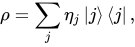
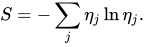
In physics, the von Neumann entropy, named after John von Neumann, is a measure of the statistical uncertainty within a description of a quantum system. It extends the concept of Gibbs entropy from classical statistical mechanics to quantum statistical mechanics, and it is the quantum counterpart of the Shannon entropy from classical information theory. For a quantum-mechanical system described by a density matrix ρ, the von Neumann entropy iswhere denotes the trace and denotes the matrix version of the natural logarithm. If the density matrix ρ is written in a basis of its eigenvectors asthen the von Neumann entropy is merelyIn this form, S can be seen as the Shannon entropy of the eigenvalues, reinterpreted as probabilities.

The von Neumann entropy and quantities based upon it are widely used in the study of quantum entanglement.

View the full Wikipedia page for Von Neumann entropy
↑ Return to Menu

Quantum entanglement in the context of Quantum social science

Quantum social science is an emerging field of interdisciplinary research which draws parallels between quantum physics and the social sciences. Although there is no settled consensus on a single approach, a unifying theme is that, while the social sciences have long modelled themselves on mechanistic science, they can learn much from quantum ideas such as complementarity and entanglement. Some authors are motivated by quantum mind theories that the brain, and therefore human interactions, are literally based on quantum processes, while others are more interested in taking advantage of the quantum toolkit to simulate social behaviours which elude classical treatment. Quantum ideas have been particularly influential in psychology but are starting to affect other areas such as international relations and diplomacy in what one 2018 paper called a "quantum turn in the social sciences".

View the full Wikipedia page for Quantum social science
↑ Return to Menu