Pythagoras in the context of "The School of Athens"

⭐ In the context of *The School of Athens*, Pythagoras is considered…

Ad spacer

⭐ Core Definition: Pythagoras

Pythagoras of Samos (Ancient Greek: Πυθαγόρας; c. 570 – c. 495 BC) was an ancient Ionian Greek philosopher, polymath, and the eponymous founder of Pythagoreanism. His political and religious teachings were well known in Magna Graecia and influenced the philosophies of Plato, Aristotle, and, through them, Western philosophy. Modern scholars disagree regarding Pythagoras's education and influences, but most agree that he travelled to Croton in southern Italy around 530 BC, where he founded a school in which initiates were allegedly sworn to secrecy and lived a communal, ascetic lifestyle.

In antiquity, Pythagoras was credited with mathematical and scientific discoveries, such as the Pythagorean theorem, Pythagorean tuning, the five regular solids, the theory of proportions, the sphericity of the Earth, the identity of the morning and evening stars as the planet Venus, and the division of the globe into five climatic zones. He was reputedly the first man to call himself a philosopher ("lover of wisdom"). Historians debate whether Pythagoras made these discoveries and pronouncements, as some of the accomplishments credited to him likely originated earlier or were made by his colleagues or successors, such as Hippasus and Philolaus.

↓ Menu

>>>PUT SHARE BUTTONS HERE<<<

👉 Pythagoras in the context of The School of Athens

The School of Athens (Italian: Scuola di Atene) is a fresco by the Italian Renaissance artist Raphael. It was painted between 1509 and 1511 as part of a commission by Pope Julius II to decorate the rooms now called the Stanze di Raffaello in the Apostolic Palace in Vatican City.

The fresco depicts a congregation of ancient mathematicians, philosophers, and scientists, with Plato and Aristotle featured in the center. The identities of most figures are ambiguous or discernable only through subtle details or allusions; among those commonly identified are Socrates, Pythagoras, Archimedes, Heraclitus, Averroes, and Zarathustra. Additionally, Italian artists Leonardo da Vinci and Michelangelo are believed to be portrayed through Plato and Heraclitus, respectively. Raphael included a self-portrait beside Ptolemy. Hypatia is the only notable character who is looking directly at the viewer in the artwork.

↓ Explore More Topics
In this Dossier

Pythagoras in the context of Plato

Plato (/ˈplt/ PLAY-toe; Greek: Πλάτων, Plátōn; born c. 428–423 BC, died 348/347 BC) was an ancient Greek philosopher of Classical Athens who is most commonly considered the foundational thinker of the Western philosophical tradition. An innovator of the literary dialogue and dialectic forms, Plato influenced all the major areas of theoretical philosophy and practical philosophy, and was the founder of the Platonic Academy, a philosophical school in Athens where Plato taught the collection of philosophical theories that would later become known as Platonism.

Plato's most famous contribution is his Theory of Forms (or Ideas), which aims to solve what is now known as the problem of universals. He was influenced by the pre-Socratic thinkers Pythagoras, Heraclitus, and Parmenides, although much of what is known about them is derived from Plato himself.

↑ Return to Menu

Pythagoras in the context of Calabria

Calabria is a region in Southern Italy. It is a peninsula bordered by the region Basilicata to the north, the Ionian Sea to the east, the Strait of Messina to the southwest, which separates it from Sicily, and the Tyrrhenian Sea to the west. It has 1,832,147 residents as of 2025 across a total area of 15,222 km (5,877 sq mi). Catanzaro is the region's capital.

Calabria is the birthplace of the name of Italy, given to it by the Ancient Greeks who settled in this land starting from the 8th century BC. They established the first cities, mainly on the coast, as Greek colonies. During this period Calabria was the heart of Magna Graecia, home of key figures in history such as Pythagoras, Herodotus and Milo.

↑ Return to Menu

Pythagoras in the context of Pre-Socratic philosophy

Pre-Socratic philosophy, also known as early Greek philosophy, is ancient Greek philosophy before Socrates. Pre-Socratic philosophers were mostly interested in cosmology, the beginning and the substance of the universe, but the inquiries of these early philosophers spanned the workings of the natural world as well as human society, ethics, and religion. They sought explanations based on natural law rather than the actions of gods. Their work and writing has been almost entirely lost. Knowledge of their views comes from testimonia, i.e. later authors' discussions of the work of pre-Socratics. Philosophy found fertile ground in the ancient Greek world because of the close ties with neighboring civilizations and the rise of autonomous civil entities, poleis.

Pre-Socratic philosophy began in the 6th century BC with the three Milesians: Thales, Anaximander, and Anaximenes. They all attributed the arche (a word that could take the meaning of "origin", "substance" or "principle") of the world to, respectively, water, apeiron (the unlimited), and air. Another three pre-Socratic philosophers came from nearby Ionian towns: Xenophanes, Heraclitus, and Pythagoras. Xenophanes is known for his critique of the anthropomorphism of gods. Heraclitus, who was notoriously difficult to understand, is known for his maxim on impermanence, ta panta rhei, and for attributing fire to be the arche of the world. Pythagoras created a cult-like following that advocated that the universe was made up of numbers. The Eleatic school (Parmenides, Zeno of Elea, and Melissus) followed in the 5th century BC. Parmenides claimed that only one thing exists and nothing can change. Zeno and Melissus mainly defended Parmenides' opinion. Anaxagoras and Empedocles offered a pluralistic account of how the universe was created. Leucippus and Democritus are known for their atomism, and their views that only void and matter exist. The Sophists advanced philosophical relativism. The Pre-Socratics have had significant impact on several concepts of Western philosophy, such as naturalism and rationalism, and paved the way for scientific methodology.

↑ Return to Menu

Pythagoras in the context of Pythagorean theorem

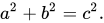
In mathematics, the Pythagorean theorem or Pythagoras's theorem is a fundamental relation in Euclidean geometry between the three sides of a right triangle. It states that the area of the square whose side is the hypotenuse (the side opposite the right angle) is equal to the sum of the areas of the squares on the other two sides.

The theorem can be written as an equation relating the lengths of the sides a, b and the hypotenuse c, sometimes called the Pythagorean equation:The theorem is named for the Greek philosopher Pythagoras, born around 570 BC. The theorem has been proved numerous times by many different methods – possibly the most for any mathematical theorem. The proofs are diverse, including both geometric proofs and algebraic proofs, with some dating back thousands of years.

↑ Return to Menu

Pythagoras in the context of Flat Earth

Flat Earth is an archaic and scientifically disproven conception of the Earth's shape as a plane or disk. Many ancient cultures subscribed to a flat-Earth cosmography. The model has undergone a recent resurgence as a conspiracy theory in the 21st century.

The idea of a spherical Earth appeared in ancient Greek philosophy with Pythagoras (6th century BC). However, the early Greek cosmological view of a flat Earth persisted among most pre-Socratics (6th–5th century BC). In the early 4th century BC, Plato wrote about a spherical Earth. By about 330 BC, his former student Aristotle had provided strong empirical evidence for a spherical Earth. Knowledge of the Earth's global shape gradually began to spread beyond the Hellenistic world. By the early period of the Christian Church, the spherical view was widely held, with some notable exceptions. In contrast, ancient Chinese scholars consistently describe the Earth as flat, and this perception remained unchanged until their encounters with Jesuit missionaries in the 17th century. Muslim scholars in early Islam maintained that the Earth is flat. However, since the 9th century, Muslim scholars have tended to believe in a spherical Earth.

↑ Return to Menu

Pythagoras in the context of Platonism

Platonism is the philosophy of Plato and philosophical systems closely derived from it, though later and contemporary Platonists do not necessarily accept all of Plato's own doctrines. Platonism has had a profound effect on Western thought. At the most fundamental level, Platonism affirms the existence of abstract objects, which are asserted to exist in a third realm distinct from both the sensible external world and from the internal world of consciousness, and is the opposite of nominalism. This can apply to properties, types, propositions, meanings, numbers, sets, truth values, and so on (see abstract object theory). Philosophers who affirm the existence of abstract objects are sometimes called Platonists; those who deny their existence are sometimes called nominalists. The terms "Platonism" and "nominalism" also have established senses in the history of philosophy. They denote positions that have little to do with the modern notion of an abstract object.

In a narrower sense, the term might indicate the doctrine of Platonic realism, a form of mysticism. The central concept of Platonism, a distinction essential to the Theory of Forms, is the distinction between the reality which is perceptible but unintelligible, associated with the flux of Heraclitus and studied by the likes of physical science, and the reality which is imperceptible but intelligible, associated with the unchanging being of Parmenides and studied by the likes of mathematics. Geometry was the main motivation of Plato, and this also shows the influence of Pythagoras. The Forms are typically described in dialogues such as the Phaedo, Symposium and Republic as perfect archetypes of which objects in the everyday world are imperfect copies. Aristotle's Third Man Argument is its most famous criticism in antiquity.

↑ Return to Menu

Pythagoras in the context of Samos

Samos (/ˈsmɒs/, also US: /ˈsæms, ˈsɑːmɔːs/; Greek: Σάμος, romanizedSámos, Greek pronunciation: [ˈsa.mos]) is a Greek island in the eastern Aegean Sea, south of Chios, north of Patmos and the Dodecanese archipelago, and off the coast of western Turkey, from which it is separated by the 1.6-kilometre-wide (1.0 mi) Mycale Strait. It is also a separate regional unit of the North Aegean region.

In ancient times, Samos was an especially rich and powerful city-state, particularly known for its vineyards and wine production. It is home to Pythagoreion and the Heraion of Samos, a UNESCO World Heritage Site that includes the Eupalinian aqueduct, a marvel of ancient engineering. Samos is the birthplace of the Greek philosopher and mathematician Pythagoras, after whom the Pythagorean theorem is named, the philosophers Melissus of Samos and Epicurus, and the astronomer Aristarchus of Samos, the first known individual to propose that the Earth revolves around the Sun. Samian wine was well known in antiquity and is still produced on the island.

↑ Return to Menu