Pythagoras of Samos (Ancient Greek: Πυθαγόρας; c. 570 – c. 495 BC) was an ancient Ionian Greek philosopher, polymath, and the eponymous founder of Pythagoreanism. His political and religious teachings were well known in Magna Graecia and influenced the philosophies of Plato, Aristotle, and, through them, Western philosophy. Modern scholars disagree regarding Pythagoras's education and influences, but most agree that he travelled to Croton in southern Italy around 530 BC, where he founded a school in which initiates were allegedly sworn to secrecy and lived a communal, ascetic lifestyle.
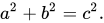
In antiquity, Pythagoras was credited with mathematical and scientific discoveries, such as the Pythagorean theorem, Pythagorean tuning, the five regular solids, the theory of proportions, the sphericity of the Earth, the identity of the morning and evening stars as the planet Venus, and the division of the globe into five climatic zones. He was reputedly the first man to call himself a philosopher ("lover of wisdom"). Historians debate whether Pythagoras made these discoveries and pronouncements, as some of the accomplishments credited to him likely originated earlier or were made by his colleagues or successors, such as Hippasus and Philolaus.