Punch and Judy in the context of "Slapstick"

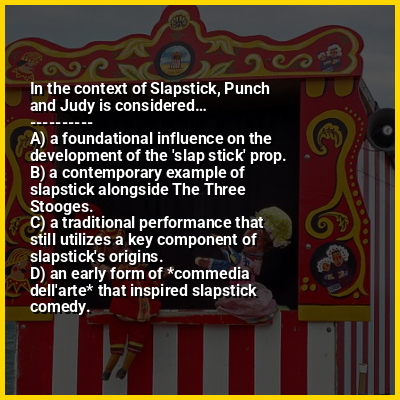
⭐ In the context of Slapstick, Punch and Judy is considered


Ad spacer

⭐ Core Definition: Punch and Judy

Punch and Judy is a traditional English puppet show featuring Mr Punch and his wife Judy. The performance consists of a sequence of short scenes, each depicting an interaction between two characters, most typically the anarchic Mr Punch and one other character who usually falls victim to the intentional violence of Punch's slapstick. First appearing in England in 1662, Punch and Judy was called by The Daily Telegraph "a staple of the British seaside scene". The various episodes of Punch comedy—often provoking shocked laughter—are dominated by the clowning of Mr Punch.

The show is performed by a single puppeteer inside the booth, known since Victorian times as a "professor" or "punchman", and assisted sometimes by a "bottler" who corrals the audience outside the booth, introduces the performance, and collects the money ("the bottle"). The bottler might also play accompanying music or sound effects on a drum or guitar, and engage in back chat with the puppets, sometimes repeating lines that may have been difficult for the audience to understand. In the Victorian era, the drum and pan pipes were the instruments of choice. Today, most professors work solo, since the need for a bottler became less important when street performing with the show gave way to paid engagements at private parties or public events. In modern shows the audience is encouraged to participate, calling out to the characters on the stage—typically shouting "He's behind you!"—to warn them of danger or clue them in to what is going on behind their backs.
↓ Menu

>>>PUT SHARE BUTTONS HERE<<<

👉 Punch and Judy in the context of Slapstick

Slapstick is a style of humor involving exaggerated physical activity that exceeds the boundaries of normal physical comedy. Slapstick may involve both intentional violence and violence by mishap, often resulting from physical abuse and/or inept use of props such as saws and ladders.

The term arises from a device developed for use in the broad, physical comedy style known as commedia dell'arte in 16th-century Italy. The "slap stick" consists of two thin slats of wood, which makes a "slap" when striking another actor, with little force needed to make a loud—and comical—sound. The physical slap stick remains a key component of the plot in the traditional and popular Punch and Judy puppet show. More contemporary examples of slapstick humor include The Three Stooges, The Naked Gun and Mr. Bean.

↓ Explore More Topics
In this Dossier

Punch and Judy in the context of Puppet

A puppet is an object, often resembling a human, animal or mythical figure, that is animated or manipulated by a person called a puppeteer. Puppetry is an ancient form of theatre which dates back to the 5th century BC in ancient Greece.

There are many different varieties of puppets, and they are made from a wide range of materials, depending on their form and intended use. They range from very simple in construction and operation to very complex. The puppeteer uses movements of their hands, arms, or control devices such as rods or strings to move the body, head, limbs, and in some cases the mouth and eyes of the puppet. The puppeteer often speaks in the voice of the character of the puppet, and then synchronizes the movements of the puppet's mouth with this spoken part. The actions, gestures and spoken parts acted out by the puppeteer with the puppet are typically used in storytelling.

↑ Return to Menu

Punch and Judy in the context of Humor

Humour (Commonwealth English) or humor (American English) is the tendency of experiences to provoke laughter and provide amusement. The term derives from the humoral medicine of the ancient Greeks, which taught that the balance of fluids in the human body, known as "humours" (Latin: humor, "body fluid"), controlled human health and emotion.

People of all ages and cultures respond to humour. Most people are able to experience humour—be amused, smile or laugh at something funny (such as a pun or joke)—and thus are considered to have a sense of humour. The hypothetical person lacking a sense of humour would likely find the behaviour to be inexplicable, strange, or even irrational. Though ultimately decided by subjective personal taste, the extent to which a person finds something humorous depends on a host of variables, including geographical location, culture, maturity, level of education, intelligence and context. For example, young children may favour slapstick such as Punch and Judy puppet shows or cartoons such as Tom and Jerry or Looney Tunes, whose physical nature makes it accessible to them. By contrast, more sophisticated forms of humour such as satire require an understanding of its social meaning and context, and thus tend to appeal to a more mature audience.

↑ Return to Menu

Punch and Judy in the context of Punch (magazine)

Punch, or The London Charivari was a British weekly magazine of humour and satire established in 1841 by Henry Mayhew and wood-engraver Ebenezer Landells. Historically, it was most influential in the 1840s and 1850s, when it helped to coin the term "cartoon" in its modern sense as a humorous illustration. Artists at Punch included John Tenniel who, from 1850, was the chief cartoon artist at the magazine for over 50 years. The editors took the anarchic puppet Mr Punch, of Punch and Judy, as their mascot—the character appears in many magazine covers—with the character also an inspiration for the magazine's name.

With its satire of the contemporary, social, and political scene, Punch became a household name in Victorian Britain. Sales of 40,000 copies a week by 1850 rose above 100,000 by 1910. After the 1940s, when its circulation peaked, it went into a long decline, closing in 1992. It was revived in 1996, but closed again in 2002.

↑ Return to Menu

Punch and Judy in the context of Punch magazine

Punch, or The London Charivari was a British weekly magazine of humour and satire established in 1841 by Henry Mayhew and wood-engraver Ebenezer Landells. Historically, it was most influential in the 1840s and 1850s, when it helped to coin the term "cartoon" in its modern sense as a humorous illustration. Artists at Punch included John Tenniel who worked for the magazine from 1850 and was its chief cartoonist from 1864 to 1901. The editors took the anarchic puppet Mr Punch, of Punch and Judy, as their mascot—the character appears in many magazine covers—with the character also an inspiration for the magazine's name.

With its satire of the contemporary, social, and political scene, Punch became a household name in Victorian Britain. Sales of 40,000 copies a week by 1850 rose above 100,000 by 1910. After the 1940s, when its circulation peaked, it went into a long decline, closing in 1992. It was revived in 1996, but closed again in 2002.

↑ Return to Menu