
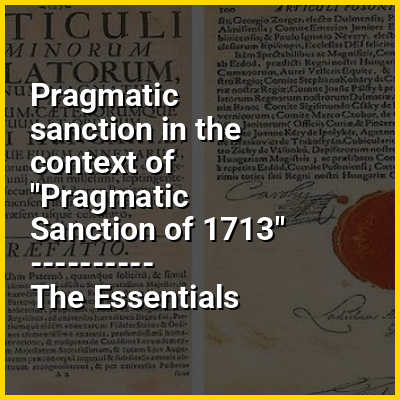
The Pragmatic Sanction of 1713 (Latin: Sanctio Pragmatica; German: Pragmatische Sanktion) was an edict issued by Holy Roman Emperor Charles VI, on 19 April 1713 to ensure that the Habsburg monarchy, which included the Archduchy of Austria, the Kingdom of Hungary, the Kingdom of Croatia, the Kingdom of Bohemia, the Duchy of Milan, the Kingdom of Naples, the Kingdom of Sardinia and the Austrian Netherlands, could be inherited by a daughter undivided.
As of 1713, Charles and his wife Elizabeth Christine had not had any children. Since the death of his elder brother, Joseph I, in 1711, Charles had been the sole surviving male member of the House of Habsburg. Joseph had died without male issue, leaving Joseph's daughter Maria Josepha as the heiress presumptive. That presented two problems. First, a prior agreement with his brother, known as the Mutual Pact of Succession (1703), had agreed that in the absence of male heirs, Joseph's daughters would take precedence over Charles's daughters in all Habsburg lands. Though Charles had no children, if he were to be survived by daughters alone, they would be cut out of the inheritance. Secondly, because Salic law precluded female inheritance, Charles VI needed to take extraordinary measures to avoid a protracted succession dispute, as other claimants would have surely contested a female inheritance.