Joseph I, Holy Roman Emperor in the context of "Pragmatic Sanction of 1713"

Play Trivia Questions online!

or

Skip to study material about Joseph I, Holy Roman Emperor in the context of "Pragmatic Sanction of 1713"


⭐ Core Definition: Joseph I, Holy Roman Emperor

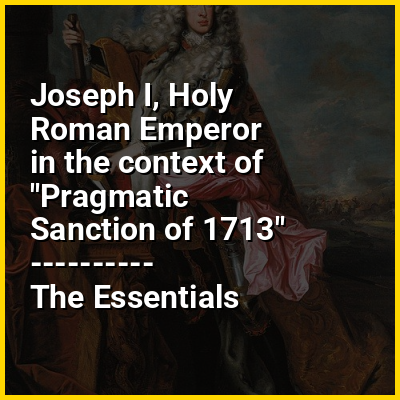
Joseph I (Joseph Jacob Ignaz Johann Anton Eustachius; 26 July 1678—17 April 1711) was Holy Roman Emperor and ruler of the Habsburg monarchy from 1705 until his death in 1711. He was the eldest son of Leopold I, Holy Roman Emperor from his third wife, Eleonor Magdalene of Neuburg. Joseph was crowned King of Hungary at the age of nine in 1687 and was elected King of the Romans at the age of eleven in 1690. He succeeded to the thrones of Bohemia and the Holy Roman Empire when his father died.

Joseph continued the War of the Spanish Succession, begun by his father against Louis XIV of France, in an attempt to make his younger brother Charles (later Emperor Charles VI) King of Spain. In the process, however, owing to the victories won by his military commander, Prince Eugene of Savoy, he did succeed in establishing Austrian hegemony over Italy. Joseph also had to contend with a protracted revolt in Hungary, fomented by Louis XIV. Neither conflict was resolved until the Treaty of Utrecht, after his death.
↓ Menu

👉 Joseph I, Holy Roman Emperor in the context of Pragmatic Sanction of 1713

The Pragmatic Sanction of 1713 (Latin: Sanctio Pragmatica; German: Pragmatische Sanktion) was an edict issued by Holy Roman Emperor Charles VI, on 19 April 1713 to ensure that the Habsburg monarchy, which included the Archduchy of Austria, the Kingdom of Hungary, the Kingdom of Croatia, the Kingdom of Bohemia, the Duchy of Milan, the Kingdom of Naples, the Kingdom of Sardinia and the Austrian Netherlands, could be inherited by a daughter undivided.

As of 1713, Charles and his wife Elizabeth Christine had not had any children. Since the death of his elder brother, Joseph I, in 1711, Charles had been the sole surviving male member of the House of Habsburg. Joseph had died without male issue, leaving Joseph's daughter Maria Josepha as the heiress presumptive. That presented two problems. First, a prior agreement with his brother, known as the Mutual Pact of Succession (1703), had agreed that in the absence of male heirs, Joseph's daughters would take precedence over Charles's daughters in all Habsburg lands. Though Charles had no children, if he were to be survived by daughters alone, they would be cut out of the inheritance. Secondly, because Salic law precluded female inheritance, Charles VI needed to take extraordinary measures to avoid a protracted succession dispute, as other claimants would have surely contested a female inheritance.

↓ Explore More Topics
In this Dossier

Joseph I, Holy Roman Emperor in the context of Charles VI, Holy Roman Emperor

Charles VI (German: Karl; Latin: Carolus; 1 October 1685 – 20 October 1740) was Holy Roman Emperor and ruler of the Austrian Habsburg monarchy from 1711 until his death, succeeding his elder brother, Joseph I. He unsuccessfully claimed the throne of Spain following the death of his relative, Charles II. In 1708, he married Elisabeth Christine of Brunswick-Wolfenbüttel, by whom he had his four children: Leopold Johann (who died in infancy), Maria Theresa, Maria Anna (Governess of the Austrian Netherlands), and Maria Amalia (who also died in infancy).

Four years before the birth of Maria Theresa, faced with his lack of male heirs, Charles provided for a male-line succession failure with the Pragmatic Sanction of 1713. The Emperor favoured his own daughters over those of his elder brother and predecessor, Joseph I, in the succession, ignoring the Mutual Pact of Succession he had signed during the reign of his father, Leopold I. Charles sought the other European powers' approval. They demanded significant terms, among which were that Austria close the Ostend Company. In total, the states of Great Britain, France, Saxony-Poland, the Dutch Republic, Spain, Venice, the Papal States, Prussia, Russia, Denmark, Savoy-Sardinia, and Bavaria, plus the Diet of the Holy Roman Empire, recognised the sanction. France, Spain, Saxony-Poland, Bavaria, and Prussia later reneged. Charles died in 1740, sparking the War of the Austrian Succession, which plagued his successor, Maria Theresa, for eight years.

↑ Return to Menu

Joseph I, Holy Roman Emperor in the context of Augustus III of Poland

Augustus III (German: August III.; Polish: August III Sas – "the Saxon"; Lithuanian: Augustas III; 17 October 1696 – 5 October 1763) was King of Poland and Grand Duke of Lithuania from 1733 until 1763, as well as Elector of Saxony in the Holy Roman Empire where he was known as Frederick Augustus II (German: Friedrich August II.).

He was the only legitimate son of Augustus II the Strong, and converted to Catholicism in 1712 to secure his candidacy for the Polish throne. In 1719 he married Maria Josepha, daughter of Joseph I, Holy Roman Emperor, and became elector of Saxony following his father's death in 1733. Augustus was able to gain the support of Charles VI by agreeing to the Pragmatic Sanction of 1713 and also gained recognition from Russian Empress Anna by supporting Russia's claim to the region of Courland. He was elected king of Poland by a small minority on 5 October 1733 and subsequently banished the former Polish king Stanisław I. He was crowned in Kraków on 17 January 1734.

↑ Return to Menu

Joseph I, Holy Roman Emperor in the context of Order of the Golden Fleece

The Distinguished Order of the Golden Fleece (Spanish: Insigne Orden del Toisón de Oro, German: Orden vom Goldenen Vlies) is a Catholic order of chivalry founded in 1430 in Brugge by Philip the Good, Duke of Burgundy, to celebrate his marriage to Isabella of Portugal. Today, two branches of the order exist, namely the Spanish Fleece and the Austrian Fleece; the current grand masters are King Felipe VI of Spain and Karl von Habsburg, head of the House of Habsburg-Lorraine, respectively. The Grand Chaplain of the Austrian branch is Cardinal Christoph Schönborn, Archbishop of Vienna.

The separation of the two existing branches took place as a result of the War of the Spanish Succession of 1701–1714. The grand master of the order, Charles II of Spain (a Habsburg), had died childless in 1700, and so the right to succeed to the throne of Spain (and incidentally to become the Sovereign of the Order of the Golden Fleece) initiated a continental conflict. On one hand, Charles, brother of the Holy Roman Emperor Joseph I, claimed the Spanish crown as an agnatic member of the House of Habsburg, which had inherited the Burgundian titles and had held the Spanish throne for almost two centuries. However, the late king of Spain had named Philip of Bourbon, his sister's grandchild, as his successor in his will. After the conclusion of the war in 1714, the European powers recognized Philip of Bourbon as King of Spain, but the old Burgundian Habsburg territories became the Austrian Netherlands (1714–1797), and with them went the Treasure of the Order and its archive. The two dynasties, the Bourbons of Spain and the Habsburgs of Austria, have ever since continued heading the separate orders of the Golden Fleece.

↑ Return to Menu

Joseph I, Holy Roman Emperor in the context of Mutual Pact of Succession

The Mutual Pact of Succession (Latin: Pactum Mutuae Successionis, German: Gegenseitiger Erbvertrag) was a succession device secretly signed by archdukes Joseph and Charles of Austria, the future emperors of the Holy Roman Empire, in 1703.

In 1700 the senior line of the House of Habsburg became extinct with the death of King Charles II of Spain. The War of the Spanish Succession ensued, with Louis XIV of France claiming the crowns of Spain for his grandson Philip and Holy Roman Emperor Leopold I claiming them for his son Archduke Charles. The Pact was devised by Emperor Leopold I, on the occasion of Charles's departure for Spain. It stipulated that the claim to the Spanish realms was to be assumed by Charles, while the right of succession to the rest of the Habsburg dominions would rest with his elder brother Joseph, thereby again dividing the House of Habsburg into two lines. The Pact also specified the succession to the brothers: they would both be succeeded by their respective male heirs but should one of them fail to have a son, the other one would succeed him in all his realms. However, should both brothers die leaving no sons, the daughters of the elder brother (Joseph) would have absolute precedence over the daughters of the younger brother (Charles) and the eldest daughter of Joseph would ascend all the Habsburg thrones.

↑ Return to Menu