Political mutilation in Byzantine culture in the context of "Michael I Rangabe"

Play Trivia Questions online!

or

Skip to study material about Political mutilation in Byzantine culture in the context of "Michael I Rangabe"


⭐ Core Definition: Political mutilation in Byzantine culture

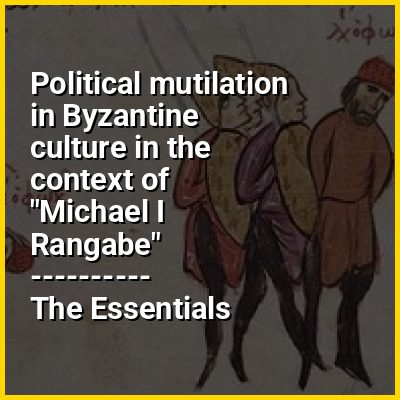
Mutilation was a common method of punishment for criminals in the Byzantine Empire, but it also had a role in the empire's political life. By blinding a rival, one would not only restrict his mobility but also make it almost impossible for him to lead an army into battle, then an important part of taking control of the empire. Castration was also used to eliminate potential opponents. In the Byzantine Empire, for a man to be castrated meant that he was no longer a man—half-dead, "life that was half death". Castration also eliminated any chance of heirs being born to threaten either the emperor's or the emperor's children's place at the throne. Other mutilations were the severing of the nose (rhinotomy), or the amputating of limbs.

↓ Menu

👉 Political mutilation in Byzantine culture in the context of Michael I Rangabe

Michael I Rangabe (also spelled Rhangabe; Greek: Μιχαὴλ Αʹ Ῥαγκαβές, romanizedMikhaḗl 1 Rhangkabés; c. 770 – 11 January 844) was Byzantine emperor from 811 to 813. A courtier of Emperor Nikephoros I (r. 802–811), he survived the disastrous campaign against the Bulgars and was preferred as imperial successor over Staurakios (r. 811–811), who was severely injured. He was proclaimed emperor by Patriarch Nicephorus I of Constantinople on 2 October 811.

Michael's policies were generally conciliatory, and he was overwhelmingly influenced by the iconodule clerics Nikephoros and Theodore the Stoudite. He improved relations with the Franks, even to the point of recognising Charlemagne as an emperor – although not "of the Romans" – and requesting papal arbitration in the Moechian controversy. His half-hearted leadership of the campaign against the Bulgars resulted in defeat in the Battle of Versinikia. The stratēgos of the Anatolic Theme, Leo the Armenian, a popular and successful general, abandoned Michael on the battlefield but was proclaimed emperor by the military, in what was the last military overthrow of an emperor in Byzantine history. Michael was pressured to abdicate, and he retired to a monastery. His sons were castrated to prevent the continuation of his dynasty.

↓ Explore More Topics
In this Dossier

Political mutilation in Byzantine culture in the context of Alexios V Doukas

Alexios V Doukas (Greek: Ἀλέξιος Δούκας, romanizedAléxios Doúkās; died December 1204), Latinized as Alexius V Ducas, was Byzantine emperor from February to April 1204, just prior to the sack of Constantinople by the participants of the Fourth Crusade. His family name was Doukas, but he was also known by the nickname Mourtzouphlos or Murtzuphlus (Μούρτζουφλος), referring to either bushy, overhanging eyebrows or a sullen, gloomy character. He achieved power through a palace coup, killing his predecessors in the process. Though he made vigorous attempts to defend Constantinople from the crusader army, his military efforts proved ineffective. His actions won the support of the mass of the populace, but he alienated the elite of the city. Following the fall, sack, and occupation of the city, Alexios V was blinded by his father-in-law, the ex-emperor Alexios III, and later executed by the new Latin regime. He was the last Byzantine emperor to rule in Constantinople until the Byzantine recapture of Constantinople in 1261.

↑ Return to Menu

Political mutilation in Byzantine culture in the context of 700s (decade)

The 700s decade ran from January 1, 700, to December 31, 709.

  • The Wariʼ people invade and occupy the Cuzco Valley (modern Peru) in the southern highlands (approximate date).
  • The Moche culture in the northern part of modern day Peru collapses, largely due to environmental problems and/or political and social unrest (approximate date).
  • July 18 – Emperor Monmu dies after a 10-year reign. He is succeeded by his aunt Genmei, who becomes the 43rd empress of Japan. She is the sister of former empress Jitō, and the niece and wife of late emperor Tenmu.
↑ Return to Menu