Poison dart frog in the context of "Bertha Lutz"

Play Trivia Questions online!

or

Skip to study material about Poison dart frog in the context of "Bertha Lutz"


⭐ Core Definition: Poison dart frog

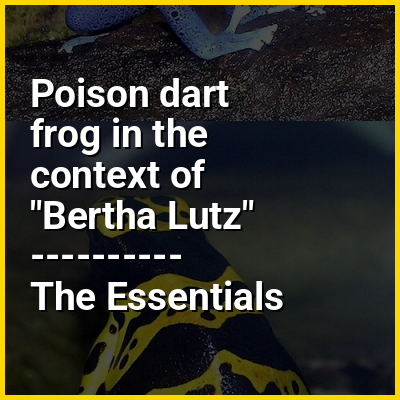
Poison dart frog (also known as dart-poison frog, poison frog or formerly known as poison arrow frog) is the common name of a group of frogs in the family Dendrobatidae which are native to tropical Central and South America. These species are diurnal and often have brightly colored bodies. This bright coloration is correlated with the toxicity of the species, making them aposematic. Some species of the family Dendrobatidae exhibit extremely bright coloration along with high toxicity — a feature derived from their diet of ants, mites and termites— while species which eat a much larger variety of prey have cryptic coloration with minimal to no amount of observed toxicity. Many species of this family are threatened due to human infrastructure encroaching on their habitats.

These amphibians are often called "dart frogs" due to the aboriginal South Americans' use of their toxic secretions to poison the tips of blowdarts. However, out of over 170 species, only four have been documented as being used for this purpose (curare plants are more commonly used for aboriginal South American darts) all of which come from the genus Phyllobates, which is characterized by the relatively large size and high levels of toxicity of its members.
↓ Menu

👉 Poison dart frog in the context of Bertha Lutz

Bertha Maria Júlia Lutz (2 August 1894 – 16 September 1976) was a Brazilian zoologist, politician, and diplomat. Lutz became a leading figure in both the Pan American feminist movement and human rights movement. She was instrumental in gaining women's suffrage in Brazil and represented her country at the United Nations Conference on International Organization, signing her name to the United Nations Charter and championing the inclusion of Article 8 in the Charter. In addition to her political work, she was a naturalist at the National Museum of Brazil, specializing in poison dart frogs. She has four frog species and two lizard species named after her.

↓ Explore More Topics
In this Dossier

Poison dart frog in the context of Wildlife of Brazil

The wildlife of Brazil comprises all naturally occurring animals, plants, and fungi in Brazil, which is the most biodiverse country in the world. Home to 60% of the Amazon rainforest, which accounts for approximately one-tenth of all species in the world, Brazil has the greatest biodiversity of any country on the planet. It has the most known species of plants (60,000), freshwater fish (3,000), amphibians (1,188), snakes (430), insects (90,000) and mammals (775). Brazil is also the country with the most native species of eatable fruits (over 300).It also ranks third on the list of countries with the most bird species (1,971) and the third with the most reptile species (848). The number of fungal species is unknown (+3,300 species). Approximately two-thirds of all species worldwide are found in tropical areas, often coinciding with developing countries such as Brazil. Brazil is second only to Indonesia as the country with the most endemic species.

↑ Return to Menu

Poison dart frog in the context of Müllerian mimicry

Müllerian mimicry is a type of biological mimicry in which two or more well-defended species, often foul-tasting and sharing common predators, converge in appearance to mimic each other's honest warning signals. This convergence of appearance achieves the following benefit to species that undergo it: predators need only experience a single unpleasant encounter with any member of a set of Müllerian mimics in order to thereafter avoid all creatures of similar appearance, whether or not it is the same species as the initial encounter. A ring of distinct species is thereby protected from their mutual predators by attempted predation upon any one of its members. The phenomenon is named after the German-Brazilian naturalist Fritz Müller, who proposed the concept in 1878, supporting his theory with a mathematical model of frequency-dependent selection, one of the first such models anywhere in biology.

Müllerian mimicry was first identified in tropical butterflies that shared colourful wing patterns, but it is found in many groups of insects such as bumblebees, as well as in other animals such as poison frogs and coral snakes. The mimicry need not be restricted to that detected by vision—many snakes share auditory warning signals. Similarly, the defences involved are not limited to toxicity—anything that tends to deter predators, such as foul taste, sharp spines, or defensive behaviour can make a species unprofitable enough to predators to allow Müllerian mimicry to develop.

↑ Return to Menu

Poison dart frog in the context of Yellow-banded poison dart frog

The yellow-banded poison dart frog (Dendrobates leucomelas), also known as yellow-headed poison dart frog or bumblebee poison frog, is a poison dart frog from the genus Dendrobates of the family Dendrobatidae.

↑ Return to Menu

Poison dart frog in the context of Poisoned arrow

Arrow poisons are used to poison arrow heads or darts for the purposes of hunting and warfare. They have been used by indigenous peoples worldwide and are still in use in areas of South America, Africa and Asia. Notable examples are the poisons secreted from the skin of the poison dart frog, and curare (or 'ampi'), a general term for a range of plant-derived arrow poisons used by the indigenous peoples of South America.

↑ Return to Menu

Poison dart frog in the context of Müllerian mimic

Müllerian mimicry is a type of biological mimicry in which two or more well-defended species, often foul-tasting and sharing common predators, converge in appearance to mimic each other's honest warning signals. This convergence of appearance achieves the following benefit to species that undergo it: predators need only experience a single unpleasant encounter with any member of a set of Müllerian mimics in order to thereafter avoid all creatures of similar appearance, whether or not it is the same species as the initial encounter. A ring of distinct species is thereby protected from their mutual predators by attempted predation upon any one of its members. The phenomenon is named after the German-Brazilian naturalist Fritz Müller, who proposed the concept in 1878, supporting his theory with a mathematical model of frequency-dependent selection, one of the first such models to be deployed in biology.

Müllerian mimicry was first identified in tropical butterflies that shared colourful wing patterns, but it is found in many groups of insects such as bumblebees, as well as in other animals such as poison frogs and coral snakes. The mimicry need not be restricted to that detected by vision—many snakes share auditory warning signals. Similarly, the defences involved are not limited to toxicity—anything that tends to deter predators, such as foul taste, sharp spines, or defensive behaviour can make a species unprofitable enough to predators to allow Müllerian mimicry to develop.

↑ Return to Menu