Parthenon in the context of "Pericles"

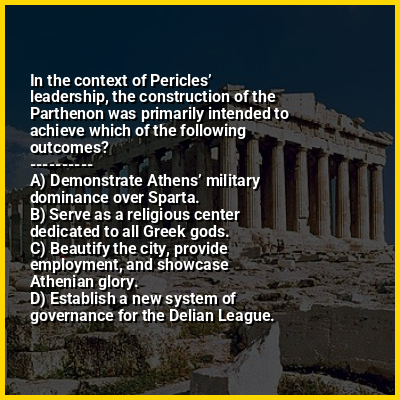
⭐ In the context of Pericles’ leadership, the construction of the Parthenon was primarily intended to achieve which of the following outcomes?

Ad spacer

⭐ Core Definition: Parthenon

The Parthenon (/ˈpɑːrθəˌnɒn, -nən/; Ancient Greek: Παρθενών, romanizedParthenōn [par.tʰe.nɔ̌ːn]; Greek: Παρθενώνας, romanizedParthenónas [parθeˈnonas]) is a former temple on the Athenian Acropolis, Greece, that was dedicated to the goddess Athena. Its decorative sculptures are considered some of the high points of classical Greek art, and the Parthenon is considered an enduring symbol of ancient Greece, Western civilization, and democracy.

The Parthenon was built in the 5th century BC in thanksgiving for the Greek victory over the Persian invaders during the Greco-Persian Wars. Like most Greek temples, the Parthenon also served as the city treasury. Construction started in 447 BC when the Delian League was at the peak of its power. It was completed in 438 BC; work on the artwork and decorations continued until 432 BC. For a time, it served as the treasury of the Delian League, which later became the Athenian Empire.

↓ Menu

>>>PUT SHARE BUTTONS HERE<<<

👉 Parthenon in the context of Pericles

Pericles (/ˈpɛrɪklz/ ; Ancient Greek: Περικλῆς; c. 495–429 BC) was a Greek statesman and general during the Golden Age of Athens. He was prominent and influential in Ancient Athenian politics, particularly between the Greco-Persian Wars and the Peloponnesian War, and was acclaimed by Thucydides, a contemporary historian, as "the first citizen of Athens". Pericles turned the Delian League into an Athenian empire and led his countrymen during the first two years of the Peloponnesian War. The period during which he led Athens as its preeminent orator and statesman, roughly from 461 to 429 BC, is sometimes known as the "Age of Pericles", but the period thus denoted can include times as early as the Persian Wars or as late as the following century.

Pericles promoted the arts and literature, and it was principally through his efforts that Athens acquired the reputation of being the educational and cultural center of the ancient Greek world. He started an ambitious project that generated most of the surviving structures on the Acropolis, including the Parthenon. This project beautified and protected the city, exhibited its glory, and gave work to its people. Pericles also fostered Athenian democracy to such an extent that critics called him a populist. Pericles was descended, through his mother, from the powerful and historically influential Alcmaeonid family. He, along with several members of his family, succumbed to the Plague of Athens in 429 BC, which weakened the city-state during a protracted conflict with Sparta.

↓ Explore More Topics
In this Dossier

Parthenon in the context of Athena

Athena or Athene, often given the epithet Pallas, is an ancient Greek goddess associated with wisdom, warfare, and handicraft who was later syncretized with the Roman goddess Minerva. Athena was regarded as the patron and protectress of various cities across Greece, particularly the city of Athens, from which she most likely received her name. The Parthenon on the Acropolis of Athens is dedicated to her. Her major symbols include owls, olive trees, snakes, and the Gorgoneion. In art, she is generally depicted wearing a helmet and holding a spear.

From her origin as an Aegean palace goddess, Athena was closely associated with the city. She was known as Polias and Poliouchos (both derived from polis, meaning "city-state"), and her temples were usually located atop the fortified acropolis in the central part of the city. The Parthenon on the Athenian Acropolis is dedicated to her, along with numerous other temples and monuments. As the patron of craft and weaving, Athena was known as Ergane. She was also a warrior goddess, and was believed to lead soldiers into battle as Athena Promachos. Her main festival in Athens was the Panathenaia, which was celebrated during the month of Hekatombaion in midsummer and was the most important festival on the Athenian calendar.

↑ Return to Menu

Parthenon in the context of Heraclion

Heraklion, Herakleion (/hɪˈrækliən/ hih-RAK-lee-ən; Greek: Ηράκλειο, Iráklio, pronounced [iˈrakli.o], not to be mistaken with Heracleion, Egypt) or Iraklion, is the largest city and the administrative capital of the island of Crete and capital of Heraklion regional unit. It is the fourth largest city in Greece, and the largest city in the Greek islands, with a municipal population of 179,302 (2021) and 211,370 in its wider metropolitan area, according to the 2011 census.The greater area of Heraklion has been continuously inhabited since at least 7000 BCE, making it one of the oldest inhabited regions in Europe. It is also home to the ancient Knossos Palace, a major center of the Minoan civilization dating back to approximately 2000-1350 BCE, often considered Europe's oldest city. The palace is one of the most significant archaeological sites in Greece, second only to the Parthenon in terms of visitor numbers.

Heraklion was Europe's fastest growing tourism destination for 2017, according to Euromonitor, with an 11.2% growth in international arrivals. According to the ranking, Heraklion was ranked as the 20th most visited region in Europe, as the 66th area on the planet and as the 2nd in Greece for the year 2017, with 3.2 million visitors and the 19th in Europe for 2018, with 3.4 million visitors.

↑ Return to Menu

Parthenon in the context of Greek culture

The culture of Greece has evolved over thousands of years, beginning in Minoan and later in Mycenaean Greece, continuing most notably into Classical Greece, while influencing the Roman Empire and its successor the Byzantine Empire. Other cultures and states such as the Frankish states, the Ottoman Empire, the Venetian Republic and Bavarian and Danish monarchies have also left their influence on modern Greek culture. Also they believed in greek mythology

Modern democracies owe a debt to Greek beliefs in government by the people, trial by jury, and equality under the law. The ancient Greeks pioneered in many fields that rely on systematic thought, including biology, geometry, history, philosophy, and physics. They introduced important literary forms as epic and lyric poetry, history, tragedy, and comedy. In their pursuit of order and proportion, the Greeks created an ideal of beauty that strongly influenced Western art.

↑ Return to Menu

Parthenon in the context of List of Greek deities

In ancient Greece, deities were regarded as immortal, anthropomorphic, and powerful. They were conceived of as individual persons, rather than abstract concepts or notions, and were described as being similar to humans in appearance, albeit larger and more beautiful. The emotions and actions of deities were largely the same as those of humans; they frequently engaged in sexual activity, and were jealous and amoral. Deities were considered far more knowledgeable than humans, and it was believed that they conversed in a language of their own. Their immortality, the defining marker of their godhood, meant that they ceased aging after growing to a certain point. In place of blood, their veins flowed with ichor, a substance which was a product of their diet, and conferred upon them their immortality. Divine power allowed the gods to intervene in mortal affairs in various ways: they could cause natural events such as rain, wind, the growing of crops, or epidemics, and were able to dictate the outcomes of complex human events, such as battles or political situations.

As ancient Greek religion was polytheistic, a multiplicity of gods were venerated by the same groups and individuals. The identity of a deity was demarcated primarily by their name, which could be accompanied by an epithet (a title or surname); religious epithets could refer to specific functions of a god, to connections with other deities, or to a divinity's local forms. The Greeks honoured the gods by means of worship, as they believed deities were capable of bringing to their lives positive outcomes outside their own control. Greek cult, or religious practice, consisted of activities such sacrifices, prayers, libations, festivals, and the building of temples. By the 8th century BC, most deities were honoured in sanctuaries (temenē), sacred areas which often included a temple and dining room, and were typically dedicated to a single deity. Aspects of a god's cult such as the kinds of sacrifices made to them and the placement of their sanctuaries contributed to the distinct conception worshippers had of them.
↑ Return to Menu

Parthenon in the context of Acropolis of Athens

The Acropolis of Athens (Ancient Greek: ἡ Ἀκρόπολις τῶν Ἀθηνῶν, romanizedhē Akropolis tōn Athēnōn; Modern Greek: Ακρόπολη Αθηνών, romanizedAkrópoli Athinón) is an ancient citadel located on a rocky outcrop above the city of Athens, Greece, and contains the remains of several ancient buildings of great architectural and historical significance, the most famous being the Parthenon. The word Acropolis is from Greek ἄκρον (akron) 'highest point, extremity' and πόλις (polis) 'city'. The term acropolis is generic and there are many other acropoleis in Greece. During ancient times the Acropolis of Athens was also more properly known as Cecropia, after the legendary serpent-man Cecrops, the supposed first Athenian king.

While there is evidence that the hill was inhabited as early as the 4th millennium BC, it was Pericles (c. 495–429 BC) in the fifth century BC who coordinated the construction of the buildings whose present remains are the site's most important ones, including the Parthenon, the Propylaea, the Erechtheion and the Temple of Athena Nike. The Parthenon and the other buildings were seriously damaged during the 1687 siege by the Venetians during the Morean War when gunpowder being stored by the Turkish rulers in the Parthenon was hit by a Venetian bombardment and exploded.

↑ Return to Menu

Parthenon in the context of Athena Promachos

The Athena Promachos (Ἀθηνᾶ Πρόμαχος, "Athena who fights in the front line") was a colossal bronze statue of Athena sculpted by Phidias, which stood between the Propylaea and the Parthenon on the Acropolis of Athens. Athena was the tutelary deity of Athens and the goddess of wisdom and warriors. Pheidias also sculpted two other figures of Athena on the Acropolis, the huge gold and ivory ("chryselephantine") cult image of Athena Parthenos in the Parthenon and the Lemnian Athena.

The designation Athena Promachos is not attested before a dedicatory inscription of the early fourth century CE; Pausanias (1.28.2) referred to it as "the great bronze Athena" on the Acropolis.

↑ Return to Menu

Parthenon in the context of Classical Greece

Classical Greece was a period of around 200 years (the 5th and 4th centuries BC) in Ancient Greece, marked by much of the eastern Aegean and northern regions of Greek culture (such as Ionia and Macedonia) gaining increased autonomy from the Persian Empire; the peak flourishing of democratic Athens; the First and Second Peloponnesian Wars; the Spartan and then Theban hegemonies; and the expansion of Macedonia under Philip II. Much of the early defining mathematics, science, artistic thought (architecture, sculpture), theatre, literature, philosophy, and politics of Western civilization derives from this period of Greek history, which had a powerful influence on the later Roman Empire. Part of the broader era of classical antiquity, the classical Greek era ended after Philip II's unification of most of the Greek world against the common enemy of the Persian Empire, which was conquered within 13 years during the wars of Alexander the Great, Philip's son.

In the context of the art, architecture, and culture of ancient Greece, the Classical period corresponds to most of the 5th and 4th centuries BC (the most common dates being the fall of the last Athenian tyrant in 510 BC to the death of Alexander the Great in 323 BC). The Classical period in this sense follows the Greek Dark Ages and Archaic period and is in turn succeeded by the Hellenistic period.

↑ Return to Menu

Parthenon in the context of Age of Pericles

Fifth-century Athens was the Greek city-state of Athens in the time from 480 to 404 BC. Formerly known as the Golden Age of Athens, the latter part being the Age of Pericles, it was buoyed by political hegemony, economic growth and cultural flourishing. The period began in 478 BC, after the defeat of the Persian invasion, when an Athenian-led coalition of city-states, known as the Delian League, confronted the Persians to keep the liberated Asian Greek cities free.

After peace was made with Persia in the mid-5th century BC, what started as an alliance of independent city-states became an Athenian empire after Athens abandoned the pretense of parity among its allies and relocated the Delian League treasury from Delos to Athens, where it funded the building of the Athenian Acropolis, put half its population on the public payroll, and maintained its position as the dominant naval power in the Greek world.

↑ Return to Menu