Parable of the Prodigal Son in the context of "Luke 15"

Play Trivia Questions online!

or

Skip to study material about Parable of the Prodigal Son in the context of "Luke 15"


⭐ Core Definition: Parable of the Prodigal Son

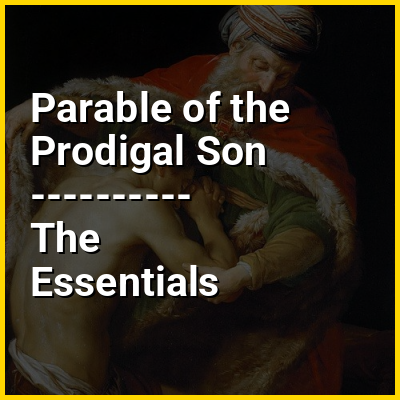
The Parable of the Prodigal Son (also known as the parable of the Two Brothers, Lost Son, Loving Father, or of the Forgiving Father; Greek: Παραβολή του Ασώτου Υιού, romanizedParabolē tou Asōtou Huiou) is one of the parables of Jesus in the Bible, appearing in Luke 15:11–32. In Luke 15, Jesus tells this story, along with those of a man with 100 sheep and a woman with ten coins, to a group of Pharisees and religious leaders who criticized him for welcoming and eating with tax collectors and others seen as sinners.

The Prodigal Son is the third and final parable of a cycle on redemption, following the parables of the Lost Sheep and the Lost Coin. In the Revised Common Lectionary and Roman Rite Catholic Lectionary, this parable is read on the fourth Sunday of Lent (in Year C); in the latter it is also included in the long form of the Gospel on the 24th Sunday of Ordinary Time in Year C, along with the preceding two parables of the cycle. In the Eastern Orthodox Church it is read on the Sunday of the Prodigal Son.
↓ Menu

👉 Parable of the Prodigal Son in the context of Luke 15

Luke 15 is the fifteenth chapter of the Gospel of Luke in the New Testament of the Christian Bible. The book containing this chapter is anonymous, but early Christian tradition uniformly affirmed that Luke the Evangelist composed this Gospel as well as the Acts of the Apostles. This chapter records three parables of Jesus Christ: the lost sheep, the lost coin and the lost or 'prodigal' son, a trilogy about redemption that Jesus tells after the Pharisees and religious leaders accuse him of welcoming and eating with "sinners".

Biblical commentator Heinrich Meyer refers to this chapter, the following chapter and Luke 17:1–10 as a "new, important, and for the most part parabolic set of discourses" linked by the murmuring of the Pharisees and Jesus' responses to them and to his disciples. Arno Gaebelein notes that while these parables have wide appeal and application, in studying them "it must not be overlooked that the Lord answers in the first place the murmuring Pharisees".

↓ Explore More Topics
In this Dossier

Parable of the Prodigal Son in the context of Parables of Jesus

The parables of Jesus are found in the Synoptic Gospels and some of the non-canonical gospels. They form approximately one third of his recorded teachings. Christians place great emphasis on these parables, which they generally regard as the words of Jesus.

Jesus's parables are seemingly simple and memorable stories, often with imagery, and all teach a lesson in daily life. Scholars have commented that although these parables seem simple, the messages they convey are deep, and central to the teachings of Jesus. Christian authors view them not as mere similitudes that serve the purpose of illustration, but as internal analogies in which nature becomes a witness for the spiritual world.

↑ Return to Menu

Parable of the Prodigal Son in the context of The Return of the Prodigal Son (Rembrandt)

The Return of the Prodigal Son (Dutch: De terugkeer van de verloren zoon) is an oil painting by Rembrandt, part of the collection of the Hermitage Museum in St. Petersburg. It is among the Dutch master's final works, likely completed within two years of his death in 1669. Depicting the moment of the prodigal son's return to his father in the Biblical parable, it is a renowned work described by art historian Kenneth Clark as "a picture which those who have seen the original in St. Petersburg may be forgiven for claiming as the greatest picture ever painted".

In the painting, the son has returned home in a wretched state from travels in which he has wasted his inheritance and fallen into poverty and despair. He kneels before his father in repentance, wishing for forgiveness and the position of a servant in his father's household, having realized that even his father's servants had a better station in life than he. His father receives him with a tender gesture and welcomes him as his own son. His hands seem to suggest mothering and fathering at once; the left appears larger and more masculine, set on the son's shoulder, while the right is softer and more receptive in gesture. Standing at the right is the prodigal son's older brother, who crosses his hands in judgment; in the parable he objects to the father's compassion for the sinful son:

↑ Return to Menu

Parable of the Prodigal Son in the context of Contrition

In Christianity, contrition or contriteness (from Latin contritus 'ground to pieces', i.e. a breaking of something hardened) is repentance for sins one has committed. The remorseful person is said to be contrite.

A central concept in much of Christianity, contrition is regarded as the first step, through Christ, towards reconciliation with God. It consists of repentance for all one's sins, a desire for God over sin, and faith in Christ's redemption on the cross and its sufficiency for salvation (see regeneration and ordo salutis). It is widely referred to throughout the Bible, e.g. Ezekiel 33:11, Psalms 6:7ff, Psalm 51:1–12, Luke 13:5, Luke 18:9–13, and the well-known parable of the prodigal son (Luke 15:11–32).

↑ Return to Menu

Parable of the Prodigal Son in the context of Parable of the Lost Coin

The Parable of the Lost Coin is one of the parables of Jesus. It appears in Luke 15:8–10. In it, a woman searches for a lost coin, finds it, and rejoices. It is a member of a trilogy on redemption that Jesus tells after the Pharisees and religious leaders accuse Him of welcoming and eating with "sinners." The other two are the Parable of the Lost Sheep, and the Parable of the Lost Son or Prodigal Son.

↑ Return to Menu