Orbit of the Moon in the context of "Free fall"

Play Trivia Questions online!

or

Skip to study material about Orbit of the Moon in the context of "Free fall"

Ad spacer

⭐ Core Definition: Orbit of the Moon

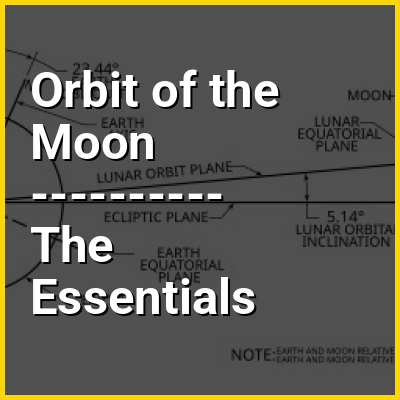
The Moon orbits Earth in the prograde direction and completes one revolution relative to the Vernal Equinox and the fixed stars in about 27.3 days (a tropical month and a sidereal month), and one revolution relative to the Sun in about 29.5 days (a synodic month).

On average, the distance to the Moon is about 384,400 km (238,900 mi) from Earth's centre, which corresponds to about 60 Earth radii or 1.28 light-seconds.

↓ Menu

>>>PUT SHARE BUTTONS HERE<<<

👉 Orbit of the Moon in the context of Free fall

In classical mechanics, free fall is any motion of a body where gravity is the only force acting upon it.A freely falling object may not necessarily be falling down in the vertical direction. If the common definition of the word "fall" is used, an object moving upwards is not considered to be falling, but using scientific definitions, if it is subject to only the force of gravity, it is said to be in free fall. The Moon is thus in free fall around the Earth, though its orbital speed keeps it in very far orbit from the Earth's surface.

In a roughly uniform gravitational field gravity acts on each part of a body approximately equally. When there are no other forces, such as the normal force exerted between a body (e.g. an astronaut in orbit) and its surrounding objects, it will result in the sensation of weightlessness, a condition that also occurs when the gravitational field is weak (such as when far away from any source of gravity).

↓ Explore More Topics
In this Dossier

Orbit of the Moon in the context of Moon

The Moon is the only natural satellite of Earth. It orbits around Earth at an average distance of 384,399 kilometres (238,854 mi), a distance roughly 30 times the width of Earth. It completes an orbit (lunar month) in relation to Earth and the Sun (synodically) every 29.5 days. The Moon and Earth are bound by gravitational attraction, which is stronger on their facing sides. The resulting tidal forces are the main driver of Earth's tides, and have pulled the Moon to always face Earth with the same near side. This tidal locking effectively synchronizes the Moon's rotation period (lunar day) to its orbital period (lunar month).

In geophysical terms, the Moon is a planetary-mass object or satellite planet. Its mass is 1.2% that of the Earth, and its diameter is 3,474 km (2,159 mi), roughly one-quarter of Earth's (about as wide as the contiguous United States). Within the Solar System, it is larger and more massive than any known dwarf planet, and the fifth-largest and fifth-most massive moon, as well as the largest and most massive in relation to its parent planet. Its surface gravity is about one-sixth of Earth's, about half that of Mars, and the second-highest among all moons in the Solar System after Jupiter's moon Io. The body of the Moon is differentiated and terrestrial, with only a minuscule hydrosphere, atmosphere, and magnetic field. The lunar surface is covered in regolith dust, which mainly consists of the fine material ejected from the lunar crust by impact events. The lunar crust is marked by impact craters, with some younger ones featuring bright ray-like streaks. The Moon was volcanically active until 1.2 billion years ago, surfacing lava mostly on the thinner near side of the Moon, filling ancient craters, which through cooling formed the today prominently visible dark plains of basalt called maria ('seas'). The Moon formed out of material from Earth, ejected by a giant impact into Earth of a hypothesized Mars-sized body named Theia 4.51 billion years ago, not long after Earth's formation.

↑ Return to Menu

Orbit of the Moon in the context of Antarctic Circle

The Antarctic Circle is the most southerly of the five major circles of latitude that mark maps of Earth. The region south of this circle is known as the Antarctic, and the zone immediately to the north is called the Southern Temperate Zone. South of the Antarctic Circle, the Sun is above the horizon for 24 continuous hours at least once per year (and therefore visible at solar midnight) and the centre of the Sun (ignoring refraction) is below the horizon for 24 continuous hours at least once per year (and therefore not visible at solar noon); this is also true within the Arctic Circle, the Antarctic Circle’s counterpart in the Northern Hemisphere.

The position of the Antarctic Circle is not fixed and, not taking account of the nutation, currently runs 66°33′50.7″ south of the Equator. This figure may be slightly inaccurate because it does not allow for the effects of astronomical nutation, which can be up to 10″. Its latitude depends on the Earth's axial tilt, which fluctuates within a margin of more than 2° over a 41,000-year period, due to tidal forces resulting from the orbit of the Moon. Consequently, the Antarctic Circle is currently drifting southwards at a speed of about 14.5 m (48 ft) per year.

↑ Return to Menu

Orbit of the Moon in the context of Lunar distance

The instantaneous Earth–Moon distance, or distance to the Moon, is the distance from the center of Earth to the center of the Moon. In contrast, the Lunar distance (LD or ), or Earth–Moon characteristic distance, is a unit of measure in astronomy. More technically, it is the semi-major axis of the geocentric lunar orbit. The average lunar distance is approximately 385,000 km (239,000 mi), or 1.3 light-seconds. It is roughly 30 times Earth's diameter and a non-stop plane flight traveling that distance would take more than two weeks. Around 389 lunar distances make up an astronomical unit (roughly the distance from Earth to the Sun).

Lunar distance is commonly used to express the distance to near-Earth object encounters. Lunar semi-major axis is an important astronomical datum. It has implications for testing gravitational theories such as general relativity and for refining other astronomical values, such as the mass, radius, and rotation of Earth. The measurement is also useful in measuring the lunar radius, as well as the distance to the Sun.

↑ Return to Menu

Orbit of the Moon in the context of Earth-Moon system

The Moon is the only natural satellite of Earth. It orbits around Earth at an average distance of 384,399 kilometres (238,854 mi), a distance roughly 30 times the width of Earth. It completes an orbit (lunar month) in relation to Earth and the Sun (synodically) every 29.5 days. The Moon and Earth are bound by gravitational attraction, which is stronger on the sides facing each other. The resulting tidal forces are the main driver of Earth's tides, and have pulled the Moon to always face Earth with the same near side. This tidal locking effectively synchronizes the Moon's rotation period (lunar day) to its orbital period (lunar month).

In geophysical terms, the Moon is a planetary-mass object or satellite planet. Its mass is 1.2% that of the Earth, and its diameter is 3,474 km (2,159 mi), roughly one-quarter of Earth's (about as wide as the contiguous United States). Within the Solar System, it is larger and more massive than any known dwarf planet, and the fifth-largest and fifth-most massive moon, as well as the largest and most massive in relation to its parent planet. Its surface gravity is about one-sixth of Earth's, about half that of Mars, and the second-highest among all moons in the Solar System after Jupiter's moon Io. The body of the Moon is differentiated and terrestrial, with only a minuscule hydrosphere, atmosphere, and magnetic field. The lunar surface is covered in regolith dust, which mainly consists of the fine material ejected from the lunar crust by impact events. The lunar crust is marked by impact craters, with some younger ones featuring bright ray-like streaks. The Moon was volcanically active until 1.2 billion years ago, surfacing lava mostly on the thinner near side of the Moon, filling ancient craters, which through cooling formed the today prominently visible dark plains of basalt called maria ('seas'). The origin of the Moon is not clear, although it has been hypothesized to have formed out of material from Earth, ejected by a giant impact into Earth of a Mars-sized body named Theia 4.51 billion years ago, not long after Earth's formation.
↑ Return to Menu

Orbit of the Moon in the context of High Earth orbit

A high Earth orbit is a geocentric orbit with an apogee farther than that of the geosynchronous orbit, which is 35,786 km (22,236 mi) away from Earth.In this article, the non-standard abbreviation of HEO is used for high Earth orbit.

The development of HEO technology has had a significant impact on space exploration and has paved the way for future missions to deep space. The ability to place satellites in HEO has allowed scientists to make groundbreaking discoveries in astronomy and Earth science, while also enabling global communication and navigation systems.

↑ Return to Menu

Orbit of the Moon in the context of Far side of the Moon

The far side of the Moon, also called the dark side of the Moon, is the hemisphere of the Moon that faces away from Earth; the opposite hemisphere being the near side. Due to tidal locking, the time it takes for the Moon to orbit the Earth once is equal to the time it takes for the Moon to rotate once, thus, the far side of the Moon never fully comes into view from Earth's surface. The far side has sometimes been called the "dark side of the Moon", where "dark" means "unseen" instead of "unilluminated" – despite a common misconception that the dark side of the Moon is so-called because it never receives light, each location on the Moon experiences two weeks of sunlight while the opposite location experiences night. The far side is actually more reflective than the near side, as it lacks the large areas of darker maria surface.

About 18 percent of the far side is occasionally visible from Earth due to oscillation and to libration. The remaining 82 percent remained unobserved until 1959, when it was photographed by the Soviet Luna 3 space probe. The Soviet Academy of Sciences published the first atlas of the far side in 1960. The Apollo 8 astronauts were the first humans to see the far side in person when they orbited the Moon in 1968. Compared to the near side, the far side's terrain is rugged, with a multitude of impact craters and relatively few flat and dark lunar maria ("seas"), giving it an appearance closer to other barren places in the Solar System such as Mercury and Callisto. It has one of the largest craters in the Solar System, the South Pole–Aitken basin.

↑ Return to Menu