Old City of Hebron in the context of "Cave of the Patriarchs"

Play Trivia Questions online!

or

Skip to study material about Old City of Hebron in the context of "Cave of the Patriarchs"

Ad spacer

⭐ Core Definition: Old City of Hebron

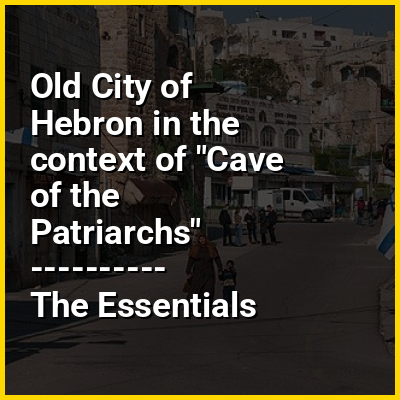
The Old City of Hebron (Arabic: البلدة القديمة الخليل Hebrew: עיר העתיקה של חברון) is the historic city centre of Hebron. The Hebron of antiquity is thought by archaeologists to have originally started elsewhere, at Tel Rumeida, which is approximately 200 meters (660 ft) west of today's Old City, and thought to have originally been a Canaanite city. Today's Old City was settled in Greek or Roman times (circa 3rd to 1st centuries BCE). It became the center of the overall Hebron site during the Abbasid Caliphate (which began circa 750 CE).

It was recognized as the third World Heritage Site in the State of Palestine in 2017.

↓ Menu

>>>PUT SHARE BUTTONS HERE<<<

👉 Old City of Hebron in the context of Cave of the Patriarchs

The Cave of the Patriarchs or Tomb of the Patriarchs, known to Jews by its Biblical name Cave of Machpelah (Biblical Hebrew: מְעָרַת הַמַּכְפֵּלָה, romanized: Məʿāraṯ hamMaḵpēlā, lit.'Cave of the Double') and to Muslims as the Ibrahami Mosque (Arabic: المسجد الإبراهيمي, romanizedal-Masjid al-ʾibrāhīmī), or Sanctuary of Ibrahim (Arabic: الحرم الإبراهيمي, romanizedal-Ḥaram al-ʾibrāhīmī), is a series of caves situated in the heart of the Old City of Hebron in the West Bank, 30 kilometres (19 mi) south of Jerusalem. According to the Abrahamic religions, the cave and adjoining field were purchased by Abraham as a burial plot, although most historians believe the Abraham-Isaac-Jacob narrative to be primarily mythological. The site is considered a holy place in Judaism, Christianity, and Islam.

Over the cave stands a large rectangular enclosure dating from the Herodian era. During Byzantine rule of the region, a Christian basilica was built on the site; the structure was converted into the Ibrahimi Mosque following the Muslim conquest of the Levant. By the 12th century, the mosque and its surrounding regions had fallen under Crusader-state control, but were retaken in 1188 by the Ayyubid sultan Saladin, who again converted the structure into a mosque. In 1119 CE, a monk found bones inside the cave, believing them to be the bones of the patriarchs.
↓ Explore More Topics
In this Dossier

Old City of Hebron in the context of Israeli apartheid

Israeli apartheid is a system of institutionalized segregation and discrimination in the Israeli-occupied Palestinian territories and to a lesser extent in Israel proper. This system is characterized by near-total physical separation between the Palestinian and the Israeli settler population of the West Bank, as well as the judicial separation that governs both communities, which discriminates against the Palestinians in a wide range of ways. Israel also discriminates against Palestinian refugees in the diaspora and against its own Palestinian citizens.

Since the 1948 Palestine war, Israel has denied Palestinian refugees who were expelled or fled from what became its territory the right of return and right to their lost properties. Israel has been occupying the West Bank and the Gaza Strip since the 1967 Six-Day War, which is now the longest military occupation in modern history, and, in contravention of international law, has been constructing large settlements there that separate Palestinian communities from one another and prevent the establishment of a Palestinian state. The settlements are mostly encircled by the Israeli West Bank barrier, which intentionally separates the Israeli and Palestinian populations, a policy called Hafrada. Jewish Israeli settlers are subject to Israeli civil law, but the Palestinian population is subject to military law. Settlers also have access to separate roads and exploit the region's natural resources at the expense of its Palestinian inhabitants.

↑ Return to Menu