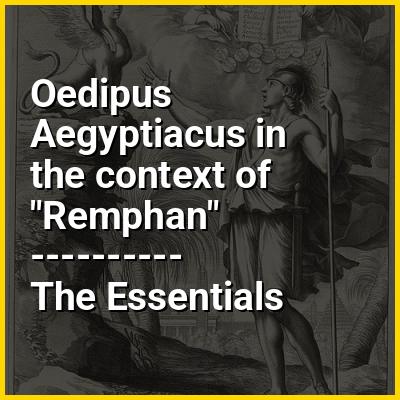
Oedipus Aegyptiacus is Athanasius Kircher's supreme work of Egyptology. The three full folio tomes of ornate illustrations and diagrams were published in Rome over the period 1652–54. Kircher cited as his sources Chaldean astrology, Hebrew kabbalah, Greek mythology, Pythagorean mathematics, Arabian alchemy and Latin philology.
In the book, Kircher attempted to translate Egyptian hieroglyphs. His primary source for the study was the Bembine Tablet, a bronze and silver tablet depicting various Egyptian deities with Isis as its centre. The work is representative of antiquarian scholarship in the late Renaissance. Kircher' renditions of hieroglyphic texts are wordy and portentous, though rather speculative in nature. He interpreted the frequent references to the sayings of Osiris in the original Egyptian text as suggestive references to the throne of Isis, the treachery of Typhon, and the vigilance of Anubis.