Observable universe in the context of "Light"

Play Trivia Questions online!

or

Skip to study material about Observable universe in the context of "Light"

Ad spacer

⭐ Core Definition: Observable universe

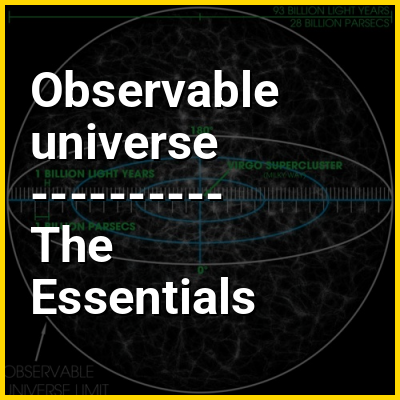
The observable universe is a spherical region of the universe consisting of all matter that can be observed from Earth; the electromagnetic radiation from these objects has had time to reach the Solar System and Earth since the beginning of the cosmological expansion. Assuming the universe is isotropic, the distance to the edge of the observable universe is the same in every direction. That is, the observable universe is a spherical region centered on the observer. Every location in the universe has its own observable universe, which may or may not overlap with the one centered on Earth.

The word observable in this sense does not refer to the capability of modern technology to detect light or other information from an object, or whether there is anything to be detected. It refers to the physical limit created by the speed of light itself. No signal can travel faster than light, hence there is a maximum distance, called the particle horizon, beyond which nothing can be detected, as the signals could not have reached the observer yet.
↓ Menu

>>>PUT SHARE BUTTONS HERE<<<
In this Dossier

Observable universe in the context of Cosmology

Cosmology (from Ancient Greek κόσμος (cosmos) 'the universe, the world' and λογία (logia) 'study of') is a branch of physics and metaphysics dealing with the nature of the universe, the cosmos. The term cosmology was first used in English in 1656 in Thomas Blount's Glossographia, with the meaning of "a speaking of the world". In 1731, German philosopher Christian Wolff used the term cosmology in Latin (cosmologia) to denote a branch of metaphysics that deals with the general nature of the physical world. Religious or mythological cosmology is a body of beliefs based on mythological, religious, and esoteric literature and traditions of creation myths and eschatology. In the science of astronomy, cosmology is concerned with the study of the chronology of the universe.

Physical cosmology is the study of the observable universe's origin, its large-scale structures and dynamics, and the ultimate fate of the universe, including the laws of science that govern these areas. It is investigated by scientists, including astronomers and physicists, as well as philosophers, such as metaphysicians, philosophers of physics, and philosophers of space and time. Because of this shared scope with philosophy, theories in physical cosmology may include both scientific and non-scientific propositions and may depend upon assumptions that cannot be tested. Physical cosmology is a sub-branch of astronomy that is concerned with the universe as a whole. Modern physical cosmology is dominated by the Big Bang Theory which attempts to bring together observational astronomy and particle physics; more specifically, a standard parameterization of the Big Bang with dark matter and dark energy, known as the Lambda-CDM model.

↑ Return to Menu

Observable universe in the context of Universe

The universe is all of space and time and their contents. It comprises all of existence, any fundamental interaction, physical process and physical constant, and therefore all forms of matter and energy, and the structures they form, from sub-atomic particles to entire galactic filaments. Since the early 20th century, the field of cosmology establishes that space and time emerged together at the Big Bang 13.787±0.020 billion years ago and that the universe has been expanding since then. The portion of the universe that can be seen by humans is approximately 93 billion light-years in diameter at present, but the total size of the universe is not known.

Some of the earliest cosmological models of the universe were geocentric, placing Earth at the center. During the European Renaissance, astronomical observations led to heliocentric models.Further observational improvements led to the realization that the Sun is one of a few hundred billion stars in the Milky Way, which is one of a few hundred billion galaxies in the observable universe. Many of the stars in a galaxy have planets. At the largest scale, galaxies are distributed uniformly and the same in all directions, meaning that the universe has neither an edge nor a center. At smaller scales, galaxies are distributed in clusters and superclusters which form immense filaments and voids in space, creating a vast foam-like structure. Discoveries in the early 20th century lead to the Big Bang theory with a hot fireball, cooling and becoming less dense as the universe expanded, allowing the first subatomic particles and simple atoms to form. Giant clouds of hydrogen and helium were gradually drawn to the places where matter was most dense, forming the first galaxies, stars, and everything else seen today.

↑ Return to Menu

Observable universe in the context of Galaxy

A galaxy is a system of stars, stellar remnants, interstellar gas, dust, and dark matter bound together by gravity. The word is derived from the Greek galaxias (γαλαξίας), literally 'milky', a reference to the Milky Way galaxy that contains the Solar System. Galaxies, averaging an estimated 100 million stars, range in size from dwarfs with less than a thousand stars, to the largest galaxies knownsupergiants with one hundred trillion stars, each orbiting its galaxy's centre of mass. Most of the mass in a typical galaxy is in the form of dark matter, with only a few per cent of that mass visible in the form of stars and nebulae. Supermassive black holes are a common feature at the centres of galaxies.

Galaxies are categorised according to their visual morphology as elliptical, spiral, or irregular. The Milky Way is an example of a spiral galaxy. It is estimated that there are between 200 billion (2×10) to 2 trillion galaxies in the observable universe. Most galaxies are 1,000 to 100,000 parsecs in diameter (approximately 3,000 to 300,000 light years) and are separated by distances in the order of millions of parsecs (or megaparsecs). For comparison, the Milky Way has a diameter of at least 26,800 parsecs (87,400 ly) and is separated from the Andromeda Galaxy, its nearest large neighbour, by just over 750,000 parsecs (2.5 million ly).

↑ Return to Menu

Observable universe in the context of Observational astronomy

Observational astronomy is a division of astronomy that is concerned with recording data about the observable universe, in contrast with theoretical astronomy, which is mainly concerned with calculating the measurable implications of physical models. It is the practice and study of observing celestial objects with the use of telescopes and other astronomical instruments.

As a science, the study of astronomy is somewhat hindered in that direct experiments with the properties of the distant universe are not possible. However, this is partly compensated by the fact that astronomers have a vast number of visible examples of stellar phenomena that can be examined. This allows for observational data to be plotted on graphs, and general trends recorded. Nearby examples of specific phenomena, such as variable stars, can then be used to infer the behavior of more distant representatives. Those distant yardsticks can then be employed to measure other phenomena in that neighborhood, including the distance to a galaxy.

↑ Return to Menu

Observable universe in the context of Dark matter

In astronomy and cosmology, dark matter is an invisible and hypothetical form of matter that does not interact with light or other electromagnetic radiation. Dark matter is implied by gravitational effects that cannot be explained by general relativity unless more matter is present than can be observed. Such effects occur in the context of formation and evolution of galaxies, gravitational lensing, the observable universe's current structure, mass position in galactic collisions, the motion of galaxies within galaxy clusters, and cosmic microwave background anisotropies. Dark matter is thought to serve as gravitational scaffolding for cosmic structures.After the Big Bang, dark matter clumped into blobs along narrow filaments with superclusters of galaxies forming a cosmic web at scales on which entire galaxies appear like tiny particles.

↑ Return to Menu

Observable universe in the context of Dark energy

In physical cosmology and astronomy, dark energy is a proposed form of energy that affects the universe on the largest scales. Its primary effect is to drive the accelerating expansion of the universe. It also slows the rate of structure formation. Assuming that the lambda-CDM model of cosmology is correct, dark energy dominates the universe, contributing 68% of the total energy in the present-day observable universe while dark matter and ordinary (baryonic) matter contribute 27% and 5%, respectively, and other components such as neutrinos and photons are nearly negligible. Dark energy's density is very low: 7×10 g/cm (6×10 J/m in mass-energy), much less than the density of ordinary matter or dark matter within galaxies. However, it dominates the universe's mass–energy content because it is uniform across space.

The first observational evidence for dark energy's existence came from measurements of supernovae. Type Ia supernovae have constant luminosity, which means that they can be used as accurate distance measures. Comparing this distance to the redshift (which measures the speed at which the supernova is receding) shows that the universe's expansion is accelerating. Prior to this observation, scientists thought that the gravitational attraction of matter and energy in the universe would cause the universe's expansion to slow over time. Since the discovery of accelerating expansion, several independent lines of evidence have been discovered that support the existence of dark energy.

↑ Return to Menu

Observable universe in the context of Astronomical object

An astronomical object, celestial object, stellar object or heavenly object is a naturally occurring physical entity, association, or structure that exists within the observable universe. In astronomy, the terms object and body are often used interchangeably. However, an astronomical body, celestial body or heavenly body is a single, tightly bound, contiguous physical object, while an astronomical or celestial object admits a more complex, less cohesively bound structure, which may consist of multiple bodies or even other objects with substructures.

Examples of astronomical objects include planetary systems, star clusters, nebulae, and galaxies, while asteroids, moons, planets, and stars are astronomical bodies. A comet may be identified as both a body and an object: It is a body when referring to the frozen nucleus of ice and dust, and an object when describing the entire comet with its diffuse coma and tail.

↑ Return to Menu

Observable universe in the context of Star

A star is a luminous spheroid of plasma held together by self-gravity. The nearest star to Earth is the Sun. Many other stars are visible to the naked eye at night; their immense distances from Earth make them appear as fixed points of light. The most prominent stars have been categorised into constellations and asterisms, and many of the brightest stars have proper names. Astronomers have assembled star catalogues that identify the known stars and provide standardized stellar designations. The observable universe contains an estimated 10 to 10 stars. Only about 4,000 of these stars are visible to the naked eye—all within the Milky Way galaxy.

A star's life begins with the gravitational collapse of a gaseous nebula of material largely comprising hydrogen, helium, and traces of heavier elements. Its total mass mainly determines its evolution and eventual fate. A star shines for most of its active life due to the thermonuclear fusion of hydrogen into helium in its core. This process releases energy that traverses the star's interior and radiates into outer space. At the end of a star's lifetime, fusion ceases and its core becomes a stellar remnant: a white dwarf, a neutron star, or—if it is sufficiently massive—a black hole.

↑ Return to Menu

Observable universe in the context of Cosmic microwave background radiation

The cosmic microwave background (CMB, CMBR), or relic radiation, is microwave radiation that fills all space in the observable universe. With a standard optical telescope, the background space between stars and galaxies is almost completely dark. However, a sufficiently sensitive radio telescope detects a faint background glow that is almost uniform and is not associated with any star, galaxy, or other object. This glow is strongest in the microwave region of the electromagnetic spectrum. Its energy density exceeds that of all the photons emitted by all the stars in the history of the universe. The accidental discovery of the CMB in 1964 by American radio astronomers Arno Allan Penzias and Robert Woodrow Wilson was the culmination of work initiated in the 1940s.

The CMB is landmark evidence of the Big Bang theory for the origin of the universe. In the Big Bang cosmological models, during the earliest periods, the universe was filled with an opaque fog of dense, hot plasma of sub-atomic particles. As the universe expanded, this plasma cooled to the point where protons and electrons combined to form neutral atoms of mostly hydrogen. Unlike the plasma, these atoms could not scatter thermal radiation by Thomson scattering, and so the universe became transparent. Known as the recombination epoch, this decoupling event released photons to travel freely through space. However, the photons have grown less energetic due to the cosmological redshift associated with the expansion of the universe. The surface of last scattering refers to a shell at the right distance in space so photons are now received that were originally emitted at the time of decoupling.

↑ Return to Menu