Nonviolent revolution in the context of "Nonviolent resistance"

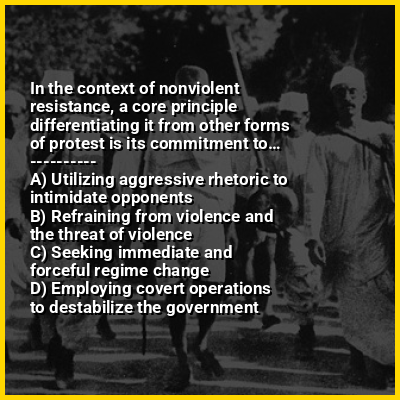
⭐ In the context of nonviolent resistance, a core principle differentiating it from other forms of protest is its commitment to…

Ad spacer

⭐ Core Definition: Nonviolent revolution

A nonviolent revolution is a revolution conducted primarily by unarmed civilians using tactics of civil resistance, including various forms of nonviolent protest, to bring about the departure of governments seen as entrenched and authoritarian without the use or threat of violence. While many campaigns of civil resistance are intended for much more limited goals than revolution, generally a nonviolent revolution is characterized by simultaneous advocacy of democracy, human rights, and national independence in the country concerned.

An effective campaign of civil resistance, and even the achievement of a nonviolent revolution, may be possible in a particular case despite the government in power taking brutal measures against protesters. The commonly held belief that most revolutions that have happened in dictatorial regimes were bloody or violent uprisings is not borne out by historical analysis. Nonviolent Revolutions came to the international forefront in the 20th century by the independence movement of India under the leadership of Gandhi with civil disobedience being the tool of nonviolent resistance. An important non-violent revolution was in Sudan in October 1964 which overthrew a military dictatorship. Later it became more successful and more common in the 1980s as Cold War political alliances which supported status quo governance waned.
↓ Menu

>>>PUT SHARE BUTTONS HERE<<<

👉 Nonviolent revolution in the context of Nonviolent resistance

Nonviolent resistance, or nonviolent action, sometimes called civil resistance, is the practice of achieving goals such as social change through symbolic protests, civil disobedience, economic or political noncooperation, satyagraha, constructive program, or other methods, while refraining from violence and the threat of violence. This type of action highlights the desires of an individual or group that feels that something needs to change to improve the current condition of the resisting person or group.

Mahatma Gandhi is the most popular figure related to this type of protest; United Nations celebrates Gandhi's birthday, October 2, as the International Day of Non-Violence. Other prominent advocates include Abdul Ghaffar Khan, Henry David Thoreau, Etienne de la Boétie, Charles Stewart Parnell, Te Whiti o Rongomai, Tohu Kākahi, Leo Tolstoy, Alice Paul, Martin Luther King Jr., Daniel Berrigan, Philip Berrigan, James Bevel, Václav Havel, Andrei Sakharov, Lech Wałęsa, Gene Sharp, Nelson Mandela, Jose Rizal, and many others. From 1966 to 1999, nonviolent civic resistance played a critical role in fifty of sixty-seven transitions from authoritarianism.

↓ Explore More Topics
In this Dossier

Nonviolent revolution in the context of Rose Revolution

The Rose Revolution or Revolution of Roses (Georgian: ვარდების რევოლუცია, romanized: vardebis revolutsia) was a nonviolent change of power that occurred in Georgia in November 2003. The event was brought about by widespread protests over the disputed parliamentary elections and culminated in the resignation of President Eduard Shevardnadze, which marked the end of Soviet-era leadership in the country. The revolution derives its name from the climactic moment, when demonstrators led by Mikheil Saakashvili stormed the Parliament session with red roses in hand.

The revolution was led by Shevardnadze's former political allies, Mikheil Saakashvili, Nino Burjanadze and Zurab Zhvania. Consisting of twenty days of protests from 3 to 23 November 2003, the Revolution triggered new presidential and parliamentary elections in Georgia, which brought the National MovementDemocrats coalition to the power. The death of Zurab Zhvania in uncertain circumstances and the withdrawal of Nino Burjanadze into opposition eventually established the United National Movement as the single ruling party.

↑ Return to Menu

Nonviolent revolution in the context of Dissolution of Czechoslovakia

The dissolution of Czechoslovakia, which took effect on 31 December 1992, was the self-determined partition of the federal republic of Czechoslovakia into the independent countries of the Czech Republic and Slovakia. Both mirrored the Czech Socialist Republic and the Slovak Socialist Republic, which had been created in 1969 as the constituent states of the Czechoslovak Socialist Republic until the end of 1989.

It is sometimes known as the Velvet Divorce, a reference to the bloodless Velvet Revolution of 1989, which had led to the end of the rule of the Communist Party of Czechoslovakia. The dissolution of Czechoslovakia is clearly linked to the end of the Cold War and the dissolution of other Eastern Bloc countries such as the Dissolution of the Soviet Union and the Breakup of Yugoslavia. Unlike Yugoslavia, which was also created in 1918 and disappeared in 1992, Czechoslovakia did not experience violent clashes due to nationalism, which in the case of Yugoslavia led to the Yugoslav Wars.

↑ Return to Menu

Nonviolent revolution in the context of 1993 Nigerian coup d'état

The 1993 Nigerian coup d'état was a bloodless military coup which took place in Nigeria on 17 November 1993 when the Armed Forces, headed by Defence Minister General Sani Abacha, forced Interim President Chief Ernest Shonekan to resign. Shonekan assumed the interim presidency on 26 August 1993, succeeding General Ibrahim Babangida as head of state, in the aftermath of Babangida's annulment of the 12 June 1993 presidential election. In a nationwide broadcast following the coup, Abacha cited the stagnant nature of Shonekan's government, and his inability to manage the democratic process in the country as a cause of his resignation. In September 1994, Abacha issued a decree that placed his government above the jurisdiction of the courts, effectively giving him absolute power. Another decree gave him the right to detain anyone for up to three months.

Abacha stayed in power until his death on 8 June 1998 at the presidential complex (Aso Villa) in Abuja. He was succeeded by the Chief of the Defence Staff Major General Abdulsalami Abubakar as head of state.

↑ Return to Menu