Niccolò Paganini in the context of "Music of Italy"

Play Trivia Questions online!

or

Skip to study material about Niccolò Paganini in the context of "Music of Italy"


⭐ Core Definition: Niccolò Paganini

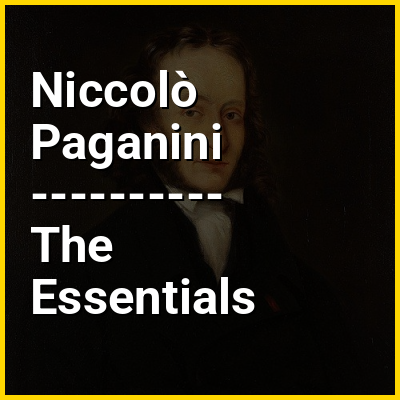
Niccolò (or Nicolò) Paganini (/pæɡəˈnni, pɑːɡə-/; Italian: [ni(k)koˈlɔ ppaɡaˈniːni] ; 27 October 1782 – 27 May 1840) was an Italian violinist and composer. He was the most celebrated violin virtuoso of his time, and left his mark as one of the pillars of modern violin technique. His 24 Caprices for Solo Violin Op. 1 are among the best known of his compositions and have served as an inspiration for many prominent composers.

Son of a ship chandler from Genoa, Paganini showed great gifts for music from an early age and studied under Alessandro Rolla, Ferdinando Paer and Gasparo Ghiretti. Accompanied by his father, he toured northern Italy extensively as a teenager. By 1805 he had come into the service of Napoleon's sister, Elisa Bonaparte, who then ruled Lucca where Paganini was first violin. From 1809 on he returned to touring and achieved continental fame in the subsequent two and a half decades, developing a reputation for his technical brilliance and showmanship, as well as his extravagant, philandering lifestyle. Paganini ended his concert career in 1834 amid declining health, and the failure of his Paris casino left him in financial ruin. He retired to southern France and died in Nice in 1840 at the age of 57.
↓ Menu

👉 Niccolò Paganini in the context of Music of Italy

In Italy, music has traditionally been one of the cultural markers of Italian national cultures and ethnic identity and holds an important position in society and in politics. Italian music innovation – in musical scale, harmony, notation, and theatre – enabled the development of opera and much of modern European classical music – such as the symphony and concerto – ranges across a broad spectrum of opera and instrumental classical music and popular music drawn from both native and imported sources. Instruments associated with classical music, including the piano and violin, were invented in Italy.

Italy's most famous composers include the Renaissance Palestrina, Monteverdi, and Gesualdo; the Baroque Scarlatti, and Vivaldi; the classical Paganini, and Rossini; and the Romantic Verdi and Puccini. Classical music has a strong hold in Italy, as evidenced by the fame of its opera houses such as La Scala, and performers such as the pianist Maurizio Pollini and tenor Luciano Pavarotti. Italy is known as the birthplace of opera. Italian opera is believed to have been founded in the 17th century.

↓ Explore More Topics
In this Dossier

Niccolò Paganini in the context of Romantic music

Romantic music is a stylistic movement in Western Classical music associated with the period of the 19th century commonly referred to as the Romantic era (or Romantic period). It is closely related to the broader concept of Romanticism—the intellectual, artistic, and literary movement that became prominent in Western culture from about 1798 until 1837.

Romantic composers sought to create music that was individualistic, emotional, dramatic, and often programmatic; reflecting broader trends within the movements of Romantic literature, poetry, art, and philosophy. Romantic music was often ostensibly inspired by (or else sought to evoke) non-musical stimuli, such as nature, literature, poetry, super-natural elements, or the fine arts. It included features such as increased chromaticism and moved away from traditional forms.

↑ Return to Menu

Niccolò Paganini in the context of Klaus Kinski

Klaus Kinski (German: [klaʊs ˈkɪnski] ; born Klaus Günter Karl Nakszynski 18 October 1926 – 23 November 1991) was a German actor. Equally renowned for his intense performance style and notorious for his volatile personality, he appeared in over 130 film roles in a career that spanned 40 years, from 1948 to 1988. He is best known for starring in five films directed by Werner Herzog from 1972 to 1987 (Aguirre, the Wrath of God; Nosferatu the Vampyre; Woyzeck; Fitzcarraldo; and Cobra Verde), who would later chronicle their tumultuous relationship in the documentary My Best Fiend.

Kinski's roles spanned multiple genres, languages, and nationalities, including Spaghetti Westerns, horror films, war films, dramas, and Edgar Wallace krimi films. His infamy was elevated by a number of eccentric creative endeavors, including a one-man show based on the life of Jesus Christ, a biopic of violinist Niccolò Paganini directed by and starring himself, and over twenty spoken word albums.

↑ Return to Menu

Niccolò Paganini in the context of 24 Caprices for Solo Violin (Paganini)

The 24 Caprices for Solo Violin were written in groups (seven, five and twelve) by Niccolò Paganini between 1802 and 1817. They are also designated as M.S. 25 in Maria Rosa Moretti's and Anna Sorrento's Catalogo tematico delle musiche di Niccolò Paganini which was published in 1982. The Caprices are in the form of études, with each number exploring different skills (double stopped trills, extremely fast switching of positions and strings, etc.)

Ricordi first published them in 1820, where they were grouped and numbered from 1 to 24 as Op. 1, together with 12 Sonatas for Violin and Guitar (Op. 2 and 3) and 6 Guitar Quartets (Op. 4 and 5). When Paganini released his Caprices, he dedicated them "alli artisti" (to the artists) rather than to a specific person. A sort of dedication can be recognized in Paganini's own score, where he annotated between 1832 and 1840 the following 'dedicatee' for each Caprice (possibly ready for a new printed edition): 1: Henri Vieuxtemps; 2: Giuseppe Austri; 3: Ernesto Camillo Sivori; 4: Ole Bornemann Bull; 5: Heinrich Wilhelm Ernst; 6: Karol Józef Lipiński; 7: Franz Liszt; 8: Delphin Alard; 9: Herrmann; 10: Theodor Haumann; 11: Sigismond Thalberg; 12: Dhuler; 13: Charles Philippe Lafont; 14: Jacques Pierre Rode; 15: Louis Spohr; 16: Rodolphe Kreutzer; 17: Alexandre Artôt; 18: Antoine Bohrer; 19: Andreas Jakob Romberg; 20: Carlo Bignami; 21: Antonio Bazzini; 22: Luigi Alliani; 23: [no name]; 24: Nicolò Paganini, sepolto pur troppo (to my self, regrettably buried).

↑ Return to Menu

Niccolò Paganini in the context of Alessandro Rolla

Alessandro Rolla (Italian pronunciation: [alesˈsandro ˈrɔlla]; 23 April 1757 – 14 September 1841) was an Italian viola and violin virtuoso, composer, conductor and teacher. His son, Antonio Rolla, was also a violin virtuoso and composer.

His fame now rests mainly as "teacher of the great Paganini", yet his role was very important in the development of violin and viola technique. Some of the technical innovations that Paganini later utilized largely, such as left-hand pizzicato, chromatic ascending and descending scales, the use of very high positions on violin and viola, octave passages, were first introduced by Rolla.

↑ Return to Menu

Niccolò Paganini in the context of Gasparo Ghiretti

Gasparo Ghiretti (1747 in Naples – 1797 in Parma) was an Italian composer, counterpointist and violinist who served as chamber musician to Ferdinand, Duke of Parma in the last part of the 1700s. In his position he was master teacher to a number of talented musicians, including composer and Duke's chapelmaster Ferdinando Paer; Ferdinando Orlandi (1774–1848); Angelo Maria Benincori; and most famously, a young Niccolò Paganini, who studied with Ghiretti for several months and possibly as long as two years. In addition to violin technique, Ghiretti's teaching focused on harmony, counterpoint, theory and composition.

↑ Return to Menu