Mount Othrys in the context of "The Fall of the Titans"

Play Trivia Questions online!

or

Skip to study material about Mount Othrys in the context of "The Fall of the Titans"

Ad spacer

⭐ Core Definition: Mount Othrys

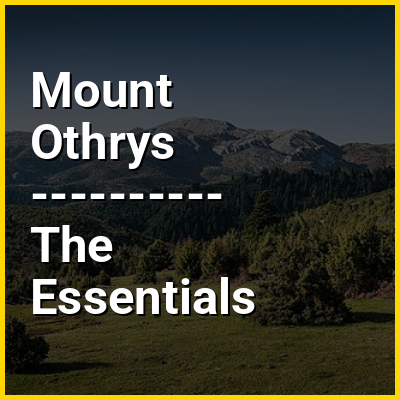
Mount Othrys (Greek: όρος Όθρυςoros Othrys, also Όθρη – Othri) is a mountain range of central Greece, in the northeastern part of Phthiotis and southern part of Magnesia. Its highest summit, Gerakovouni, situated on the border of Phthiotis and Magnesia, is 1,726 m (5,663 ft) above sea level. The population density in the mountains is low: there are a few small villages, including Anavra in the northwest, Kokkotoi in the northeast, Palaiokerasia in the south and Neraida in the southwest. The length from west to east is about 35 km (22 mi) and the width from north to south is about 25 km (16 mi). The Pagasetic Gulf lies to the northeast, and the Malian Gulf lies to the south. The summit Gerakovouni lies 19 km (12 mi) south of Almyros, 27 km (17 mi) northeast of Lamia and 44 km (27 mi) southwest of Volos. The peaks of the range are above the tree line. The main mineral constituent of the rock is ophiolite.

A Natura 2000 protected area has been defined over much, but not all, of the range according to the Birds Directive. Of interest to the government is the protection of the raptors and the prevention of clear-cutting and other settlement measures that would destroy their traditional habitat. The area, named Oros Othrys, Vouna Gkouras kai Farangi Palaio Kerasias, ID GR1430006, includes the eastern range, a spur to the south to cover Palaiokerasia Gorge, and a spur to the north to cover Gkouras Hill.
↓ Menu

>>>PUT SHARE BUTTONS HERE<<<

👉 Mount Othrys in the context of The Fall of the Titans

The Fall of the Titans is an oil painting of the Titanomachy by the Dutch painter Cornelis van Haarlem in 1588–1590. It measures 239 × 307 cm (94 × 121 in). The work is in the collection of the Statens Museum (the national art gallery) in Copenhagen, Denmark. It is an ambitious work of the Haarlem Mannerists, and a display of the artist's ability to devise and depict a large number of varied poses for the male nudes.

In Greek mythology, the Titans were members of the second generation of divine beings, descending from the primordial deities and preceding the Olympians. Based on Mount Othrys, the Titans most famously included the first twelve children of Gaia (Mother Earth) and Uranus (Father Sky). They ruled during the legendary Golden Age, and also comprised the first pantheon of Greek deities.

↓ Explore More Topics
In this Dossier

Mount Othrys in the context of Lamia (city)

Lamia (Greek: Λαμία, Lamía, pronounced [laˈmi.a]) is a city in central Greece. The city dates back to antiquity, and is today the capital of the regional unit of Phthiotis and of the Central Greece region (comprising five regional units). According to the 2021 census, the Municipality of Lamia has a population of 66,657 while Lamia itself has 47,529 inhabitants. The city is located on the slopes of Mount Othrys, near the river Spercheios. It serves as the agricultural center of a fertile rural and livestock area.

↑ Return to Menu

Mount Othrys in the context of Achaia Phthiotis

Achaea Phthiotis (Ancient Greek: Ἀχαΐα Φθιῶτις, lit.'Achaea of Phthia') or simply Phthiotis (Φθιῶτις) was a historical region of Thessaly, in ancient Greece.

It lay in southeastern Thessaly, between Mount Othrys and the northern shore of the Pagasetic Gulf. Inhabited by perioikoi, it was originally formally not a part of Thessaly proper but a Thessalian dependency, and had a seat of its own in the Delphic Amphictyony. From 363 BC it came under Boeotian control, but split away during the Lamian War. In the 3rd century BC it became a member of the Aetolian League, until declared free and autonomous by the Roman Republic in 196 BC, following the Second Macedonian War, and re-incorporated into Thessaly.

↑ Return to Menu

Mount Othrys in the context of Thessalian plain

The Thessalian plain (Greek: Θεσσαλική πεδιάδα, Θεσσαλικός κάμπος) is the dominant geographical feature of the Greek region of Thessaly.

The plain is formed by the Pineios River and its tributaries and is surrounded by mountains: the Pindus mountain range to the west, which separates Thessaly from Epirus; Mount Othrys and its outliers in the south; Mount Pelion to the east; Mount Ossa and Mount Olympus to the northeast, with the pass of the Tempe Valley leading to Macedonia; and the Chasia and Kamvounia mountains to the north.

↑ Return to Menu

Mount Othrys in the context of Titanomachy

In Greek mythology, the Titanomachy (/ˌttəˈnɒməki/; Ancient Greek: Τιτανομαχία, lit.'battle of Titans') was a ten-year war fought in ancient Thessaly, consisting of most of the Titans (the older generation of gods, based on Mount Othrys) fighting against the Olympians (the younger generations, who would come to reign on Mount Olympus) and their allies. This event is also known as the War of the Titans, Battle of the Titans, Battle of the Gods, or just the Titan War. The war was fought to decide which generation of gods would have dominion over the universe; it ended in victory for the Olympian gods.

Greeks of the classical age knew of several poems about the war between the gods and many of the Titans. The dominant one, and the only one that has survived, is the Theogony attributed to Hesiod. The Titans also played a prominent role in the poems attributed to Orpheus. Although only scraps of the Orphic narratives survive, they show differences from the Hesiodic tradition.

↑ Return to Menu

Mount Othrys in the context of Palaiokerasia

Palaiokerasia (Greek: Παλαιοκερασιά) is a Greek village on Mount Othrys, in the Echinaioi municipal unit of the Stylida municipality, Phthiotis, with vast olive groves. Population 233 (2021).

↑ Return to Menu

Mount Othrys in the context of Oxylus

In Greek mythology, Oxylus (/ˈɒksɪləs/; Ancient Greek: Ὄξυλος, romanizedÓxulos) may refer to:

↑ Return to Menu