Module (mathematics) in the context of Homological algebra


Module (mathematics) in the context of Homological algebra

Module (mathematics) Study page number 1 of 1

Play TriviaQuestions Online!

or

Skip to study material about Module (mathematics) in the context of "Homological algebra"


⭐ Core Definition: Module (mathematics)

In mathematics, a module is a generalization of the notion of vector space in which the field of scalars is replaced by a (not necessarily commutative) ring. The concept of a module also generalizes the notion of an abelian group, since the abelian groups are exactly the modules over the ring of integers.

Like a vector space, a module is an additive abelian group, and scalar multiplication is distributive over the operations of addition between elements of the ring or module and is compatible with the ring multiplication.

↓ Menu
HINT:

πŸ‘‰ Module (mathematics) in the context of Homological algebra

Homological algebra is the branch of mathematics that studies homology in a general algebraic setting. It is a relatively young discipline, whose origins can be traced to investigations in combinatorial topology (a precursor to algebraic topology) and abstract algebra (theory of modules and syzygies) at the end of the 19th century, chiefly by Henri PoincarΓ© and David Hilbert.

Homological algebra is the study of homological functors and the intricate algebraic structures that they entail; its development was closely intertwined with the emergence of category theory. A central concept is that of chain complexes, which can be studied through their homology and cohomology.

↓ Explore More Topics
In this Dossier

Module (mathematics) in the context of Algebraic integer

In algebraic number theory, an algebraic integer is a complex number that is integral over the integers. That is, an algebraic integer is a complex root of some monic polynomial (a polynomial whose leading coefficient is 1) whose coefficients are integers. The set of all algebraic integers A is closed under addition, subtraction and multiplication and therefore is a commutative subring of the complex numbers.

The ring of integers of a number field K, denoted by OK, is the intersection of K and A: it can also be characterized as the maximal order of the field K. Each algebraic integer belongs to the ring of integers of some number field. A number Ξ± is an algebraic integer if and only if the ring is finitely generated as an abelian group, which is to say, as a -module.

View the full Wikipedia page for Algebraic integer
↑ Return to Menu

Module (mathematics) in the context of Multilinear map

In linear algebra, a multilinear map is a function of several variables that is linear separately in each variable. More precisely, a multilinear map is a function

where () and are vector spaces (or modules over a commutative ring), with the following property: for each , if all of the variables but are held constant, then is a linear function of . One way to visualize this is to imagine two orthogonal vectors; if one of these vectors is scaled by a factor of 2 while the other remains unchanged, the cross product likewise scales by a factor of two. If both are scaled by a factor of 2, the cross product scales by a factor of .

View the full Wikipedia page for Multilinear map
↑ Return to Menu

Module (mathematics) in the context of Abstract algebra

In mathematics, more specifically algebra, abstract algebra or modern algebra is the study of algebraic structures, which are sets with specific operations acting on their elements. Algebraic structures include groups, rings, fields, modules, vector spaces, lattices, and algebras over a field. The term abstract algebra was coined in the early 20th century to distinguish it from older parts of algebra, and more specifically from elementary algebra, the use of variables to represent numbers in computation and reasoning. The abstract perspective on algebra has become so fundamental to advanced mathematics that it is simply called "algebra", while the term "abstract algebra" is seldom used except in pedagogy.

Algebraic structures, with their associated homomorphisms, form mathematical categories. Category theory gives a unified framework to study properties and constructions that are similar for various structures.

View the full Wikipedia page for Abstract algebra
↑ Return to Menu

Module (mathematics) in the context of Scalar multiplication

In mathematics, scalar multiplication is one of the basic operations defining a vector space in linear algebra (or more generally, a module in abstract algebra). In common geometrical contexts, scalar multiplication of a real Euclidean vector by a positive real number multiplies the magnitude of the vector without changing its direction. Scalar multiplication is the multiplication of a vector by a scalar (where the product is a vector), and is to be distinguished from inner product of two vectors (where the product is a scalar).

View the full Wikipedia page for Scalar multiplication
↑ Return to Menu

Module (mathematics) in the context of Commutative algebra

Commutative algebra, first known as ideal theory, is the branch of algebra that studies commutative rings, their ideals, and modules over such rings. Both algebraic geometry and algebraic number theory build on commutative algebra. Prominent examples of commutative rings include polynomial rings; rings of algebraic integers, including the ordinary integers ; and p-adic integers.

Commutative algebra is the main technical tool of algebraic geometry, and many results and concepts of commutative algebra are strongly related with geometrical concepts.

View the full Wikipedia page for Commutative algebra
↑ Return to Menu

Module (mathematics) in the context of Linear relation

In linear algebra, a linear relation, or simply relation, between elements of a vector space or a module is a linear equation that has these elements as a solution.

More precisely, if are elements of a (left) module M over a ring R (the case of a vector space over a field is a special case), a relation between is a sequence of elements of R such that

View the full Wikipedia page for Linear relation
↑ Return to Menu

Module (mathematics) in the context of Associative algebra

In mathematics, an associative algebra A over a commutative ring (often a field) K is a ring A together with a ring homomorphism from K into the center of A. This is thus an algebraic structure with an addition, a multiplication, and a scalar multiplication (the multiplication by the image of the ring homomorphism of an element of K). The addition and multiplication operations together give A the structure of a ring; the addition and scalar multiplication operations together give A the structure of a module or vector space over K. In this article we will also use the term K-algebra to mean an associative algebra over K. A standard first example of a K-algebra is a ring of square matrices over a commutative ring K, with the usual matrix multiplication.

A commutative algebra is an associative algebra for which the multiplication is commutative, or, equivalently, an associative algebra that is also a commutative ring.

View the full Wikipedia page for Associative algebra
↑ Return to Menu

Module (mathematics) in the context of Representation theory

Representation theory is a branch of mathematics that studies abstract algebraic structures by representing their elements as linear transformations of vector spaces, and studies modules over these abstract algebraic structures. In essence, a representation makes an abstract algebraic object more concrete by describing its elements by matrices and their algebraic operations (for example, matrix addition, matrix multiplication).

The algebraic objects amenable to such a description include groups, associative algebras and Lie algebras. The most prominent of these (and historically the first) is the representation theory of groups, in which elements of a group are represented by invertible matrices such that the group operation is matrix multiplication.

View the full Wikipedia page for Representation theory
↑ Return to Menu

Module (mathematics) in the context of Additive map

In algebra, an additive map, -linear map or additive function is a function that preserves the addition operation:for every pair of elements and in the domain of ⁠⁠. For example, any linear map is additive. When the domain is the real numbers, this is Cauchy's functional equation. For a specific case of this definition, see additive polynomial.

More formally, an additive map is a -module homomorphism. Since an abelian group is a -module, it may be defined as a group homomorphism between abelian groups.

View the full Wikipedia page for Additive map
↑ Return to Menu

Module (mathematics) in the context of Hilbert series and Hilbert polynomial

In commutative algebra, the Hilbert function, the Hilbert polynomial, and the Hilbert series of a graded commutative algebra finitely generated over a field are three strongly related notions which measure the growth of the dimension of the homogeneous components of the algebra.

These notions have been extended to filtered algebras, and graded or filtered modules over these algebras, as well as to coherent sheaves over projective schemes.

View the full Wikipedia page for Hilbert series and Hilbert polynomial
↑ Return to Menu

Module (mathematics) in the context of Direct sum

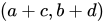
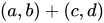
The direct sum is an operation between structures in abstract algebra, a branch of mathematics. It is defined differently but analogously for different kinds of structures. As an example, the direct sum of two abelian groups and is another abelian group consisting of the ordered pairs where and . To add ordered pairs, the sum is defined to be ; in other words, addition is defined coordinate-wise. For example, the direct sum , where is real coordinate space, is the Cartesian plane, . A similar process can be used to form the direct sum of two vector spaces or two modules.
Direct sums can also be formed with any finite number of summands; for example, , provided and are the same kinds of algebraic structures (e.g., all abelian groups, or all vector spaces). That relies on the fact that the direct sum is associative up to isomorphism. That is, for any algebraic structures , , and of the same kind. The direct sum is also commutative up to isomorphism, i.e. for any algebraic structures and of the same kind.


View the full Wikipedia page for Direct sum
↑ Return to Menu

Module (mathematics) in the context of Coproduct

In category theory, the coproduct, or categorical sum, is a construction which includes as examples the disjoint union of sets and of topological spaces, the free product of groups, and the direct sum of modules and vector spaces. The coproduct of a family of objects is essentially the "least specific" object to which each object in the family admits a morphism. It is the category-theoretic dual notion to the categorical product, which means the definition is the same as the product but with all arrows reversed. Despite this seemingly innocuous change in the name and notation, coproducts can be and typically are dramatically different from products within a given category.

View the full Wikipedia page for Coproduct
↑ Return to Menu

Module (mathematics) in the context of Representation of an algebra

In abstract algebra, a representation of an associative algebra is a module for that algebra. Here an associative algebra is a (not necessarily unital) ring. If the algebra is not unital, it may be made so in a standard way (see the adjoint functors page); there is no essential difference between modules for the resulting unital ring, in which the identity acts by the identity mapping, and representations of the algebra.

View the full Wikipedia page for Representation of an algebra
↑ Return to Menu