Mean in the context of Lake retention time


Mean in the context of Lake retention time

Mean Study page number 1 of 3

Play TriviaQuestions Online!

or

Skip to study material about Mean in the context of "Lake retention time"


⭐ Core Definition: Mean

A mean is a quantity representing the "center" of a collection of numbers and is intermediate to the extreme values of the set of numbers. There are several kinds of means (or "measures of central tendency") in mathematics, especially in statistics. Each attempts to summarize or typify a given group of data, illustrating the magnitude and sign of the data set. Which of these measures is most illuminating depends on what is being measured, and on context and purpose.

The arithmetic mean, also known as "arithmetic average", is the sum of the values divided by the number of values. The arithmetic mean of a set of numbers x1, x2, ..., xn is typically denoted using an overhead bar, . If the numbers are from observing a sample of a larger group, the arithmetic mean is termed the sample mean () to distinguish it from the group mean (or expected value) of the underlying distribution, denoted or .

↓ Menu
HINT:

👉 Mean in the context of Lake retention time

Lake retention time (also called the residence time of lake water, or the water age or flushing time) is a calculated quantity expressing the mean time that water (or some dissolved substance) spends in a particular lake. At its simplest, this figure is the result of dividing the lake volume by the flow into or out of the lake. It roughly expresses the amount of time taken for a substance introduced into a lake to flow out of it again. The retention time is particularly important where downstream flooding or pollutants are concerned.

↓ Explore More Topics
In this Dossier

Mean in the context of Confidence interval

In statistics, a confidence interval (CI) is a range of values used to estimate an unknown statistical parameter, such as a population mean. Rather than reporting a single point estimate (e.g. "the average screen time is 3 hours per day"), a confidence interval provides a range, such as 2 to 4 hours, along with a specified confidence level, typically 95%.

A 95% confidence level does not imply a 95% probability that the true parameter lies within a particular calculated interval. The confidence level instead reflects the long-run reliability of the method used to generate the interval. In other words, if the same sampling procedure were repeated 100 times from the same population, approximately 95 of the resulting intervals would be expected to contain the true population mean.

View the full Wikipedia page for Confidence interval
↑ Return to Menu

Mean in the context of Sea level

Mean sea level (MSL, often shortened to sea level) is an average surface level of one or more among Earth's coastal bodies of water from which heights such as elevation may be measured. The global MSL is a type of vertical datum – a standardised geodetic datum – that is used, for example, as a chart datum in cartography and marine navigation, or, in aviation, as the standard sea level at which atmospheric pressure is measured to calibrate altitude and, consequently, aircraft flight levels. A common and relatively straightforward mean sea-level standard is instead a long-term average of tide gauge readings at a particular reference location.

The term above sea level generally refers to the height above mean sea level (AMSL). The term APSL means above present sea level, comparing sea levels in the past with the level today.

View the full Wikipedia page for Sea level
↑ Return to Menu

Mean in the context of Statistical parameter

In statistics, as opposed to its general use in mathematics, a parameter is any quantity of a statistical population that summarizes or describes an aspect of the population, such as a mean or a standard deviation. If a population exactly follows a known and defined distribution, for example the normal distribution, then a small set of parameters can be measured which provide a comprehensive description of the population and can be considered to define a probability distribution for the purposes of extracting samples from this population.

A "parameter" is to a population as a "statistic" is to a sample; that is to say, a parameter describes the true value calculated from the full population (such as the population mean), whereas a statistic is an estimated measurement of the parameter based on a sample (such as the sample mean, which is the mean of gathered data per sampling, called sample). Thus a "statistical parameter" can be more specifically referred to as a population parameter.

View the full Wikipedia page for Statistical parameter
↑ Return to Menu

Mean in the context of Median income

The median income is the income amount that divides a population into two groups, half having an income above that amount, and half having an income below that amount. It may differ from the mean (or average) income. Both of these are ways of understanding income distribution. Median income can be calculated by household income, by personal income, or for specific demographic groups. When taxes and mandatory contributions are subtracted from income, the result is called net or disposable income. The measurement of income from individuals and households, which is necessary to produce statistics such as the median, can pose challenges and yield results inconsistent with aggregate national accounts data. For example, an academic study on the Census income data claims that when correcting for underreporting, U.S. median gross household income was 15% higher in 2010 (table 3).

View the full Wikipedia page for Median income
↑ Return to Menu

Mean in the context of List of countries by wealth per adult

This is a list of countries of the world by wealth per adult, from UBS's Global Wealth Databook. Wealth includes both financial and non-financial assets.

UBS publishes various statistics relevant for calculating net wealth. These figures are influenced by real estate prices, equity market prices, exchange rates, liabilities, debts, adult percentage of the population, human resources, natural resources and capital and technological advancements, which may create new assets or render others worthless in the future.

View the full Wikipedia page for List of countries by wealth per adult
↑ Return to Menu

Mean in the context of Arithmetic mean

In mathematics and statistics, the arithmetic mean ( /ˌærɪθˈmɛtɪk/ arr-ith-MET-ik), arithmetic average, or just the mean or average is the sum of a collection of numbers divided by the count of numbers in the collection. The collection is often a set of results from an experiment, an observational study, or a survey. The term "arithmetic mean" is preferred in some contexts in mathematics and statistics because it helps to distinguish it from other types of means, such as geometric and harmonic.

Arithmetic means are also frequently used in economics, anthropology, history, and almost every other academic field to some extent. For example, per capita income is the arithmetic average of the income of a nation's population.

View the full Wikipedia page for Arithmetic mean
↑ Return to Menu

Mean in the context of Normal distribution

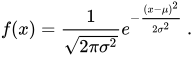
In probability theory and statistics, a normal distribution or Gaussian distribution is a type of continuous probability distribution for a real-valued random variable. The general form of its probability density function is

The parameter is the mean or expectation of the distribution (and also its median and mode), while the parameter is the variance. The standard deviation of the distribution is (sigma). A random variable with a Gaussian distribution is said to be normally distributed and is called a normal deviate.

View the full Wikipedia page for Normal distribution
↑ Return to Menu

Mean in the context of Descriptive statistics

A descriptive statistic (in the count noun sense) is a summary statistic that quantitatively describes or summarizes features from a collection of information, while descriptive statistics (in the mass noun sense) is the process of using and analysing those statistics. Descriptive statistics is distinguished from inferential statistics (or inductive statistics) by its aim to summarize a sample, rather than use the data to learn about the population that the sample of data is thought to represent. This generally means that descriptive statistics, unlike inferential statistics, is not developed on the basis of probability theory, and are frequently nonparametric statistics. Even when a data analysis draws its main conclusions using inferential statistics, descriptive statistics are generally also presented. For example, in papers reporting on human subjects, typically a table is included giving the overall sample size, sample sizes in important subgroups (e.g., for each treatment or exposure group), and demographic or clinical characteristics such as the average age, the proportion of subjects of each sex, the proportion of subjects with related co-morbidities, etc.

Some measures that are commonly used to describe a data set are measures of central tendency and measures of variability or dispersion. Measures of central tendency include the mean, median and mode, while measures of variability include the standard deviation (or variance), the minimum and maximum values of the variables, kurtosis and skewness.

View the full Wikipedia page for Descriptive statistics
↑ Return to Menu

Mean in the context of Standard deviation

In statistics, the standard deviation is a measure of the amount of variation of the values of a variable about its mean. A low standard deviation indicates that the values tend to be close to the mean (also called the expected value) of the set, while a high standard deviation indicates that the values are spread out over a wider range. The standard deviation is commonly used in the determination of what constitutes an outlier and what does not. Standard deviation may be abbreviated SD or std dev, and is most commonly represented in mathematical texts and equations by the lowercase Greek letter σ (sigma), for the population standard deviation, or the Latin letter s, for the sample standard deviation.

The standard deviation of a random variable, sample, statistical population, data set, or probability distribution is the square root of its variance. (For a finite population, variance is the average of the squared deviations from the mean.) A useful property of the standard deviation is that, unlike the variance, it is expressed in the same unit as the data. Standard deviation can also be used to calculate standard error for a finite sample, and to determine statistical significance.

View the full Wikipedia page for Standard deviation
↑ Return to Menu

Mean in the context of Compound annual growth rate

Compound annual growth rate (CAGR) is a business, economics and investing term representing the mean annualized growth rate for compounding values over a given time period. CAGR smoothes the effect of volatility of periodic values that can render arithmetic means less meaningful. It is particularly useful to compare growth rates of various data values, such as revenue growth of companies, or of economic values, over time.

View the full Wikipedia page for Compound annual growth rate
↑ Return to Menu

Mean in the context of Sample mean

The sample mean (sample average) or empirical mean (empirical average), and the sample covariance or empirical covariance are statistics computed from a sample of data on one or more random variables.

The sample mean is the average value (or mean value) of a sample of numbers taken from a larger population of numbers, where "population" indicates not number of people but the entirety of relevant data, whether collected or not. A sample of 40 companies' sales from the Fortune 500 might be used for convenience instead of looking at the population, all 500 companies' sales. The sample mean is used as an estimator for the population mean, the average value in the entire population, where the estimate is more likely to be close to the population mean if the sample is large and representative. The reliability of the sample mean is estimated using the standard error, which in turn is calculated using the variance of the sample. If the sample is random, the standard error falls with the size of the sample and the sample mean's distribution approaches the normal distribution as the sample size increases.

View the full Wikipedia page for Sample mean
↑ Return to Menu

Mean in the context of Average

An average of a collection or group is a value that is most central or most common in some sense, and represents its overall position.

In mathematics, especially in colloquial usage, it most commonly refers to the arithmetic mean, so the "average" of the list of numbers [2, 3, 4, 7, 9] is generally considered to be (2+3+4+7+9)/5 = 25/5 = 5. In situations where the data is skewed or has outliers, and it is desired to focus on the main part of the group rather than the long tail, "average" often instead refers to the median; for example, the average personal income is usually given as the median income, so that it represents the majority of the population rather than being overly influenced by the much higher incomes of the few rich people. In certain real-world scenarios, such computing the average speed from multiple measurements taken over the same distance, the average used is the harmonic mean. In situations where a histogram or probability density function is being referenced, the "average" could instead refer to the mode. Other statistics that can be used as an average include the mid-range and geometric mean, but they would rarely, if ever, be colloquially referred to as "the average".

View the full Wikipedia page for Average
↑ Return to Menu

Mean in the context of Stationary process

In mathematics and statistics, a stationary process (also called a strict/strictly stationary process or strong/strongly stationary process) is a stochastic process whose statistical properties, such as mean and variance, do not change over time. More formally, the joint probability distribution of the process remains the same when shifted in time. This implies that the process is statistically consistent across different time periods. Because many statistical procedures in time series analysis assume stationarity, non-stationary data are frequently transformed to achieve stationarity before analysis.

A common cause of non-stationarity is a trend in the mean, which can be due to either a unit root or a deterministic trend. In the case of a unit root, stochastic shocks have permanent effects, and the process is not mean-reverting. With a deterministic trend, the process is called trend-stationary, and shocks have only transitory effects, with the variable tending towards a deterministically evolving mean. A trend-stationary process is not strictly stationary but can be made stationary by removing the trend. Similarly, processes with unit roots can be made stationary through differencing.

View the full Wikipedia page for Stationary process
↑ Return to Menu

Mean in the context of Regression toward the mean

In statistics, regression toward the mean (also called regression to the mean, reversion to the mean, and reversion to mediocrity) is the phenomenon where if one sample of a random variable is extreme, the next sampling of the same random variable is likely to be closer to its mean. Furthermore, when many random variables are sampled and the most extreme results are intentionally picked out, it refers to the fact that (in many cases) a second sampling of these picked-out variables will result in "less extreme" results, closer to the initial mean of all of the variables.

Mathematically, the strength of this "regression" effect is dependent on whether or not all of the random variables are drawn from the same distribution, or if there are genuine differences in the underlying distributions for each random variable. In the first case, the "regression" effect is statistically likely to occur, but in the second case, it may occur less strongly or not at all.

View the full Wikipedia page for Regression toward the mean
↑ Return to Menu